

Tennis Elbow
Tennis elbow is a common cause of pain around the outside of the elbow. Despite its name, you do not have to play tennis to develop it.
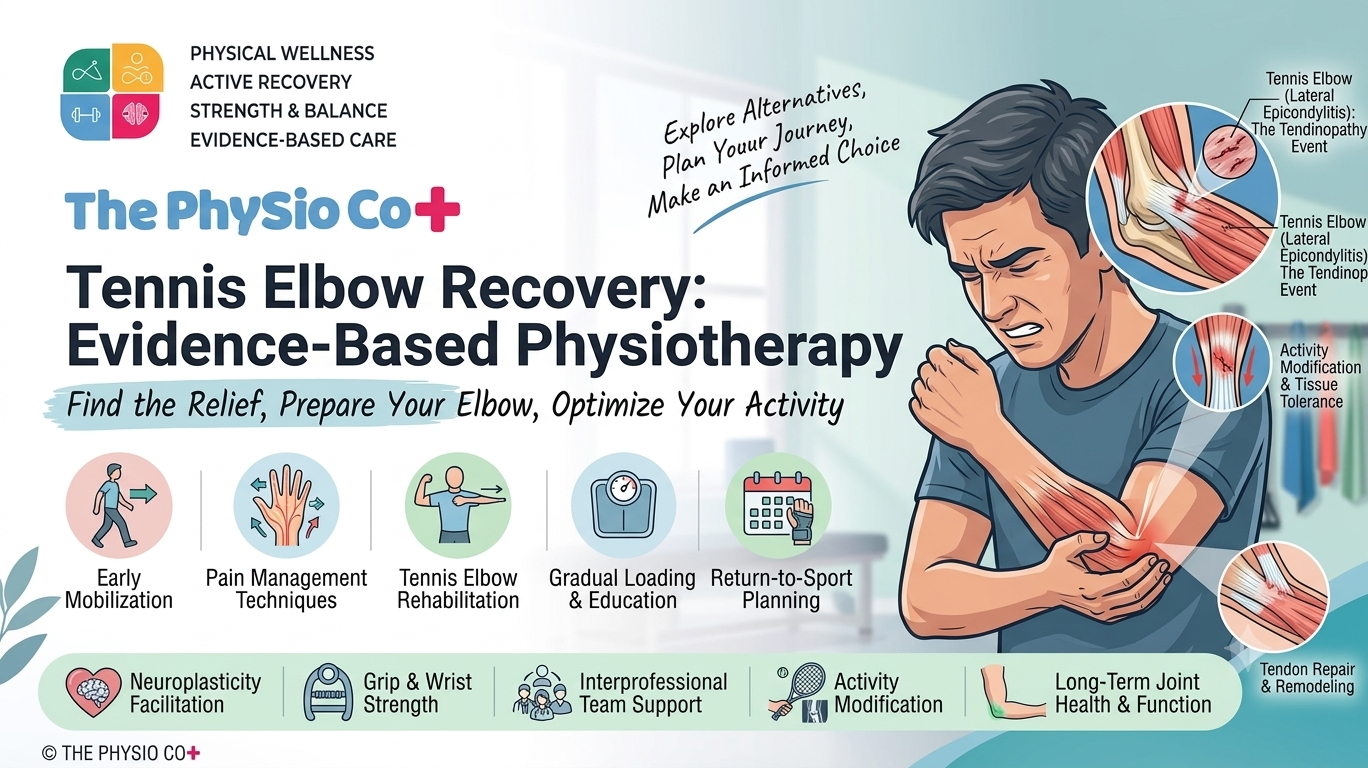
Tennis elbow, medically known as lateral elbow tendinopathy, commonly develops when the tendons attaching the forearm muscles to the outside of the elbow are repeatedly exposed to loads that exceed their current capacity.
It can affect people who play sports, work at a computer, use tools, lift objects frequently or perform repetitive hand and wrist movements.
If you are searching for tennis elbow physiotherapy in Delhi, understanding what causes the condition and how rehabilitation works can help you choose the right approach.
What Is Tennis Elbow?
Tennis elbow is commonly associated with pain and tenderness around the outer side of the elbow.
The condition primarily involves the tendons of the wrist and finger extensor muscles, particularly the tendon associated with the extensor carpi radialis brevis.
The term lateral elbow tendinopathy is often preferred because the condition is not simply an acute inflammation of the tendon.
Instead, persistent tendon pain can involve changes in tendon structure, load tolerance and the way the nervous system responds to mechanical loading.
What Causes Tennis Elbow?
Tennis elbow often develops when the forearm tendons are exposed to repeated or excessive loading without sufficient time or capacity to adapt.
Common contributing activities include:
- Repetitive gripping
- Tennis and racquet sports
- Weight training
- Manual work
- Using tools
- Repetitive computer or mouse use
- Lifting heavy objects
- Repeated wrist extension
- Sudden increases in exercise volume
It is not necessarily one single movement that causes the problem.
Sometimes symptoms develop gradually after a change in workload.
For example, someone may increase gym training, start playing tennis more frequently or take on a new manual job.
Who Can Develop Tennis Elbow?
Anyone can develop lateral elbow tendinopathy.
It is commonly seen in:
- Racquet-sport players
- Gym-goers
- Office workers
- Manual workers
- Electricians
- Carpenters
- Mechanics
- Painters
- People involved in repetitive lifting
- People performing repetitive gripping activities
The condition can also occur without an obvious single injury.
What Are the Symptoms of Tennis Elbow?
The most common symptom is pain on the outside of the elbow.
You may experience pain when:
- Gripping an object
- Opening a jar
- Shaking hands
- Lifting a cup
- Carrying a bag
- Using a screwdriver
- Typing or using a mouse for prolonged periods
- Playing tennis
- Performing wrist extension exercises
Other symptoms may include:
- Tenderness around the outer elbow
- Reduced grip strength
- Forearm discomfort
- Pain with resisted wrist extension
- Pain during lifting
- Difficulty performing repetitive activities
Symptoms can develop gradually rather than appearing suddenly.
Does Tennis Elbow Cause Weak Grip?
It can.
People with lateral elbow tendinopathy may experience reduced grip strength, particularly when gripping causes pain.
Sometimes the actual muscle capacity is not severely reduced, but pain inhibits the person’s ability to generate force comfortably.
This is one reason progressive strengthening is an important part of rehabilitation.
Tennis Elbow vs Golfer’s Elbow
These two conditions are often confused.
| Feature | Tennis Elbow | Golfer’s Elbow |
|---|---|---|
| Medical term | Lateral elbow tendinopathy | Medial elbow tendinopathy |
| Main pain location | Outside of elbow | Inside of elbow |
| Commonly involved muscles | Wrist/finger extensors | Wrist/finger flexors |
| Common aggravating activity | Gripping and wrist extension | Gripping and wrist flexion |
| Common sports association | Tennis/racquet sports | Golf/throwing sports |
Both conditions are forms of elbow tendinopathy, but they affect different areas of the elbow.
How Is Tennis Elbow Diagnosed?
Tennis elbow is generally diagnosed clinically.
A physiotherapist or healthcare professional may assess:
- Pain location
- Symptom history
- Grip strength
- Wrist movement
- Elbow movement
- Forearm strength
- Pain with resisted movements
- Functional activities
Specific clinical tests may reproduce the patient’s familiar pain.
Imaging is not always required.
Ultrasound or MRI may sometimes be considered when the diagnosis is uncertain, symptoms are persistent or another condition needs to be ruled out.
Can Tennis Elbow Heal on Its Own?
Yes, many cases improve with time and appropriate load management.
However, simply resting the arm indefinitely is usually not the long-term solution.
Tendons adapt to appropriate loading.
The goal is therefore generally to find the right balance between:
Reducing excessive aggravating load
and
Gradually rebuilding tendon capacity.
This is where physiotherapy can be particularly useful.
How Is Tennis Elbow Treated?
Treatment should be based on the person’s symptoms, activity demands and functional limitations.
A physiotherapy program may include:
1. Activity Modification
The first step may be reducing or modifying activities that repeatedly aggravate the tendon.
This does not necessarily mean stopping all use of the arm.
For example, instead of completely avoiding lifting, the physiotherapist may modify:
- Load
- Repetitions
- Grip position
- Wrist position
- Frequency
- Recovery time
2. Progressive Strengthening
Progressive resistance exercise is one of the key components of rehabilitation.
Exercises may target:
- Wrist extensors
- Wrist flexors
- Forearm muscles
- Grip
- Shoulder muscles
- Scapular muscles
The load should be progressed according to symptoms and functional response.
3. Isometric Exercises
Isometric exercises involve producing muscle force without significant joint movement.
They may be introduced when dynamic loading is initially uncomfortable.
Examples include:
- Isometric wrist extension
- Isometric grip exercises
- Isometric forearm exercises
They are not necessarily the final rehabilitation exercise.
As tolerance improves, rehabilitation generally progresses toward dynamic resistance training.
4. Eccentric and Progressive Resistance Exercises
Eccentric loading has historically received considerable attention in tendon rehabilitation.
However, current rehabilitation approaches generally emphasize progressive resistance loading, which can include both eccentric and concentric muscle actions.
Exercises may include:
- Wrist extension with a dumbbell
- Controlled wrist lowering
- Resistance-band exercises
- Forearm strengthening
- Grip strengthening
5. Shoulder and Upper-Limb Strength
The elbow does not work in isolation.
Depending on the individual’s assessment, rehabilitation may also address:
- Shoulder strength
- Scapular control
- Upper-limb movement
- Grip mechanics
- Overall lifting technique
Tennis Elbow Exercises
Exercises should be selected according to your current symptoms and strength.
Some commonly used exercises include:
Wrist Extension With Resistance
- Sit comfortably with your forearm supported.
- Hold a light dumbbell.
- Keep your forearm stable.
- Slowly extend your wrist.
- Lower the weight in a controlled manner.
- Repeat for the prescribed number of repetitions.
The load should be appropriate for your current capacity.
Grip Strengthening
- Hold a soft ball or appropriate resistance device.
- Squeeze gradually.
- Hold briefly.
- Relax slowly.
- Repeat.
Avoid repeatedly squeezing very hard if it significantly increases your symptoms.
Forearm Pronation and Supination
- Hold a light object or dumbbell.
- Keep the elbow close to your body.
- Slowly rotate the forearm palm-up and palm-down.
- Perform controlled repetitions.
This can help progressively load the forearm musculature.
Resistance-Band Wrist Exercises
Resistance bands can be used to progressively strengthen wrist and forearm muscles.
The exact resistance and repetitions should be adjusted according to symptoms and rehabilitation stage.
Should You Rest Completely With Tennis Elbow?
Usually, complete rest is not necessary.
Reducing activities that significantly aggravate symptoms can be helpful during the painful stage.
However, prolonged avoidance of loading can reduce physical capacity.
A better approach is often relative rest followed by progressive loading.
For example:
Instead of stopping all lifting:
Reduce the weight → modify the grip → reduce repetitions → gradually rebuild strength.
Does a Tennis Elbow Brace Help?
A counterforce brace or wrist support may provide short-term symptom relief for some people during activities.
However, a brace should generally be viewed as an adjunct, not the primary treatment.
Long-term improvement usually requires appropriate load management and progressive rehabilitation.
Can Physiotherapy Help Tennis Elbow?
Yes.
Physiotherapy can help by addressing:
- Pain
- Grip weakness
- Forearm strength
- Load tolerance
- Wrist function
- Work-related aggravating factors
- Sport-specific demands
- Return to normal activities
The treatment plan may combine education, exercise and selected hands-on techniques depending on the individual’s presentation.
Exercise-based rehabilitation is generally an important component of management for lateral elbow tendinopathy.
What About Dry Needling or Manual Therapy?
Manual therapy and techniques such as dry needling may sometimes be used as adjuncts to an active rehabilitation program.
They should not replace progressive strengthening and load management.
If used, their role is generally to help manage symptoms or improve short-term function so that the person can participate more comfortably in rehabilitation.
How Long Does Tennis Elbow Take to Recover?
Recovery varies considerably.
Some people improve within weeks, while persistent cases can take several months.
Factors that may affect recovery include:
- Duration of symptoms
- Severity
- Work demands
- Training load
- Strength deficits
- Sleep and recovery
- Previous elbow problems
- Ability to modify aggravating activities
- Consistency with rehabilitation
A key point is that tendon rehabilitation is usually a gradual process.
Improvement does not necessarily happen in a straight line.
Can You Play Tennis With Tennis Elbow?
It depends on symptom severity and how the elbow responds to activity.
You may need to temporarily modify:
- Playing duration
- Number of sessions
- Stroke volume
- Grip
- Equipment
- Rest intervals
Returning to full tennis should be progressive.
For competitive players, rehabilitation should eventually include sport-specific loading and repeated gripping activities before full return.
How Can Tennis Elbow Be Prevented?
You cannot eliminate the risk completely, but several strategies may help:
- Increase training gradually
- Avoid sudden increases in workload
- Strengthen the forearm
- Maintain overall upper-limb strength
- Use appropriate technique
- Take recovery breaks during repetitive work
- Avoid excessive gripping when unnecessary
- Gradually build tolerance to sport-specific loads
For athletes, training load should be increased progressively rather than making sudden large changes.
When Should You See a Physiotherapist?
Consider getting assessed if:
- Elbow pain persists for several weeks
- Grip strength is decreasing
- Pain interferes with work
- You cannot exercise normally
- Tennis or another sport aggravates your symptoms
- Pain is worsening despite modifying activity
- Symptoms keep returning
A physiotherapist can determine whether your symptoms are consistent with lateral elbow tendinopathy or whether another condition needs to be considered.
When Is Elbow Pain NOT Typical Tennis Elbow?
Not every outer-elbow pain is tennis elbow.
Other conditions can cause elbow or forearm symptoms.
Seek medical assessment if you have:
- Significant trauma
- Severe swelling
- Obvious deformity
- Numbness or persistent tingling
- Significant loss of elbow movement
- Severe weakness
- Neck pain associated with arm symptoms
- Symptoms that are not improving
A proper assessment is important when the presentation is unusual or persistent.
Tennis Elbow Physiotherapy in Delhi
If you are looking for tennis elbow physiotherapy in Delhi, treatment should focus on identifying the activities contributing to your symptoms and gradually restoring the capacity of the affected tissues.
At The Physio Co+, physiotherapy rehabilitation can include assessment of elbow and forearm function, activity modification, progressive strengthening and return-to-work or return-to-sport rehabilitation.
For patients in and around Vasant Kunj, the rehabilitation program can be tailored according to symptoms, occupation, exercise routine and activity goals.
Related services: Sports Injury Physiotherapy | Pain Management Physiotherapy | Physiotherapy in Delhi
Frequently Asked Questions
What is tennis elbow?
Tennis elbow, or lateral elbow tendinopathy, is a condition commonly associated with pain around the outside of the elbow involving the forearm extensor tendons.
Can tennis elbow happen without playing tennis?
Yes. Repetitive gripping, lifting, manual work, gym training and other activities can also contribute to tennis elbow.
Can physiotherapy cure tennis elbow?
Physiotherapy can help manage symptoms and restore strength and load tolerance. Recovery varies between individuals, and no treatment can guarantee a specific outcome.
How long does tennis elbow take to heal?
Recovery varies. Mild cases may improve relatively quickly, while persistent tendinopathy can take several months to settle.
Should I stop exercising if I have tennis elbow?
Not necessarily. Activities that significantly aggravate symptoms may need to be modified, while appropriate strengthening is generally an important part of rehabilitation.
Are tennis elbow exercises safe?
Exercises should be appropriately dosed. Mild discomfort during rehabilitation can sometimes occur, but exercises that produce a significant or progressively worsening response should be reviewed.
Is a tennis elbow brace useful?
A brace may provide short-term symptom relief for some people, but it should generally complement rather than replace progressive rehabilitation.
Can I get tennis elbow from using a laptop?
Prolonged computer use alone does not automatically cause tennis elbow. However, repetitive wrist and hand activity may contribute to symptoms in some people, particularly when combined with other loading factors.
Does tennis elbow require surgery?
Most cases are initially managed conservatively with education, activity modification and rehabilitation. Surgery is generally considered only in selected persistent cases after appropriate non-operative management.
Key Takeaway
Tennis elbow is not limited to tennis players.
It is commonly associated with repetitive or excessive loading of the forearm tendons, leading to pain around the outside of the elbow and sometimes reduced grip strength.
The most important part of rehabilitation is usually not simply resting the elbow.
It is finding the right level of activity and progressively rebuilding the tendon and muscle’s capacity to tolerate load.
If you have persistent outer-elbow pain, a physiotherapy assessment can help determine the likely cause and develop an appropriate rehabilitation plan.
If you are searching for tennis elbow physiotherapy in Delhi, tennis elbow treatment in Delhi or physiotherapy for elbow pain in Vasant Kunj, professional assessment can help guide your recovery.
References
- American Academy of Orthopaedic Surgeons. Tennis Elbow (Lateral Epicondylitis). OrthoInfo.
- Coombes BK, Bisset L, Vicenzino B. Management of lateral elbow tendinopathy: one size does not fit all. Journal of Orthopaedic & Sports Physical Therapy.
- Bisset L, Coombes B. Tennis elbow. BMJ Clinical Evidence.
- British Journal of Sports Medicine. Evidence and clinical guidance relating to tendinopathy management and progressive loading.
- American Physical Therapy Association / JOSPT. Clinical guidance relating to lateral elbow pain and rehabilitation.