



Urinary Incontinence & Pelvic Floor Physiotherapy
Leaking urine when you cough, sneeze, laugh, exercise or suddenly feel the need to use the bathroom is more common than many people realise.
But common does not mean that you simply have to live with it.
Urinary incontinence can affect women at different stages of life, including during pregnancy, after childbirth, around menopause and later in life. It can also affect daily activities, exercise, sleep, confidence and social life.
Pelvic floor physiotherapy can be an important part of managing certain types of urinary incontinence.
If you are searching for pelvic floor physiotherapy in Delhi or urinary incontinence physiotherapy in Delhi, this guide explains what urinary incontinence is, the different types, pelvic floor exercises, bladder training and what to expect from physiotherapy.
What Is Urinary Incontinence?
Urinary incontinence means involuntary leakage of urine.
It can happen occasionally or regularly.
You may notice leakage when:
- Coughing
- Sneezing
- Laughing
- Running
- Jumping
- Lifting
- Exercising
Some people experience a sudden, strong urge to urinate followed by leakage.
Others may experience a combination of both.
Urinary leakage is not something you should feel embarrassed about discussing with a healthcare professional.
What Is the Pelvic Floor?
The pelvic floor is a group of muscles and connective tissues located at the bottom of the pelvis.
These muscles help support the pelvic organs and are involved in:
- Bladder control
- Bowel control
- Sexual function
- Pelvic stability
The pelvic floor needs to do more than simply “squeeze.”
It needs to contract when required, relax when required and coordinate with breathing and movement.
This is one reason why pelvic floor physiotherapy is more than simply doing repeated Kegel exercises.
What Are the Different Types of Urinary Incontinence?
The two common types are stress urinary incontinence and urge urinary incontinence.
Some people have a combination, known as mixed urinary incontinence.
1. Stress Urinary Incontinence
Stress urinary incontinence happens when urine leaks during activities that increase pressure inside the abdomen.
For example:
- Coughing
- Sneezing
- Laughing
- Running
- Jumping
- Lifting
- Exercising
It does not mean that you are emotionally stressed.
The word “stress” refers to physical pressure placed on the bladder and pelvic floor.
2. Urgency Urinary Incontinence
Urgency urinary incontinence occurs when you experience a sudden, difficult-to-control urge to urinate followed by leakage.
You may also notice:
- Frequent trips to the bathroom
- Strong urgency
- Getting up repeatedly at night to urinate
Bladder training and lifestyle strategies may be part of management for urgency symptoms. NICE recommends supported bladder retraining for women with urinary frequency, urgency or mixed incontinence.
3. Mixed Urinary Incontinence
Some women experience both:
Stress leakage + Urgency leakage
This is called mixed urinary incontinence.
Treatment is usually tailored to which symptoms are most troublesome.
What Causes Urinary Incontinence?
There is rarely just one cause.
Factors that can contribute include:
- Pregnancy
- Childbirth
- Pelvic floor muscle changes
- Menopause
- Increasing age
- Previous pelvic surgery
- Constipation
- Persistent coughing
- Higher body weight
- High-impact exercise
- Certain neurological conditions
- Bladder-related conditions
Having one of these risk factors does not mean that you will definitely develop urinary incontinence.
Urinary Incontinence During Pregnancy
Pregnancy places additional demands on the pelvic floor.
As the baby grows, pressure within the abdomen and pelvis changes, while hormonal and physical changes can also affect the pelvic floor.
Some women experience urine leakage during pregnancy, particularly when:
- Coughing
- Sneezing
- Exercising
- Laughing
Pelvic floor muscle training is recommended during pregnancy and after childbirth to help prevent and manage pelvic floor symptoms.
Urinary Incontinence After Childbirth
Urine leakage can occur after vaginal or assisted birth and can also occur after other types of delivery.
The pelvic floor may need time to recover after pregnancy and childbirth.
Postnatal physiotherapy can assess:
- Pelvic floor contraction
- Pelvic floor relaxation
- Abdominal function
- Breathing
- Pelvic control
- Urinary symptoms
- Return to exercise
You do not have to simply accept urinary leakage as a permanent consequence of having a baby.
Can Menopause Cause Urinary Leakage?
Menopause can be associated with changes in the urinary and pelvic tissues.
Some women notice changes such as:
- Increased urgency
- Increased frequency
- Urinary leakage
- Recurrent urinary symptoms
Pelvic floor physiotherapy may be one part of a broader management plan.
Medical assessment may also be appropriate depending on the symptoms.
How Can Pelvic Floor Physiotherapy Help?
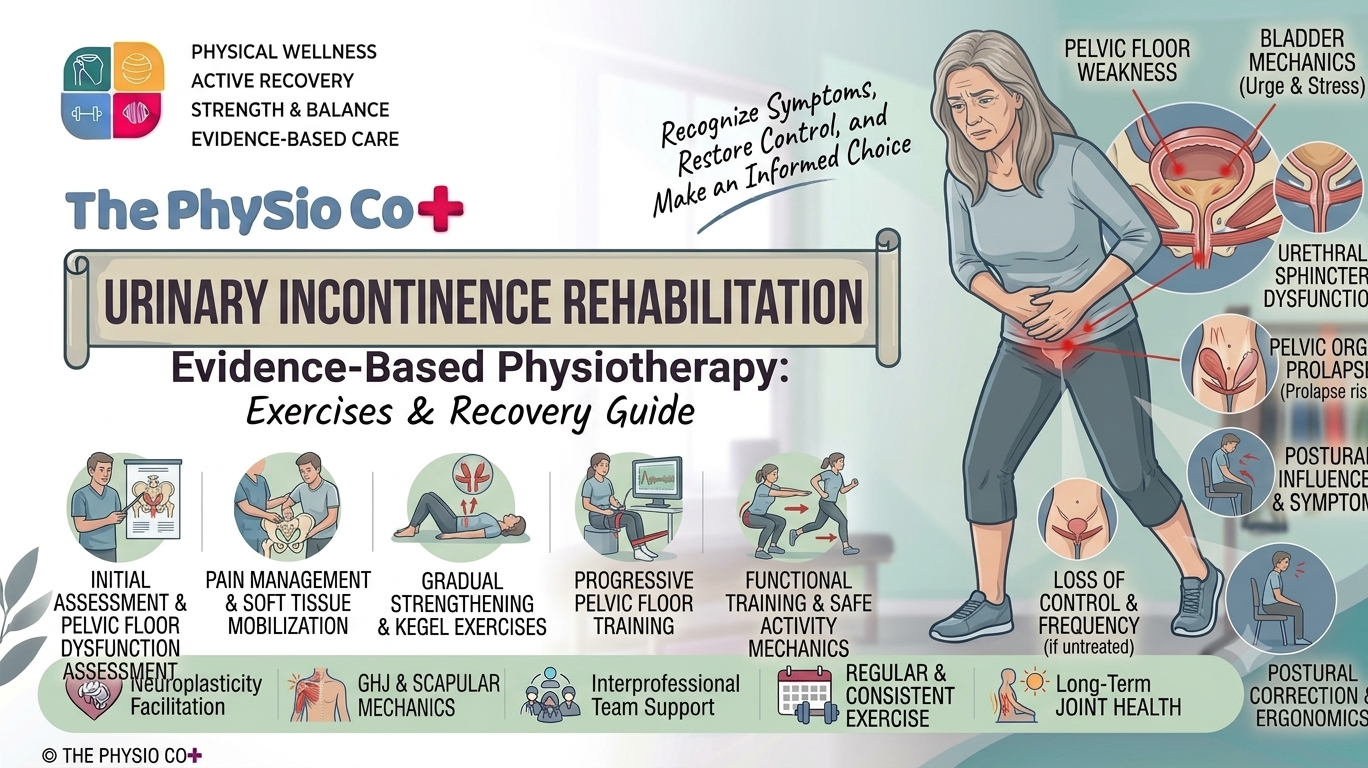
Pelvic floor physiotherapy begins with an assessment rather than immediately prescribing exercises.
A physiotherapist may look at:
- Your urinary symptoms
- When leakage occurs
- Frequency of urination
- Urgency
- Pelvic floor muscle contraction
- Ability to relax the muscles
- Breathing patterns
- Abdominal and pelvic control
- Exercise habits
- Pregnancy and childbirth history
NICE recommends supervised pelvic floor muscle training for women with stress or mixed urinary incontinence and recommends that the programme be tailored to the person’s ability to contract and relax the pelvic floor.
What Happens During a Pelvic Floor Physiotherapy Assessment?
Your first appointment may involve a detailed discussion about your symptoms.
You may be asked:
- When does leakage happen?
- How often do you urinate?
- Do you experience urgency?
- Do you leak during exercise?
- Do you wake at night to urinate?
- Have you been pregnant or given birth?
- Do you experience pelvic pain?
- Do you have difficulty emptying your bladder?
A bladder diary may sometimes be useful for understanding patterns.
Depending on the situation, the physiotherapist may also assess the pelvic floor muscles.
An internal pelvic floor assessment is not automatically required for everyone and should only be performed when appropriate, with explanation and consent.
Pelvic Floor Exercises for Urinary Incontinence
Pelvic floor muscle training can help many women with stress and mixed urinary incontinence.
However, the exercise programme should be individualised.
NICE recommends a supervised programme for at least 3 months for women with stress or mixed urinary incontinence.
1. Pelvic Floor Contractions
A basic pelvic floor contraction involves gently tightening the muscles used to prevent passing urine or gas.
The sensation should be a controlled lift and squeeze rather than pushing down.
Try to avoid:
- Holding your breath
- Tightening your buttocks excessively
- Clenching your thighs
- Bearing down
The correct technique is more important than doing hundreds of repetitions.
2. Long Holds
Once you can perform a correct pelvic floor contraction, you may gradually work on holding the contraction for longer.
The duration should be based on your current ability.
3. Quick Contractions
The pelvic floor also needs to respond quickly.
Short contractions may be used to train the muscles to react to sudden increases in pressure, such as coughing or sneezing.
4. Relaxation
Pelvic floor training is not only about strengthening.
The muscles also need to relax properly.
A physiotherapist may teach you how to coordinate:
Breathe → Relax → Contract → Release
This is particularly important when the pelvic floor is tense or difficult to relax.
Should You Do Kegels Every Day?
Pelvic floor exercises are often called Kegels, but simply doing as many contractions as possible is not necessarily the right approach.
A good programme should consider:
- Strength
- Endurance
- Speed
- Relaxation
- Coordination
- Your symptoms
NICE recommends that pelvic floor muscle training programmes be supervised and tailored to the individual’s ability and needs.
What Is Bladder Training?
Bladder training is a structured approach that helps you gradually increase the time between bathroom visits and learn strategies for managing urgency.
It may be useful for women with:
- Urgency
- Frequent urination
- Urgency urinary incontinence
- Mixed urinary incontinence
NICE recommends bladder training for at least 6 weeks as first-line treatment for women with urgency or mixed urinary incontinence.
Lifestyle Changes That May Help
Lifestyle changes can be useful alongside pelvic floor rehabilitation.
Depending on your symptoms, these may include:
Caffeine
Coffee, tea, energy drinks and other caffeinated drinks may worsen urgency in some people.
NICE recommends considering caffeine reduction for women with overactive bladder symptoms.
Fluid Intake
Drinking too little is not necessarily better.
Very high or very low fluid intake can affect urinary symptoms.
Your fluid intake should be appropriate for your individual needs.
Constipation
Straining and constipation can increase pressure on the pelvic floor.
Maintaining healthy bowel habits can therefore be an important part of pelvic health.
Can Exercise Make Urinary Leakage Worse?
Some activities can temporarily increase leakage, particularly if the pelvic floor has not yet adapted to the physical demand.
Examples include:
- Running
- Jumping
- Skipping
- High-impact workouts
- Heavy lifting
This does not automatically mean that you need to stop exercising.
Instead, rehabilitation can help you gradually build your capacity for these activities.
Can You Run With Urinary Incontinence?
Yes.
Urinary leakage during running is common among some women, particularly after pregnancy and childbirth.
Rather than permanently avoiding running, rehabilitation can focus on:
- Pelvic floor strength
- Pelvic floor coordination
- Breathing
- Hip and trunk strength
- Running load
- Gradual return to impact
The aim is to help your body tolerate the activity rather than simply telling you to stop.
Can Pelvic Floor Physiotherapy Help With Postnatal Urinary Leakage?
Yes.
Pelvic floor muscle training is an important part of postnatal pelvic health care.
NICE encourages pelvic floor muscle training during pregnancy and after childbirth and recommends supervised training in specific postnatal situations.
Postnatal rehabilitation may also address:
- Abdominal weakness
- Pelvic discomfort
- Scar-related concerns
- Return to exercise
- Running
- Strength training
- Posture and movement
Is Pelvic Floor Physiotherapy Only for Women After Pregnancy?
No.
Pelvic floor physiotherapy can be relevant to women who have never been pregnant.
It may help with symptoms related to:
- Stress urinary incontinence
- Urgency
- Mixed urinary incontinence
- Pelvic floor weakness
- Pelvic floor overactivity
- Pelvic pain
- Exercise-related leakage
Pelvic floor problems can occur at different stages of life.
Can a Weak Pelvic Floor Cause Urinary Leakage?
It can contribute to stress urinary incontinence.
However, urinary symptoms are not always caused by weakness alone.
Some people have difficulty relaxing or coordinating their pelvic floor muscles.
That is why strengthening exercises should not be prescribed blindly to everyone with urinary symptoms.
How Long Does Pelvic Floor Physiotherapy Take to Work?
There is no fixed timeline.
Pelvic floor muscle training generally requires consistent practice over time.
NICE recommends at least 3 months of supervised pelvic floor muscle training for stress or mixed urinary incontinence.
Some people notice improvements earlier, while others need longer.
Consistency matters.
Can Urinary Incontinence Be Completely Cured?
It depends on the cause and type of incontinence.
Many people experience significant improvement with appropriate treatment.
However, no treatment can guarantee complete elimination of symptoms for everyone.
The aim may be to:
- Reduce leakage
- Improve bladder control
- Return to exercise
- Improve confidence
- Reduce bathroom frequency
- Improve quality of life
When Should You See a Pelvic Floor Physiotherapist?
Consider an assessment if you:
- Leak urine when coughing or sneezing
- Leak while exercising
- Leak while running or jumping
- Have a sudden urge to urinate
- Frequently need to use the bathroom
- Wake repeatedly at night to urinate
- Experience urinary leakage after childbirth
- Avoid activities because of bladder leakage
- Feel unsure how to perform pelvic floor exercises
You do not have to wait until symptoms become severe.
When Should You See a Doctor?
Urinary leakage should sometimes be assessed medically, particularly when symptoms are new, unusual or associated with other problems.
Seek medical assessment if you have:
- Blood in the urine
- Persistent bladder pain
- Difficulty emptying your bladder
- Recurrent or persistent urinary infections
- Significant pelvic pain
- New neurological symptoms
- Sudden major changes in bladder control
NICE also identifies symptoms such as persistent bladder pain, voiding difficulty, suspected neurological disease and previous pelvic surgery as reasons that specialist assessment may be appropriate.
Urinary Incontinence & Pelvic Floor Physiotherapy in Delhi
If you are searching for pelvic floor physiotherapy in Delhi, urinary incontinence physiotherapy in Delhi, pelvic floor physiotherapy in Vasant Kunj or women’s health physiotherapy in Delhi, treatment should begin with understanding your symptoms rather than simply prescribing generic Kegel exercises.
At The Physio Co+, pelvic floor rehabilitation can be tailored around your symptoms, activity level, pregnancy or postnatal stage and individual goals.
Treatment may include:
- Pelvic floor muscle training
- Pelvic floor relaxation and coordination
- Bladder training
- Breathing exercises
- Core and pelvic rehabilitation
- Exercise progression
- Return-to-running or fitness guidance
The aim is to help you regain confidence and control while returning to the activities that matter to you.
Related services: Women’s Health Physiotherapy | Pelvic Floor Physiotherapy | Postnatal Physiotherapy | Clinical Pilates
Frequently Asked Questions
What is urinary incontinence?
Urinary incontinence is the involuntary leakage of urine. It can happen during activities such as coughing and exercise or with a sudden urge to urinate.
Can pelvic floor physiotherapy help urinary leakage?
Yes. Supervised pelvic floor muscle training is recommended as a first-line treatment for women with stress or mixed urinary incontinence.
Are Kegel exercises enough?
Not necessarily. Treatment may involve strengthening, relaxation, coordination, bladder training and lifestyle changes depending on the type of symptoms.
Can urinary incontinence happen after childbirth?
Yes. Pregnancy and childbirth can affect pelvic floor function and contribute to urinary leakage.
Can I exercise if I have urinary incontinence?
Usually, yes. Exercise may need to be modified initially, followed by a gradual progression as pelvic floor and whole-body capacity improves.
How long does pelvic floor physiotherapy take?
Improvement varies. For stress or mixed urinary incontinence, NICE recommends a supervised pelvic floor muscle training programme lasting at least three months.
Can urinary incontinence happen without pregnancy?
Yes. Urinary incontinence can occur in women who have never been pregnant.
Should I stop drinking water if I leak urine?
No. Reducing fluids excessively is not a good general strategy. Fluid intake should be appropriate for your individual needs.
Does coffee make urinary urgency worse?
Caffeine can worsen urgency symptoms in some people, which is why NICE recommends considering caffeine reduction for women with overactive bladder symptoms.
Is urinary leakage a normal part of ageing?
Urinary leakage becomes more common with age, but it should not simply be accepted as something that cannot be managed.
Key Takeaway
Urinary leakage is common, but you do not have to simply live with it.
The right treatment depends on the type and cause of your symptoms.
Pelvic floor physiotherapy may include:
Assessment → Pelvic floor training → Relaxation & coordination → Bladder training → Lifestyle changes → Gradual return to exercise
And importantly, pelvic floor rehabilitation is not just about squeezing the pelvic floor harder.
The goal is to help the pelvic floor work effectively when you need it and relax when you need it.
If you are looking for pelvic floor physiotherapy in Delhi, urinary incontinence physiotherapy in Delhi or women’s health physiotherapy in Vasant Kunj, an individual assessment can help determine the most appropriate approach.
References
- National Institute for Health and Care Excellence (NICE). Urinary incontinence and pelvic organ prolapse in women: management (NG123).
- National Institute for Health and Care Excellence (NICE). Pelvic floor dysfunction: prevention and non-surgical management (NG210).
- NICE. Urinary incontinence in women: Quality Standard QS77.
- NICE. Quality statement: Bladder training for urinary urgency and mixed urinary incontinence.
- NICE. Rationale and impact: Pelvic floor muscle training for urinary incontinence.
- NICE. Urinary incontinence in neurological disease: assessment and management (CG148).