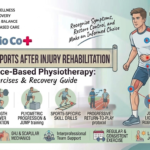


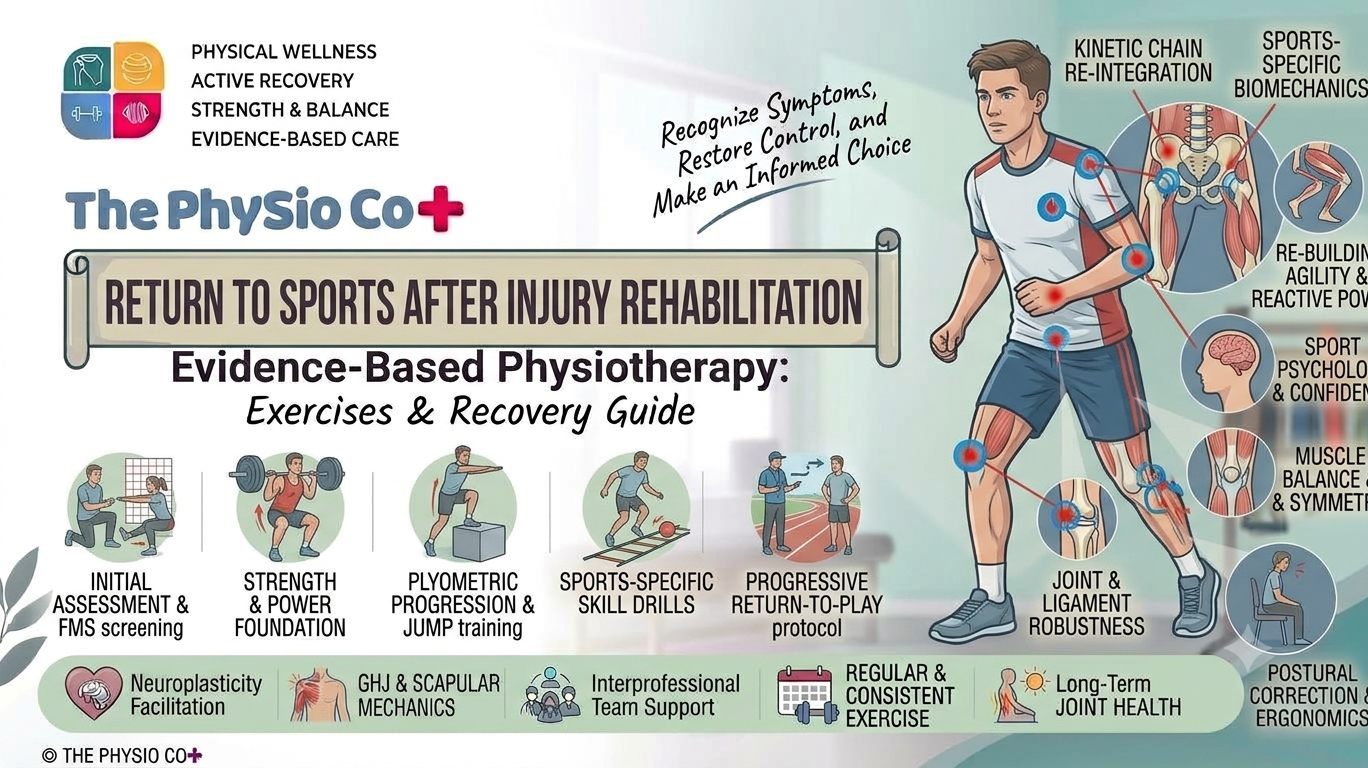

Return to Sport After Injury.
Getting back to sport after an injury is about more than simply feeling better.
An athlete may be able to walk without pain but still lack the strength, balance, coordination, confidence or sport-specific capacity needed to safely return to training or competition.
That is why return-to-sport physiotherapy uses a combination of clinical assessment, functional testing and progressive sport-specific activities rather than relying on a single test or a fixed number of weeks.
Current sports physiotherapy consensus describes return to sport as a continuum rather than one single moment: returning to participation, returning to sport, and eventually returning to previous performance levels.
For athletes recovering from a sports injury, a physiotherapist can help determine what has recovered, what still needs work and how to progressively rebuild the physical demands of the sport.
What Does “Return to Sport” Actually Mean?
Return to sport (RTS) means an athlete has progressed sufficiently through rehabilitation to resume their desired sporting activity.
However, there are different stages.
1. Return to participation
The athlete starts participating in modified training or activity but may still have restrictions.
For example:
- Reduced training duration
- Modified running
- Limited jumping
- No contact
- Reduced match time
- Continued rehabilitation alongside training
2. Return to sport
The athlete has returned to their sport but may not yet be performing at their previous level.
3. Return to performance
The athlete has progressed back toward their pre-injury level of performance.
This distinction is important because being able to participate does not necessarily mean being ready to perform at full intensity.
What Does a Physiotherapist Assess Before Return to Sport?
There is no universal checklist that applies identically to every injury or every sport.
A footballer’s return-to-sport assessment may look very different from that of a swimmer, runner, cricketer or basketball player.
However, several important areas are commonly assessed.
1. Pain and Symptoms
The first step is understanding how the injured area responds to activity.
A physiotherapist may assess:
- Pain at rest
- Pain during exercise
- Pain during sport-specific movements
- Pain after training
- Symptoms over the following 24 hours
- Swelling
- Stiffness
- Sensitivity around the injured area
Pain is not the only factor used to decide readiness, but persistent or increasing symptoms may indicate that the current training load needs modification.
For example, an athlete may feel comfortable during a session but develop increased swelling or pain later that day or the following morning.
This response can provide useful information about whether the current workload is appropriate.
2. Range of Motion
Adequate movement is important for many sports.
Depending on the injury, a physiotherapist may measure:
- Knee flexion and extension
- Ankle dorsiflexion
- Hip rotation
- Shoulder rotation
- Elbow movement
- Spinal mobility
For example, restricted ankle dorsiflexion can affect squatting, landing, running and changing direction.
Similarly, reduced shoulder rotation can be particularly relevant for throwing and overhead athletes.
The assessment is not simply about whether the joint moves normally. The physiotherapist also considers whether the available movement is sufficient for the athlete’s specific sport.
3. Muscle Strength
An injury can cause significant loss of strength, even after pain has improved.
Strength assessment may include:
- Manual muscle testing
- Hand-held dynamometry
- Isometric testing
- Resistance exercises
- Functional strength tests
- Sport-specific strength testing
Depending on the injury, the physiotherapist may examine:
- Maximum strength
- Explosive strength
- Strength endurance
- Eccentric strength
- Side-to-side differences
For example, after a knee injury, assessment may include quadriceps, hamstring, gluteal and calf strength.
After a shoulder injury, rotator cuff and scapular muscle function may be particularly important.
Importantly, there is no single strength percentage that automatically clears every athlete for return to sport. The appropriate assessment depends on the injury and sporting demands.
4. Balance and Proprioception
Injury can affect an athlete’s ability to control their body position.
A physiotherapist may therefore assess:
- Single-leg balance
- Dynamic balance
- Joint position awareness
- Landing control
- Trunk control
- Balance during movement
This can be particularly important after ankle, knee and lower-limb injuries.
For example, an athlete may be able to perform a controlled squat but lose balance when landing from a jump or changing direction quickly.
Return-to-sport testing should therefore progress beyond simple static movements when the sport requires dynamic control.
5. Functional Movement
Functional testing helps determine whether the athlete can perform movements required for sport.
Depending on the injury, testing may include:
- Squats
- Lunges
- Step-downs
- Single-leg squats
- Hopping
- Jumping
- Landing
- Cutting
- Change of direction
- Sprinting
- Deceleration
The goal is not simply to see whether the athlete can complete the movement.
The physiotherapist also observes:
- Movement quality
- Control
- Symmetry
- Confidence
- Pain
- Fatigue
- Compensatory movements
6. Hop and Jump Testing
Hop tests are commonly used during lower-limb rehabilitation.
Examples include:
Single-leg hop
The athlete hops forward on one leg and the performance is measured.
Triple hop
The athlete performs three consecutive hops on the same leg.
Side hop
The athlete repeatedly hops from side to side.
Crossover hop
The athlete performs repeated hops while crossing over a line.
These tests can provide information about:
- Power
- Dynamic control
- Confidence
- Limb function
- Ability to tolerate repeated loading
However, hop testing should not be treated as a stand-alone clearance test.
A complete return-to-sport assessment should combine functional testing with symptoms, strength, movement quality, sport-specific performance and other relevant factors.
7. Running and Sprinting
For running-based sports, simply being able to jog may not be enough.
The athlete may need to progress through:
Walking → jogging → running → faster running → sprinting → acceleration → deceleration → change of direction
Depending on the sport, the physiotherapist may assess:
- Running mechanics
- Sprint speed
- Acceleration
- Deceleration
- High-speed running
- Cutting
- Direction changes
- Repeated sprint ability
For hamstring injuries, for example, progression toward high-speed running and sport-specific movements is an important part of rehabilitation.
8. Agility and Change of Direction
Many sports require rapid changes of direction.
Examples include:
- Football
- Basketball
- Tennis
- Badminton
- Hockey
- Kabaddi
- Cricket
A physiotherapist may assess drills involving:
- Side shuffling
- Cutting
- Figure-of-eight running
- Shuttle runs
- Reactive changes of direction
- Acceleration and stopping
This is important because sport does not always involve predictable movements.
An athlete may need to react to another player, ball or external cue.
Consensus recommendations therefore highlight the importance of progressing beyond predictable or closed movements toward reactive, sport-specific tasks when appropriate.
9. Sport-Specific Skills
This is one of the most important parts of return-to-sport rehabilitation.
A footballer needs to demonstrate more than the ability to perform a squat.
They may need to:
- Sprint
- Kick
- Pass
- Change direction
- Jump
- Decelerate
- React to opponents
A tennis player may need:
- Lateral movement
- Sprinting
- Lunging
- Rotational movements
- Repeated hitting
- Rapid changes of direction
A cricket player may require:
- Sprinting between wickets
- Throwing
- Bowling
- Batting
- Jumping
- Fielding
The final stages of rehabilitation should therefore increasingly resemble the actual demands of the athlete’s sport.
10. Ability to Handle Training Load
One important question is:
Can the athlete tolerate the amount of work their sport requires?
An athlete might be able to perform one sprint but struggle with repeated sprinting.
They might complete five jumps but develop symptoms after 30 jumps.
Therefore, rehabilitation should gradually expose the athlete to increasing:
- Volume
- Intensity
- Speed
- Frequency
- Complexity
- Fatigue
Training load is an important consideration because returning directly to full sporting demands can place excessive stress on a recovering athlete.
11. Psychological Readiness
Physical recovery is only one part of return to sport.
An athlete may have good strength and movement but still be afraid of:
- Re-injury
- Landing
- Sprinting
- Tackling
- Changing direction
- Contact
- Putting full weight through the injured limb
Confidence and psychological readiness should therefore be considered during rehabilitation.
For example, an athlete recovering from an ACL injury may physically be able to perform a movement but hesitate because they do not trust the knee.
Psychological readiness does not mean that an athlete is “just scared.” It is another part of the return-to-sport process that may need to be addressed.
12. Patient-Reported Function
The athlete’s own experience is also important.
A physiotherapist may ask:
- How does the injured area feel during sport?
- Do you trust the injured limb?
- Are you confident changing direction?
- Are you avoiding any movements?
- Do you feel weaker?
- Are you worried about getting injured again?
- How close do you feel to your previous level?
Validated questionnaires may also be used depending on the injury.
This helps combine objective testing with the athlete’s perception of their recovery.
Return-to-Sport Assessment: What Might It Look Like?
A return-to-sport assessment could include:
| Assessment area | What the physiotherapist may check |
|---|---|
| Pain | Pain during and after activity |
| Swelling | Response to increasing workload |
| Range of motion | Joint movement |
| Strength | Muscle capacity and endurance |
| Balance | Static and dynamic control |
| Neuromuscular control | Movement quality and coordination |
| Hopping | Power and single-leg control |
| Jumping | Landing and force absorption |
| Running | Speed, acceleration and mechanics |
| Agility | Cutting and change of direction |
| Sport-specific skills | Movements required by the sport |
| Training tolerance | Ability to handle increasing workload |
| Confidence | Trust in the injured body part |
| Psychological readiness | Fear or apprehension |
| Functional performance | Ability to perform relevant sporting tasks |
This type of multi-domain assessment is consistent with modern return-to-sport approaches rather than relying on a single measurement.
Does Passing a Test Mean You Cannot Get Injured Again?
No.
This is an important point.
Return-to-sport testing can provide useful information about an athlete’s current capacity, but no test can guarantee that an athlete will not be injured again.
Sports involve unpredictable movements, fatigue, contact, training load and many other factors.
Research and consensus statements also highlight that many commonly used return-to-sport criteria have limitations, and validated cut-off values are not available for every injury.
The aim is therefore not to find a magical “100% safe” score.
The aim is to understand the athlete’s current capacity and progressively prepare them for the demands they are going to face.
When Should Return-to-Sport Testing Start?
Return-to-sport assessment should not necessarily happen only at the very end of rehabilitation.
Testing can be used throughout rehabilitation to monitor progress.
For example:
Early rehabilitation
→ Pain and swelling
→ Range of motion
→ Basic strength
→ Movement quality
Middle rehabilitation
→ Progressive strengthening
→ Balance
→ Running
→ Jumping
→ Functional movements
Late rehabilitation
→ Sprinting
→ Agility
→ Change of direction
→ Reactive drills
→ Sport-specific skills
→ Full training exposure
Return to performance
→ Full sporting demands
→ Performance monitoring
→ Training load progression
This approach fits the concept of return to sport as a continuum rather than a single clearance decision.
How Physiotherapy Helps You Return to Sport
A sports physiotherapist can help build a progressive rehabilitation programme based on:
- The type of injury
- Severity of the injury
- Stage of tissue healing
- Previous fitness level
- Age and training history
- Sport
- Position played
- Competition level
- Current strength and mobility
- Functional limitations
- Psychological readiness
Treatment may include:
Strength training
To restore muscle capacity and load tolerance.
Mobility exercises
To address relevant restrictions in movement.
Balance and neuromuscular training
To improve control during sport-related movements.
Plyometric training
To progressively prepare the body for jumping, landing and explosive movements.
Running progression
To gradually reintroduce speed and running volume.
Agility training
To prepare for cutting and direction changes.
Sport-specific rehabilitation
To replicate the movements and demands of the athlete’s sport.
Load management
To progressively increase training without unnecessarily overwhelming the recovering tissues.
Return to Sport Is Not the Same as Return to Full Performance
An athlete may be medically ready to participate but still need additional conditioning before reaching their previous performance level.
For example:
Injury → Rehabilitation → Modified training → Full training → Return to sport → Return to performance
This distinction can be especially important for competitive athletes.
The goal should not simply be:
“Can I play?”
It should also be:
“Can my body handle the demands of my sport?”
Common Mistakes Athletes Make After Injury
1. Returning because the pain has disappeared
Pain reduction is encouraging, but it does not automatically mean full recovery.
2. Testing only strength
Strength is important, but sport also requires balance, coordination, speed, reaction and skill.
3. Skipping sport-specific training
Gym exercises cannot completely reproduce the demands of competition.
4. Going from rehabilitation directly to competition
A gradual progression through training is generally more appropriate than an abrupt jump to full competition.
5. Ignoring confidence
Fear of movement or re-injury can affect how an athlete performs.
6. Increasing workload too quickly
The body needs time to adapt to increasing training demands.
How Long Does It Take to Return to Sport?
There is no universal recovery timeline.
Return-to-sport time depends on factors such as:
- Type of injury
- Severity
- Tissue involved
- Treatment or surgery
- Sport
- Position
- Previous fitness
- Rehabilitation progress
- Strength and functional capacity
- Training demands
- Psychological readiness
Even athletes with the same diagnosis may have different recovery timelines.
The 2016 international consensus specifically noted that time to return to sport varies and that predicting an individual’s exact return date can be difficult.
Therefore, rehabilitation should be criterion-based as well as time-based.
When Should You See a Sports Physiotherapist?
Consider an assessment if you:
- Are returning after a sports injury
- Still have pain during sport
- Feel weaker on one side
- Have difficulty changing direction
- Cannot sprint confidently
- Feel unstable
- Have swelling after training
- Are afraid of re-injury
- Have difficulty returning to your previous level
- Keep getting the same injury
A physiotherapist can identify the factors limiting your return and build a progressive rehabilitation plan.
FAQs
Can I return to sport when I have no pain?
Not necessarily. Pain-free activity is an important factor, but strength, movement quality, balance, sport-specific ability, workload tolerance and psychological readiness may also need to be assessed.
Is strength testing enough for return to sport?
No. Strength is only one component. Depending on the sport and injury, functional, balance, agility, running, sport-specific and psychological assessments may also be relevant.
Do I need hop tests after every leg injury?
Not necessarily. Hop testing can be useful for certain lower-limb injuries, but the assessment should be selected according to the injury and sporting demands.
Can physiotherapy reduce the risk of re-injury?
Rehabilitation can address modifiable factors such as strength deficits, movement control, conditioning and sport-specific capacity. However, no rehabilitation programme can guarantee that an athlete will not be injured again.
Should I train before returning to competition?
Usually, the athlete should progressively build toward the demands of their sport before returning to unrestricted competition. The exact progression depends on the injury and sport.
What is the difference between return to sport and return to performance?
Return to sport means the athlete has resumed the sport. Return to performance means progressing toward their previous or desired performance level. These are not necessarily the same stage.
Key Takeaway
Return to sport is not simply about waiting for an injury to stop hurting.
A physiotherapist may assess pain, swelling, mobility, strength, balance, movement control, jumping, running, agility, sport-specific skills, training tolerance and psychological readiness.
The exact assessment depends on the injury and the sport.
The goal is to progressively prepare the athlete for the real demands of their sport rather than relying on a single test or a fixed recovery timeline.
Return-to-Sport Physiotherapy in Delhi
If you are recovering from a sports injury and want to return to running, gym training, football, cricket, badminton, tennis or another sport, a structured rehabilitation programme can help assess your current physical capacity and progressively rebuild your sporting demands.
At The Physio Co+, physiotherapy and sports rehabilitation can be tailored according to the injury, activity level and goals of the individual athlete.
Learn more about physiotherapy and rehabilitation in Delhi and Vasant Kunj.
References
- Ardern CL, et al. 2016 Consensus statement on return to sport from the First World Congress in Sports Physical Therapy, Bern. British Journal of Sports Medicine.
- Smith MD, et al. Return to sport decisions after an acute lateral ankle sprain injury: introducing the PAASS framework. British Journal of Sports Medicine. 2021;55:1270–1276.
- Lack of consensus on return-to-sport criteria following lateral ankle sprain: systematic review of expert opinions. Journal of Athletic Training.
- London International Consensus and Delphi study on hamstring injuries: rehabilitation, running and return to sport.