

Rotator Cuff Injury
Shoulder pain can make even simple things difficult — reaching for something on a shelf, putting on a shirt, sleeping on your side, or lifting your arm.
One common reason for shoulder pain is a rotator cuff injury.
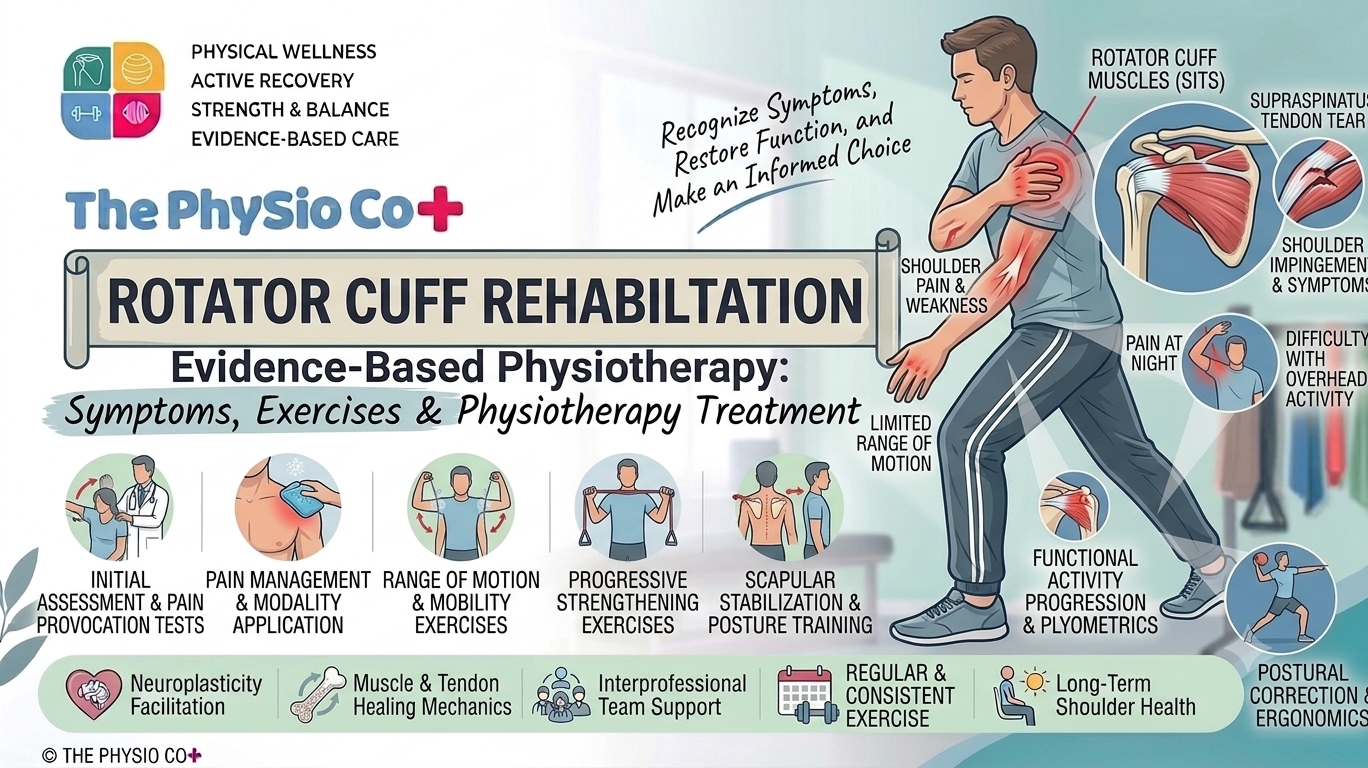
The rotator cuff is a group of four muscles and their tendons that help control shoulder movement and keep the shoulder joint stable. These tissues can become irritated, overloaded or torn, especially after repetitive overhead activity, sports, a fall, or changes that happen with age.
The good news is that not every rotator cuff injury requires surgery. Many people improve with appropriate activity modification, exercise and physiotherapy.
If you’re looking for rotator cuff physiotherapy in Delhi, this guide explains the condition, common symptoms, exercises and treatment options in simple language.
What Is the Rotator Cuff?
The rotator cuff is made up of four muscles around the shoulder:
- Supraspinatus
- Infraspinatus
- Teres minor
- Subscapularis
Together, they help you:
- Raise your arm
- Rotate your shoulder
- Reach overhead
- Perform everyday movements
- Keep the shoulder joint controlled while moving
The tendons of these muscles attach to the upper arm bone.
Because the shoulder is designed for a large amount of movement, the muscles and tendons around it have to work continuously to control that movement.
What Is a Rotator Cuff Injury?
A rotator cuff injury can range from irritation or overload of a tendon to a partial or complete tendon tear.
Some injuries happen suddenly, for example after:
- Falling on the arm
- Lifting something heavy
- A sudden pulling movement
- A sports injury
Others develop gradually.
For example, repeated overhead activities over months or years can cause shoulder pain and reduced function.
Age-related changes in the rotator cuff are also common, and a tear seen on an MRI does not always mean that it is the cause of someone’s pain.
This is why symptoms and physical examination are important when deciding on treatment.
What Causes Rotator Cuff Injuries?
Rotator cuff problems can develop for several reasons.
Repetitive overhead activity
Activities such as:
- Swimming
- Tennis
- Badminton
- Volleyball
- Cricket
- Weight training
- Painting
- Repeated overhead work
can place repeated demands on the shoulder.
Sudden injury
A fall or sudden force through the arm can injure the rotator cuff.
Age-related changes
As we get older, changes in the tendons become more common.
This does not mean that shoulder pain is an inevitable part of ageing. Many people with tendon changes have little or no pain.
Sudden increase in exercise
Increasing gym or sports training too quickly can overload the shoulder.
For example, suddenly adding heavy:
- Shoulder presses
- Lateral raises
- Pull-ups
- Overhead exercises
may increase symptoms.
What Are the Symptoms of a Rotator Cuff Injury?
Common symptoms include:
- Pain when lifting the arm
- Pain when reaching overhead
- Pain when reaching behind the back
- Shoulder weakness
- Difficulty putting on clothes
- Pain while sleeping on the affected side
- Difficulty lifting objects
- Reduced shoulder movement
- Pain during certain gym or sports activities
Some people also describe a painful clicking or catching sensation.
However, clicking by itself does not necessarily mean that the rotator cuff is damaged.
Where Does Rotator Cuff Pain Usually Occur?
Rotator cuff-related pain is often felt around the:
- Front of the shoulder
- Side of the shoulder
- Upper arm
Some people may describe the pain as travelling down the upper arm.
Pain location alone cannot confirm a rotator cuff injury because several shoulder conditions can produce similar symptoms.
Why Does My Shoulder Hurt When I Raise My Arm?
Raising your arm requires several muscles and joints to work together.
When the shoulder tissues are irritated or overloaded, certain movements may become painful.
For example, you may notice pain while:
- Reaching for a shelf
- Washing your hair
- Putting on a shirt
- Hanging clothes
- Lifting weights
- Playing an overhead sport
Pain during a particular movement does not automatically mean that the tendon is being damaged every time you move.
In many cases, gradually restoring the shoulder’s strength and tolerance to movement is an important part of recovery.
Can a Rotator Cuff Tear Heal Without Surgery?
It depends on the type of tear.
Some partial tears and many cases of rotator cuff-related shoulder pain can be managed without surgery.
Treatment may include:
- Activity modification
- Exercise
- Physiotherapy
- Pain management
- Gradual strengthening
Complete tears are more complicated. Some people can function well without surgery, while others may benefit from surgical assessment, particularly when there is significant weakness following an acute injury or when symptoms remain despite appropriate rehabilitation.
The decision should be based on symptoms, shoulder function, examination and imaging when appropriate.
Rotator Cuff Injury vs Rotator Cuff Tear
These terms are sometimes used interchangeably, but they are not exactly the same.
Rotator cuff injury is a broad term that can include tendon irritation, overload and tears.
A rotator cuff tear means that some or all of the tendon fibres have torn.
Tears can be:
- Partial
- Full thickness
The size and location of a tear are important, but MRI findings should be considered alongside symptoms and shoulder function.
How Is a Rotator Cuff Injury Diagnosed?
A healthcare professional will usually begin with your history and a physical examination.
They may check:
- Shoulder movement
- Strength
- Pain during different movements
- Shoulder function
- Neck movement
- Other possible causes of shoulder pain
Special tests may be used to help narrow down the possible cause.
An ultrasound or MRI may sometimes be recommended, particularly when a significant tear is suspected or when symptoms are not improving.
Imaging should not be interpreted in isolation.
Can Physiotherapy Help Rotator Cuff Injuries?
Yes.
Exercise-based physiotherapy is commonly used for rotator cuff-related shoulder pain.
The aim is to gradually improve the shoulder’s ability to handle everyday and physical activities.
A rehabilitation program may include:
- Gentle shoulder movement
- Rotator cuff strengthening
- Shoulder blade strengthening
- Upper-arm strengthening
- Postural and movement advice
- Gradual return to overhead activity
- Sport-specific exercises when needed
The exercises should be progressed gradually rather than pushing through significant pain.
Rotator Cuff Physiotherapy Treatment
1. Activity Modification
You may not need to stop using your shoulder completely.
Instead, activities that strongly increase pain may need to be temporarily modified.
For example, this might mean:
- Reducing heavy overhead lifting
- Taking breaks from repetitive work
- Reducing training volume
- Changing exercise technique
- Avoiding movements that repeatedly flare symptoms
The goal is to keep the shoulder active while giving irritated tissues a chance to settle.
2. Restoring Shoulder Movement
Shoulder stiffness can make recovery more difficult.
Depending on your symptoms, a physiotherapist may prescribe gentle movements such as:
- Pendulum exercises
- Assisted shoulder elevation
- Gentle external rotation
- Shoulder mobility exercises
These should be comfortable and controlled.
3. Rotator Cuff Strengthening
As symptoms improve, strengthening becomes an important part of rehabilitation.
Exercises may target:
- External rotation
- Internal rotation
- Shoulder elevation
- Shoulder blade control
Resistance bands are often useful because the resistance can be increased gradually.
4. Shoulder Blade Strengthening
The shoulder blade plays an important role in shoulder movement.
Exercises may include:
- Wall exercises
- Resistance-band rows
- Scapular control exercises
- Serratus anterior exercises
The aim is to improve overall shoulder control rather than focus on one muscle alone.
5. Progressive Loading
One of the most important parts of rehabilitation is gradually increasing the amount of work the shoulder can tolerate.
For example:
Light resistance → More repetitions → More resistance → Functional movements → Sport or work-specific activity
The progression depends on your symptoms and goals.
Rotator Cuff Exercises at Home
Here are some exercises commonly used during rehabilitation.
Pendulum Exercise
- Support yourself with your unaffected arm.
- Allow the affected arm to hang comfortably.
- Make small, gentle movements.
- Gradually move the arm forward, backward and in small circles.
- Keep the movement relaxed.
This can be useful when the shoulder is painful or stiff.
Isometric External Rotation
- Keep your elbow close to your body.
- Bend the elbow to approximately 90 degrees.
- Place the back of your hand against a stable surface.
- Gently push outward without actually moving the arm.
- Hold for a few seconds.
- Relax.
The effort should be controlled rather than maximal.
Resistance-Band External Rotation
- Attach a resistance band securely.
- Keep your elbow close to your side.
- Hold the band.
- Slowly rotate your forearm outward.
- Return to the starting position with control.
Start with light resistance.
Wall Slides
- Stand facing a wall.
- Place your hands or forearms against the wall.
- Slowly slide your arms upward.
- Move only as far as comfortable.
- Slowly return.
This can help gradually restore overhead movement.
Resistance-Band Rows
- Attach a resistance band securely.
- Hold the band with both hands.
- Pull your elbows backward.
- Gently bring your shoulder blades together.
- Return slowly.
Avoid shrugging your shoulders toward your ears.
How Often Should You Do Rotator Cuff Exercises?
There is no single routine that works for everyone.
Exercise frequency depends on:
- Severity of symptoms
- Exercise intensity
- Strength level
- Stage of rehabilitation
- Response to the previous session
Consistency is generally more important than doing a large number of exercises.
A physiotherapist can help determine the appropriate frequency and progression.
Should You Rest a Rotator Cuff Injury?
Relative rest can be useful during a painful flare-up.
However, complete rest for a prolonged period can lead to:
- Muscle weakness
- Stiffness
- Reduced confidence with movement
- Lower exercise capacity
Instead of completely avoiding movement, the aim is usually to reduce activities that significantly aggravate symptoms while continuing appropriate movement and exercise.
Can You Go to the Gym With a Rotator Cuff Injury?
In many cases, yes — but your training may need to be modified.
You may temporarily need to reduce or change exercises such as:
- Heavy shoulder presses
- Painful lateral raises
- Heavy bench pressing
- Overhead movements
- Exercises that repeatedly reproduce significant pain
You may still be able to train other body parts and perform shoulder exercises that are appropriate for your rehabilitation stage.
A physiotherapist can help you modify your gym program instead of simply telling you to stop exercising.
Can You Sleep on a Rotator Cuff Injury?
Sleeping directly on the painful shoulder may increase discomfort.
Some people find it more comfortable to:
- Sleep on the opposite side
- Use a pillow to support the affected arm
- Sleep on their back with the arm comfortably supported
The most comfortable position can vary between individuals.
How Long Does a Rotator Cuff Injury Take to Heal?
There is no fixed recovery time.
Recovery depends on:
- Type of injury
- Severity
- Duration of symptoms
- Age
- General strength
- Activity demands
- Exercise consistency
- Whether there is a significant tear
Some people improve within several weeks, while others need a longer rehabilitation period.
A chronic rotator cuff problem may require several months of progressive rehabilitation.
When Is Surgery Considered for a Rotator Cuff Tear?
Surgery is not automatically required for every rotator cuff tear.
Surgical assessment may be considered when:
- There is a significant acute tear
- There is substantial weakness after an injury
- Symptoms remain despite an appropriate rehabilitation program
- The tear and symptoms are affecting function significantly
- The person has specific work or sporting demands
The decision should be made with an orthopaedic specialist after considering symptoms, examination and imaging.
Physiotherapy After Rotator Cuff Surgery
If surgery is required, physiotherapy becomes an important part of recovery.
The rehabilitation process is usually gradual.
It may progress through:
Protection → Gentle movement → Active movement → Strengthening → Functional training → Return to work/sport
The exact timeline depends on the surgical procedure and the surgeon’s rehabilitation protocol.
Do not progress exercises faster than recommended after rotator cuff repair.
Can Rotator Cuff Injuries Come Back?
Yes, shoulder pain can return if the shoulder is exposed to more load than it can currently tolerate.
This is particularly relevant when returning to:
- Gym training
- Swimming
- Tennis
- Badminton
- Cricket
- Overhead work
A gradual increase in training volume and strength can help the shoulder adapt to higher demands.
How Can You Prevent Rotator Cuff Problems?
You cannot prevent every shoulder injury.
However, some habits may help:
- Increase exercise gradually
- Strengthen the shoulder regularly
- Maintain overall fitness
- Avoid sudden increases in training volume
- Take breaks from repetitive overhead work
- Work on technique
- Address persistent shoulder pain early
For athletes, conditioning should match the demands of their sport.
When Should You See a Physiotherapist?
Consider getting assessed if you have:
- Shoulder pain lasting more than a few days
- Pain when lifting your arm
- Difficulty reaching overhead
- Shoulder weakness
- Night pain
- Difficulty returning to the gym or sport
- Repeated shoulder problems
A physiotherapist can assess the shoulder and determine whether physiotherapy is appropriate.
When Should You See a Doctor?
Medical assessment is particularly important if your shoulder pain started after:
- A significant fall
- A sudden injury
- Heavy lifting with immediate weakness
- A major loss of shoulder movement
You should also seek medical attention if you have severe or worsening pain, significant weakness, deformity or symptoms suggesting another serious condition.
Rotator Cuff Physiotherapy in Delhi
If you are searching for rotator cuff physiotherapy in Delhi, treatment should begin with a proper assessment rather than assuming that every shoulder pain is a rotator cuff tear.
At The Physio Co+, rehabilitation can focus on restoring shoulder movement, improving rotator cuff and shoulder-blade strength, managing activity levels and gradually returning you to work, exercise or sport.
The treatment plan can be adjusted according to your symptoms, occupation, fitness level and functional goals.
For patients in and around Vasant Kunj, rehabilitation can be designed around everyday activities as well as gym and sports requirements.
Related services: Physiotherapy in Delhi | Sports Injury Physiotherapy | Shoulder Pain Physiotherapy | Clinical Pilates
Frequently Asked Questions
What is a rotator cuff injury?
A rotator cuff injury affects one or more of the muscles or tendons that help control and stabilize the shoulder.
What are the symptoms of a rotator cuff injury?
Common symptoms include shoulder pain, weakness, difficulty lifting the arm, pain at night and difficulty with overhead activities.
Can a rotator cuff injury heal without surgery?
Many rotator cuff problems can improve with appropriate exercise-based rehabilitation and activity modification. Some significant tears may require surgical assessment.
What are the best exercises for a rotator cuff injury?
Exercises such as gentle shoulder mobility, external rotation, resistance-band exercises and progressive strengthening may be used depending on the individual’s condition.
Should I stop going to the gym with a rotator cuff injury?
Not necessarily. Exercises that aggravate symptoms may need to be modified, while other training can often continue.
How long does a rotator cuff injury take to heal?
Recovery varies depending on the type and severity of the injury and the individual’s rehabilitation. Some people improve within weeks, while others require several months.
Can physiotherapy help a rotator cuff tear?
Physiotherapy can help improve shoulder strength, movement and function and may be used as part of conservative treatment for many rotator cuff tears.
Is a rotator cuff tear always painful?
No. Some rotator cuff tears, particularly age-related tears, may be present without causing significant symptoms.
Can I sleep on the affected shoulder?
You can, but if sleeping on that side increases pain, try sleeping on the opposite side or supporting the affected arm with a pillow.
When is surgery needed for a rotator cuff tear?
Surgery may be considered in selected cases, including some acute significant tears, substantial weakness or symptoms that continue despite appropriate non-surgical treatment.
Key Takeaway
A rotator cuff injury does not automatically mean that you need surgery.
Many people can improve with appropriate exercise, gradual strengthening, activity modification and physiotherapy.
The goal is not simply to reduce pain. Good rehabilitation should help you regain the strength and confidence needed for everyday activities, work, exercise and sport.
If you are looking for rotator cuff physiotherapy in Delhi, shoulder pain physiotherapy in Delhi or shoulder rehabilitation in Vasant Kunj, a proper assessment can help determine the most suitable treatment approach.
References
- American Academy of Orthopaedic Surgeons (AAOS). Rotator Cuff Tears. OrthoInfo.
- American Academy of Orthopaedic Surgeons. Management of Rotator Cuff Injuries: Evidence-Based Clinical Practice Guideline.
- Lewis JS. Rotator cuff related shoulder pain: Assessment, management and uncertainties. Manual Therapy.
- Littlewood C, et al. Exercise for rotator cuff tendinopathy: systematic review and clinical guidance.
- Kuhn JE. Exercise in the treatment of rotator cuff impingement: a systematic review and a synthesized evidence-based rehabilitation protocol.
- American Physical Therapy Association. Clinical resources and guidance relating to shoulder pain and rotator cuff rehabilitation.
SEO Setup
Primary Keyword:
Rotator Cuff Physiotherapy in Delhi
Secondary Keywords:
- Rotator Cuff Injury Physiotherapy Delhi
- Rotator Cuff Tear Treatment Delhi
- Rotator Cuff Rehabilitation Delhi
- Shoulder Pain Physiotherapy Delhi
- Rotator Cuff Exercises
- Rotator Cuff Tear Exercises
- Shoulder Physiotherapy Delhi
- Rotator Cuff Physiotherapy Vasant Kunj
- Rotator Cuff Treatment Vasant Kunj
- Shoulder Rehabilitation Delhi
- Physiotherapist for Shoulder Pain Delhi
- Rotator Cuff Tear Without Surgery
- Sports Injury Physiotherapy Delhi
- Shoulder Pain Treatment Delhi
Suggested URL Slug:/blog/rotator-cuff-injury-physiotherapy-in-delhi/
SEO Title:
Rotator Cuff Injury: Symptoms, Exercises & Physiotherapy Treatment
Meta Description:
Learn about rotator cuff injury symptoms, causes, exercises and physiotherapy treatment. Understand when exercise can help and when specialist assessment may be needed.
Suggested Internal Links:
- Rotator Cuff Physiotherapy →
https://thephysiocoplus.com/ - Shoulder Pain Physiotherapy →
https://thephysiocoplus.com/ - Sports Injury Physiotherapy →
https://thephysiocoplus.com/ - Clinical Pilates →
https://thephysiocoplus.com/ - Frozen Shoulder → your existing frozen shoulder blog
- Tennis Elbow → your existing tennis elbow blog
Suggested Blog Banner Text:
Rotator Cuff Injury
Symptoms, Exercises & Physiotherapy Treatment
Optional subtitle:
Reduce Shoulder Pain • Build Strength • Restore Movement