


Muscle Strain vs Ligament Injury
You twist your ankle, pull your leg during a workout, or suddenly feel pain while playing a sport—and the first question is often:
“Did I strain a muscle, or did I injure a ligament?”
Muscle strains and ligament injuries are both common musculoskeletal injuries, particularly in people who participate in sports, exercise or physically demanding activities.
Although they can cause similar symptoms such as pain, swelling and difficulty moving, they affect different tissues and usually occur through different mechanisms.
Understanding the difference can help you know what kind of assessment and rehabilitation may be appropriate.
What Is a Muscle Strain?
A muscle strain is an injury involving a muscle or the tendon connecting the muscle to bone.
A strain can occur when a muscle is:
- Stretched beyond its capacity
- Suddenly loaded
- Forced to contract while being lengthened
- Repeatedly overloaded
- Exposed to a sudden increase in training intensity
Muscle strains are particularly common in sports involving sprinting, jumping and rapid changes of movement.
Commonly affected areas include:
- Hamstrings
- Calf muscles
- Quadriceps
- Groin muscles
- Lower back muscles
For example, a sudden sprint can place a high load on the hamstrings, potentially causing a hamstring strain.
What Is a Ligament Injury?
A ligament is a strong band of connective tissue that connects one bone to another and helps provide stability to a joint.
A ligament injury, commonly called a sprain, usually occurs when a joint is forced beyond its normal range of motion.
Common examples include:
- Ankle ligament sprain
- ACL injury of the knee
- MCL injury of the knee
- Wrist ligament injury
- Thumb ligament injury
A ligament can be overstretched or partially or completely torn depending on the severity of the injury.
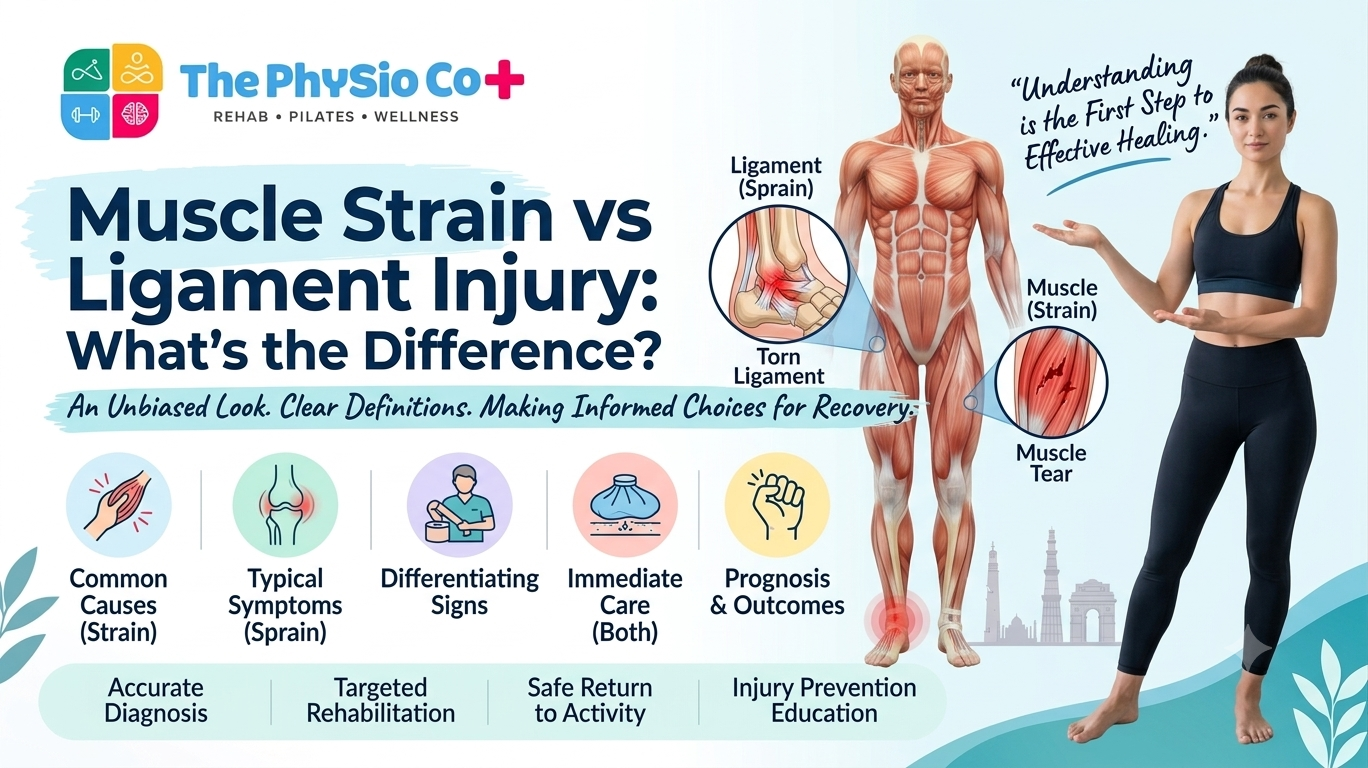
Muscle Strain vs Ligament Injury: The Main Difference
The simplest way to remember it is:
Muscle strain → muscle or tendon
Ligament sprain → ligament around a joint
| Feature | Muscle Strain | Ligament Injury |
|---|---|---|
| Tissue injured | Muscle or musculotendinous tissue | Ligament |
| Usually affects | Muscle function | Joint stability |
| Common mechanism | Sudden stretch or forceful contraction | Joint forced beyond normal movement |
| Common symptoms | Local pain, tenderness, weakness | Pain, swelling, tenderness, instability |
| Common locations | Hamstring, calf, groin, quadriceps | Ankle, knee, wrist, thumb |
| Rehabilitation | Strength, mobility and gradual loading | Protection, mobility, strength and stability |
| Severe injury | Significant muscle/tendon damage | Partial or complete ligament tear |
What Does a Muscle Strain Feel Like?
Symptoms vary depending on the severity and location of the injury.
You may experience:
- Sudden pain during activity
- Localised tenderness
- Pain when contracting the affected muscle
- Pain when stretching the muscle
- Reduced strength
- Swelling
- Bruising
- Difficulty using the affected muscle
For example, someone with a hamstring strain may experience pain during sprinting, bending the knee or stretching the hamstring.
The pain is usually located around the injured muscle or musculotendinous region.
What Does a Ligament Injury Feel Like?
A ligament injury can produce:
- Pain around a joint
- Swelling
- Bruising
- Tenderness
- Reduced joint movement
- Difficulty putting weight through the limb
- A feeling of instability or “giving way”
Some people describe hearing or feeling a pop at the time of certain ligament injuries, particularly with injuries such as ACL tears.
However, a popping sensation does not automatically mean that a ligament has torn.
A proper clinical assessment is required.
How Do These Injuries Happen?
Muscle Strain
Muscle strains commonly occur when the muscle experiences a force that exceeds its current capacity.
Examples include:
- Sprinting
- Sudden acceleration
- Jumping
- Rapid changes in direction
- Heavy lifting
- Sudden stretching
- Returning to sport too quickly
A sudden increase in training load can also increase injury risk.
Ligament Injury
Ligament injuries usually occur when a joint is exposed to excessive force or movement.
Examples include:
Ankle
Rolling the ankle inward can injure the lateral ankle ligaments.
Knee
A sudden change of direction, landing or contact during sport can injure knee ligaments such as the ACL or MCL.
Wrist
A fall onto an outstretched hand can place substantial stress on wrist ligaments.
Are Muscle Strains and Ligament Injuries Graded?
Yes.
Both types of injury can vary considerably in severity.
Muscle Strain Grades
Muscle strains are sometimes classified into grades based on the extent of tissue damage.
Grade 1
Usually involves relatively minor damage with limited strength loss and function.
Grade 2
Represents a more significant partial injury with greater pain, weakness and functional limitation.
Grade 3
Represents a severe or complete disruption of the muscle-tendon unit and may require specialist assessment.
The exact terminology and grading systems can vary depending on the muscle and clinical classification being used.
Ligament Injury Grades
Ligament sprains are commonly described as:
Grade 1
The ligament is stretched with relatively minor structural damage.
Grade 2
There is a partial tear with greater pain and some loss of stability.
Grade 3
There is a complete ligament rupture and significant joint instability may occur.
Again, grading should not be determined based solely on symptoms.
Can You Tell the Difference Yourself?
Sometimes the location and mechanism provide clues, but you cannot reliably diagnose a muscle strain or ligament tear simply by looking at the symptoms.
For example, swelling and pain can occur with both injuries.
A physiotherapist or medical professional may assess:
- Mechanism of injury
- Pain location
- Range of motion
- Muscle strength
- Joint stability
- Swelling
- Functional movement
- Specific clinical tests
Imaging may be required in selected cases.
Depending on the suspected injury, this may include:
- Ultrasound
- X-ray
- MRI
Not every sports injury requires imaging.
What Should You Do Immediately After an Injury?
The appropriate early management depends on the injury and its severity.
Rather than trying to completely immobilise every injury or aggressively stretch it immediately, current sports injury management generally focuses on protecting the injured area while gradually restoring appropriate movement and loading.
The PEACE & LOVE framework is one commonly discussed approach to acute soft-tissue injuries.
PEACE
P — Protect
Reduce or modify activities that significantly aggravate symptoms during the early period.
E — Elevate
When appropriate, elevation can help manage swelling.
A — Avoid unnecessary anti-inflammatory strategies
The PEACE & LOVE framework highlights that excessive use of anti-inflammatory interventions may potentially interfere with aspects of tissue healing, although medication decisions should be discussed with an appropriate healthcare professional.
C — Compression
Compression may be useful for managing swelling in appropriate injuries.
E — Education
Understanding the injury and recovery process is an important part of rehabilitation.
LOVE
After the initial stage:
L — Load
Gradually introduce appropriate mechanical loading.
O — Optimism
Recovery is influenced by physical as well as psychological factors, including fear and confidence in movement.
V — Vascularisation
Appropriate cardiovascular activity can be gradually introduced when safe.
E — Exercise
Progressive exercise is an important component of rehabilitation.
The appropriate programme depends on the injury and should be modified according to symptoms and clinical findings.
Should You Use Ice for a Muscle Strain or Ligament Injury?
Ice can temporarily reduce pain and may be useful for symptom management in some acute injuries.
However, it should not be considered a treatment that automatically speeds tissue healing.
Current sports medicine approaches generally place greater emphasis on appropriate protection, progressive loading and rehabilitation rather than relying solely on passive treatments.
If you are unsure whether an injury requires medical assessment, particularly when there is significant swelling, deformity or inability to bear weight, seek professional evaluation.
How Is a Muscle Strain Treated?
Treatment depends on the muscle involved and severity of the injury.
A physiotherapy rehabilitation programme may include:
Early Stage
- Relative protection
- Pain management
- Gentle movement
- Maintaining appropriate mobility
- Gradual muscle activation
Recovery Stage
As symptoms settle, rehabilitation can progress toward:
- Isometric strengthening
- Resistance exercises
- Progressive muscle loading
- Mobility work
- Functional exercises
Return-to-Sport Stage
For athletes, rehabilitation should eventually include activities that resemble the demands of their sport.
This may include:
- Running
- Acceleration
- Deceleration
- Jumping
- Direction changes
- Sport-specific drills
The goal is not simply to become pain-free.
The goal is to restore the capacity needed for the activity you want to return to.
How Is a Ligament Injury Treated?
Treatment depends heavily on which ligament is injured and the severity of the injury.
A rehabilitation programme may include:
- Swelling management
- Restoring joint movement
- Strengthening surrounding muscles
- Balance training
- Proprioception exercises
- Neuromuscular training
- Functional movement
- Sport-specific rehabilitation
For example, rehabilitation after an ankle sprain may include calf strengthening, balance exercises and progressive hopping and running drills.
An ACL injury requires a more specialised rehabilitation programme and may involve both physiotherapy and surgical consultation depending on the individual’s injury, activity level and goals.
Can Physiotherapy Help Muscle Strains?
Yes.
Physiotherapy can help guide the progression from early symptom management to strengthening and return to activity.
The key is progressive loading.
Simply resting until the pain disappears does not necessarily restore the strength and capacity required for sport.
A physiotherapist can help determine:
- When to start loading
- Which exercises to perform
- How much resistance to use
- When to progress
- When running can resume
- When sport-specific training can begin
Can Physiotherapy Help Ligament Injuries?
Yes.
Physiotherapy is an important component of rehabilitation for many ligament injuries.
Rehabilitation may focus on:
- Joint mobility
- Muscle strength
- Balance
- Proprioception
- Neuromuscular control
- Functional movement
- Return-to-sport preparation
For ankle sprains in particular, exercise-based rehabilitation can help improve function and reduce the risk of recurrent injury.
A systematic review and clinical practice guideline for lateral ankle sprains supports progressive exercise therapy and functional rehabilitation as important components of management. (pubmed.ncbi.nlm.nih.gov)
How Long Does Recovery Take?
There is no single recovery timeline for either a muscle strain or ligament injury.
Recovery depends on:
- Tissue involved
- Severity
- Location
- Age
- Previous injuries
- Overall fitness
- Training load
- Rehabilitation
- Other medical factors
- Return-to-sport demands
A mild injury may recover relatively quickly, while a severe muscle injury or complete ligament tear can require a much longer rehabilitation period.
For this reason, returning to sport should not be based only on the number of days since the injury.
When Can You Return to Sport?
Being pain-free is helpful, but it is not the only factor.
Before returning to high-demand sport, rehabilitation may need to address:
- Strength
- Range of motion
- Balance
- Power
- Running ability
- Agility
- Change of direction
- Sport-specific movements
- Confidence
- Repeated-load tolerance
For athletes, the final stage of rehabilitation should progressively reproduce the demands of their sport.
When Should You See a Physiotherapist?
Consider getting assessed if you have:
- Persistent pain after an injury
- Significant swelling
- Bruising
- Reduced strength
- Difficulty walking
- Difficulty using the affected limb
- Joint instability
- Repeated episodes of the same injury
- Difficulty returning to exercise
- Pain that continues despite rest
You should seek prompt medical assessment if there is:
- Significant deformity
- Inability to bear weight after an acute injury
- Severe or rapidly increasing swelling
- Significant loss of movement
- Numbness or loss of circulation
- Suspected fracture
- Severe pain after major trauma
Muscle Strain vs Ligament Injury: Which One Is More Serious?
Neither is automatically “more serious.”
Severity depends on the extent of tissue damage and its effect on function.
A mild muscle strain may recover quickly, while a severe muscle injury can require extensive rehabilitation.
Likewise, a mild ankle ligament sprain may recover well with rehabilitation, while a complete ligament rupture may cause significant instability and require specialist assessment.
Therefore, the tissue involved is only part of the picture.
Final Takeaway
The easiest way to remember the difference is:
Muscle strain = injury to a muscle or musculotendinous unit.
Ligament injury/sprain = injury to a ligament that supports a joint.
Both injuries can cause pain, swelling, weakness and reduced function, but their rehabilitation needs can be different.
Physiotherapy can help guide recovery through appropriate loading, strengthening, mobility, balance, movement control and progressive return to activity.
The most important thing is not to rush back to sport simply because the pain has improved.
A successful recovery means restoring the strength and function needed for your normal activities or sport.
If you have sustained a sports injury and are unsure whether it is a muscle strain, ligament sprain or another condition, an assessment by a physiotherapist or appropriate medical professional can help determine the next step.
Frequently Asked Questions
What is the difference between a muscle strain and ligament injury?
A muscle strain affects a muscle or musculotendinous tissue, while a ligament injury or sprain affects the ligament connecting bones around a joint.
Is a muscle strain worse than a ligament injury?
Not necessarily. Both can range from mild to severe. The seriousness depends on the extent of tissue damage and its effect on function.
Can a muscle strain heal without physiotherapy?
Many mild muscle strains improve with appropriate activity modification and gradual return to loading. Physiotherapy can be particularly useful for more significant injuries, recurrent injuries or athletes who need structured return-to-sport rehabilitation.
Can a ligament injury heal without surgery?
Some ligament injuries can be managed successfully without surgery, depending on the ligament, severity, joint stability and individual goals. Others may require specialist or surgical assessment.
How do I know if I tore a ligament?
Pain, swelling, instability or a popping sensation can occur with ligament injuries, but symptoms alone cannot reliably confirm a tear. Clinical assessment and, when appropriate, imaging may be required.
Should I exercise after a muscle strain?
Exercise is generally reintroduced progressively as the injury recovers. The type and intensity should match the stage of healing and your symptoms.
Can physiotherapy prevent sports injuries?
Appropriately designed strength, balance, neuromuscular and sport-specific training can help reduce the risk of certain sports injuries, although no programme can completely eliminate injury risk.
How long does a ligament injury take to heal?
Recovery depends on the specific ligament and severity of injury. A mild sprain may recover relatively quickly, while a severe or complete tear can require a much longer rehabilitation programme.
References
- Martin RL, et al. Ankle Stability and Movement Coordination Impairments: Lateral Ankle Ligament Sprains Revision 2021. Journal of Orthopaedic & Sports Physical Therapy. 2021. (pubmed.ncbi.nlm.nih.gov)
- Dubois B, Esculier JF. Soft-tissue injuries simply need PEACE and LOVE. British Journal of Sports Medicine. 2020. (bjsm.bmj.com)
- Bleakley CM, et al. Rehabilitation of ankle sprains: a systematic review. (pubmed.ncbi.nlm.nih.gov)
- Brukner P, Khan K. Clinical Sports Medicine: Injuries. McGraw-Hill Education.
- American Academy of Orthopaedic Surgeons. Sprains, Strains and Other Soft-Tissue Injuries. (orthoinfo.aaos.org)
Medical note: This article is for general educational purposes and does not replace an individual assessment by a physiotherapist or other qualified healthcare professional.