

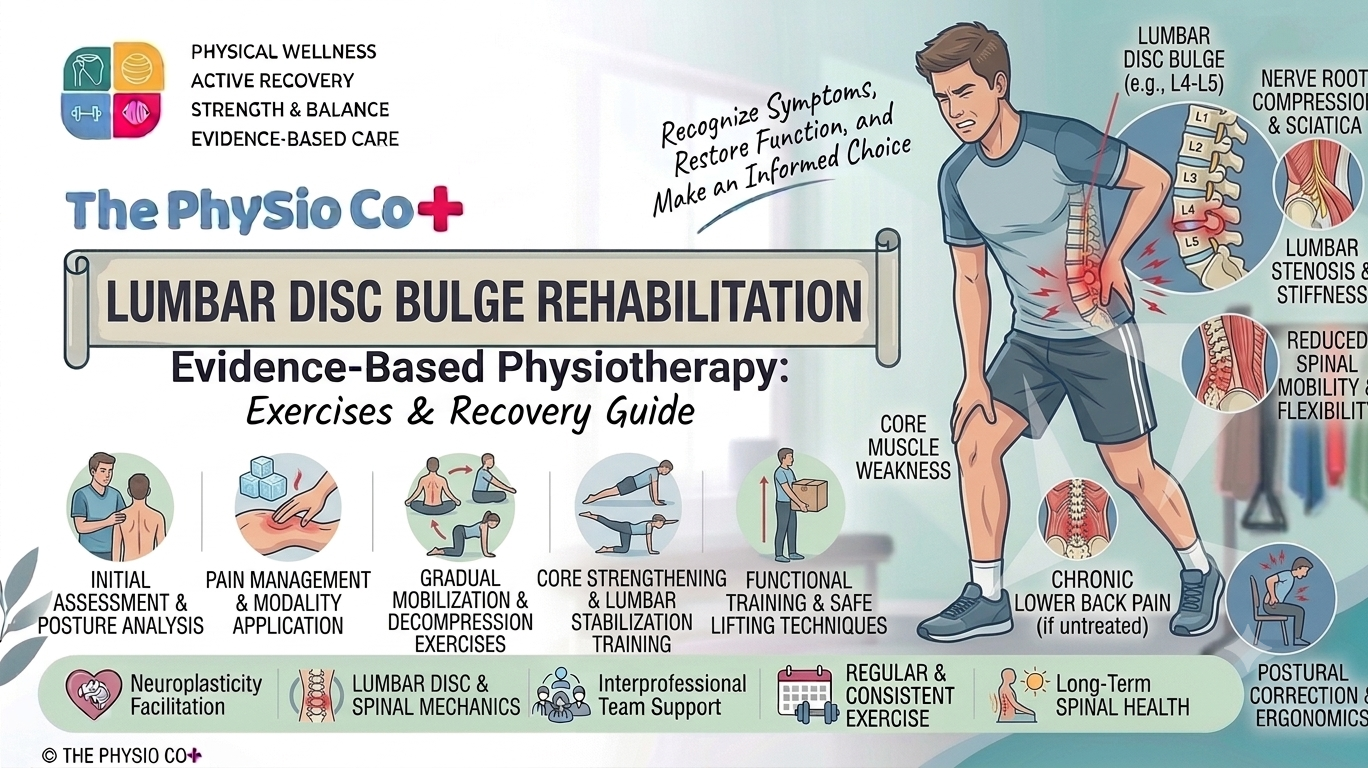

Lumbar Disc Bulge
Lower back pain is extremely common, and one possible cause is a lumbar disc bulge.
You may have heard terms such as “slip disc,” “disc bulge” or “disc herniation” during a scan or consultation. These terms can sound worrying, but a disc bulge does not automatically mean that you need surgery or that your back is permanently damaged.
Many people with a lumbar disc problem improve with appropriate activity, exercise and physiotherapy.
The right treatment depends on your symptoms, examination findings and how the condition is affecting your daily life.
If you are searching for lumbar disc bulge physiotherapy in Delhi, this guide explains the condition, common symptoms, exercises, treatment options and when medical assessment is important.
What Is a Lumbar Disc?
Your spine is made up of a series of bones called vertebrae.
Between most of these bones are soft, flexible structures called discs.
These discs help:
- Absorb loads
- Allow movement of the spine
- Reduce stress between the vertebrae
- Provide cushioning during everyday activities
The lower part of the spine is called the lumbar spine.
It contains five main vertebrae, commonly referred to as L1 to L5.
What Is a Lumbar Disc Bulge?
A disc bulge occurs when the outer part of a spinal disc extends beyond its usual boundary.
A disc can bulge without causing any symptoms.
In fact, disc changes are commonly seen on scans in people who have no back pain at all.
This is important because an MRI finding should not automatically be assumed to be the cause of your symptoms.
Your symptoms, physical examination and scan findings need to be considered together.
Disc Bulge vs Herniated Disc
These terms are sometimes used interchangeably, but they are not exactly the same.
A disc bulge generally describes a broader extension of the disc beyond its normal edge.
A disc herniation usually refers to a more focused displacement of disc material.
The terminology used in an MRI report can vary.
More important than the label is whether the disc problem is actually causing symptoms.
What Causes a Lumbar Disc Bulge?
Disc changes can occur for several reasons.
These may include:
- Natural changes with age
- Repeated loading of the spine
- Poor lifting technique
- Sudden heavy lifting
- Previous back injury
- Reduced physical activity
- Smoking
- Higher body weight
- Repetitive work or sports activities
However, there is rarely one single cause.
It is also important to understand that normal ageing can cause changes in spinal discs. Finding a disc bulge on an MRI does not necessarily mean that a particular movement caused it.
What Are the Symptoms of a Lumbar Disc Bulge?
Some people with a disc bulge have no symptoms at all.
When symptoms are present, they may include:
- Lower back pain
- Buttock pain
- Pain travelling into the leg
- Tingling
- Numbness
- Muscle weakness
- Pain that changes with certain positions
- Difficulty sitting or standing for long periods
Symptoms depend on whether the disc is irritating nearby nerves.
Can a Lumbar Disc Bulge Cause Leg Pain?
Yes.
If a disc problem irritates a nerve in the lower back, pain can travel from the back or buttock into the leg.
This is commonly called sciatica when the symptoms follow the sciatic nerve distribution.
You may experience:
- Sharp or burning pain
- Tingling
- Numbness
- Weakness
- Pain that travels below the knee
Not all leg pain comes from a disc, however, so proper assessment is important.
Can a Disc Bulge Cause Back Pain Without Leg Pain?
Yes.
A lumbar disc bulge can be present in someone with only lower back pain.
However, many other conditions can also cause lower back pain.
This is why a scan alone cannot determine the cause of pain.
Does Every Disc Bulge Need Treatment?
No.
Some people have disc bulges without any symptoms and do not require treatment for the disc itself.
If you have symptoms, treatment is generally directed toward:
- Reducing pain
- Restoring movement
- Improving strength
- Returning to normal activities
- Managing factors that may contribute to recurring symptoms
How Is a Lumbar Disc Bulge Diagnosed?
A healthcare professional will usually begin with your medical history and physical examination.
They may assess:
- Back movement
- Leg movement
- Muscle strength
- Sensation
- Reflexes
- Walking
- Nerve-related symptoms
An MRI may be recommended in selected cases, particularly when symptoms are severe, persistent or when a serious condition needs to be investigated.
Routine imaging is not usually necessary for every episode of lower back pain.
Can Physiotherapy Help a Lumbar Disc Bulge?
Yes.
Physiotherapy is commonly used as part of non-surgical management for people with lower back pain and related leg symptoms.
Treatment may include:
- Exercise
- Strength training
- Mobility exercises
- Activity modification
- Education
- Walking programs
- Gradual return to normal activities
The treatment should be based on your symptoms rather than simply on the wording of an MRI report.
Lumbar Disc Bulge Physiotherapy Treatment
1. Understanding Your Symptoms
One of the first steps is understanding which movements and activities make your symptoms better or worse.
For example, some people feel better when walking, while others may initially prefer certain resting positions.
There is no single “best” position for everyone.
2. Keeping Active
Prolonged bed rest is generally not recommended for uncomplicated lower back pain.
Staying reasonably active can help maintain:
- Strength
- Mobility
- Confidence
- General fitness
Walking is often a simple starting point.
The amount should be adjusted according to your symptoms.
3. Improving Movement
Gentle movement can help reduce stiffness and improve confidence with normal activities.
Depending on your symptoms, exercises may involve:
- Pelvic movements
- Gentle spinal movements
- Hip mobility
- Controlled bending
- Extension-based exercises
Not every exercise is appropriate for every person.
4. Strengthening
As symptoms settle, strengthening becomes increasingly important.
Exercises may target:
- Abdominal muscles
- Back muscles
- Gluteal muscles
- Hip muscles
- Legs
The aim is not to make your back completely rigid.
Instead, the goal is to build a body that can comfortably handle everyday activities and gradually higher loads.
Lumbar Disc Bulge Exercises
Here are examples of exercises that may be used during rehabilitation.
Your physiotherapist may modify them depending on your symptoms.
1. Walking
Walking is one of the simplest ways to remain active.
Start with a comfortable duration and gradually increase the time as your symptoms allow.
For example:
Short walk → Longer walk → Faster walking → Normal daily activity
There is no need to force yourself through severe pain.
2. Pelvic Tilts
- Lie on your back with your knees bent.
- Keep your feet supported.
- Gently tighten your abdominal muscles.
- Slowly tilt your pelvis.
- Relax and repeat.
Move slowly and comfortably.
3. Bridge Exercise
- Lie on your back.
- Bend your knees.
- Keep your feet on the floor.
- Tighten your abdominal and buttock muscles.
- Slowly lift your hips.
- Hold briefly.
- Lower with control.
This helps strengthen the gluteal and trunk muscles.
4. Bird Dog
- Start on your hands and knees.
- Keep your back comfortable and controlled.
- Slowly extend one arm and the opposite leg.
- Hold briefly.
- Return to the starting position.
- Repeat on the other side.
The goal is controlled movement rather than lifting as high as possible.
5. Gentle Hamstring Stretch
- Lie on your back.
- Bring one leg upward comfortably.
- Keep the movement controlled.
- Hold a gentle stretch.
- Return slowly.
Do not force the stretch, particularly if it increases leg pain or tingling.
Should You Bend Forward With a Disc Bulge?
You do not necessarily need to avoid bending forever.
During an acute flare-up, some people find repeated or loaded bending uncomfortable.
However, avoiding bending completely for long periods can create fear and reduce confidence in normal movement.
As symptoms improve, bending can usually be gradually reintroduced.
The goal is to help your back tolerate normal daily movements again.
Can You Lift Weights With a Lumbar Disc Bulge?
In many cases, yes.
People with disc problems do not necessarily need to permanently avoid weight training.
However, heavy lifting may need to be reduced temporarily during a painful episode.
As your symptoms improve, loading can be gradually increased.
A physiotherapist can help you work on:
- Lifting technique
- Strength
- Load management
- Exercise selection
- Gradual progression
The goal is to make your back stronger and more capable, not permanently protect it from normal loads.
Can You Go to the Gym With a Disc Bulge?
You may be able to continue exercising, but your program may need modification.
Depending on your symptoms, you may temporarily reduce:
- Heavy deadlifts
- Heavy squats
- Heavy bent-over exercises
- High-impact exercise
- Movements that significantly increase leg symptoms
Other exercises may still be appropriate.
Your program should be progressed gradually as your symptoms improve.
Should You Rest in Bed With a Disc Bulge?
Usually, prolonged bed rest is not recommended.
Too much inactivity can lead to:
- Muscle weakness
- Stiffness
- Reduced fitness
- Fear of movement
- Difficulty returning to normal activities
Short periods of rest may be useful during a severe flare-up, but returning to gentle activity as tolerated is generally encouraged.
Can a Lumbar Disc Bulge Heal on Its Own?
Yes.
Many people with disc-related symptoms improve over time with conservative treatment.
The body can also reduce the size of some disc herniations over time.
Importantly, symptom improvement does not always depend on the disc completely returning to its original appearance on a scan.
Pain and function are more important measures of recovery than the scan alone.
Can Physiotherapy Prevent Disc Surgery?
In many cases, physiotherapy and other non-surgical treatment can help people manage symptoms without surgery.
However, physiotherapy cannot guarantee that surgery will never be needed.
Surgery may be considered in selected situations, particularly when there is:
- Significant or progressive neurological weakness
- Severe persistent symptoms despite appropriate non-surgical treatment
- Certain serious nerve-related complications
The decision should be made with an appropriate medical specialist.
When Is Surgery Needed for a Disc Bulge?
Most people with lower back pain do not automatically need surgery because an MRI shows a disc bulge.
Surgery may be considered when symptoms are severe or persistent despite appropriate conservative treatment, or when there is significant nerve compression causing concerning neurological problems.
The decision depends on the person’s symptoms, examination and imaging findings.
Lumbar Disc Bulge and Sciatica
A lumbar disc problem can sometimes irritate a nerve and cause sciatica.
Sciatica may cause:
- Buttock pain
- Leg pain
- Tingling
- Numbness
- Weakness
The pain may be worse with certain activities or positions.
Physiotherapy can help by gradually restoring movement, strength and tolerance to activity.
Can a Disc Bulge Cause Numbness?
Yes.
If a spinal nerve is irritated or compressed, numbness or tingling may occur.
However, new or worsening numbness should be medically assessed, particularly if it is associated with weakness.
Red Flag Symptoms: When Should You Seek Urgent Medical Help?
Most lower back pain is not caused by a serious condition.
However, certain symptoms require urgent medical assessment.
Seek urgent medical help if you develop:
- New loss of bladder or bowel control
- Difficulty starting urination
- Numbness around the groin or inner thighs
- Severe or rapidly worsening weakness in the legs
- Significant symptoms affecting both legs
These symptoms can indicate serious nerve compression and should not be managed with home exercises alone.
You should also seek medical advice if back pain is associated with significant trauma, unexplained weight loss, fever or other concerning symptoms.
How Long Does a Lumbar Disc Bulge Take to Recover?
There is no fixed recovery time.
Some people improve within a few weeks, while others take longer.
Recovery depends on:
- Severity of symptoms
- Whether nerves are involved
- Duration of symptoms
- Activity levels
- General health
- Strength
- Sleep and stress
- Consistency with rehabilitation
The important goal is gradual improvement in pain and function rather than waiting for a scan to become “normal.”
How Can You Prevent Future Back Problems?
You cannot prevent every episode of back pain.
However, several habits can help keep your back healthy:
- Stay physically active
- Build strength gradually
- Avoid sudden increases in training
- Take regular movement breaks
- Learn comfortable lifting strategies
- Maintain a healthy body weight where appropriate
- Get enough sleep
- Address recurring symptoms early
You do not need to maintain a perfect posture all day to protect your back.
Lumbar Disc Bulge Physiotherapy in Delhi
If you are searching for lumbar disc bulge physiotherapy in Delhi, treatment should be based on your symptoms and functional limitations rather than the MRI report alone.
At The Physio Co+, physiotherapy can focus on reducing pain, restoring movement, improving strength and gradually helping you return to work, exercise and everyday activities.
Treatment may include therapeutic exercises, progressive strengthening, mobility work, activity modification and education about managing your back.
For patients in and around Vasant Kunj, the rehabilitation program can be tailored according to symptoms, lifestyle and activity goals.
Related services: Physiotherapy in Delhi | Back Pain Physiotherapy | Sports Injury Physiotherapy | Clinical Pilates
Frequently Asked Questions
What is a lumbar disc bulge?
A lumbar disc bulge occurs when a disc in the lower back extends beyond its normal boundary. It may or may not cause symptoms.
Is a lumbar disc bulge serious?
Not necessarily. Disc bulges are common, including in people without back pain. However, symptoms such as significant weakness, bladder or bowel changes or numbness around the groin require urgent medical assessment.
Can physiotherapy help a lumbar disc bulge?
Yes. Exercise-based physiotherapy can help improve pain, movement, strength and function in many people with lower back and disc-related symptoms.
Can a lumbar disc bulge heal without surgery?
Many people improve without surgery. Treatment may include staying active, exercise, physiotherapy and appropriate medical management.
Can I exercise with a disc bulge?
Usually, yes. Exercise should be adjusted to your symptoms and progressed gradually.
Can I lift weights with a lumbar disc bulge?
Many people can return to weight training. Heavy or painful movements may need to be modified initially, followed by gradual strengthening.
Should I avoid bending if I have a disc bulge?
Not necessarily. Bending may be uncomfortable during an acute flare-up, but long-term avoidance is usually not the goal. Movement can generally be reintroduced gradually.
How long does a lumbar disc bulge take to heal?
Recovery varies. Some people improve within weeks, while others require longer rehabilitation.
Can a disc bulge cause sciatica?
Yes. A disc problem can irritate a spinal nerve and cause pain, tingling or numbness that travels into the leg.
Does every disc bulge require an MRI?
No. Imaging is not routinely required for every episode of lower back pain. A healthcare professional can decide whether imaging is appropriate based on your symptoms and examination.
Key Takeaway
A lumbar disc bulge does not automatically mean that your spine is damaged beyond repair or that you need surgery.
Many people improve with appropriate activity, exercise and physiotherapy.
The focus of rehabilitation should be on reducing symptoms, restoring movement, building strength and gradually returning to normal activities.
If you are looking for lumbar disc bulge physiotherapy in Delhi, slip disc physiotherapy in Delhi or back pain physiotherapy in Vasant Kunj, an individual assessment can help determine the most appropriate treatment plan.
References
- National Institute for Health and Care Excellence (NICE). Low back pain and sciatica in over 16s: assessment and management (NG59).
- American College of Physicians. Noninvasive treatments for acute, subacute, and chronic low back pain: clinical practice guideline.
- World Health Organization. WHO guideline for non-surgical management of chronic primary low back pain in adults in primary and community care settings.
- Brinjikji W, et al. Systematic review of imaging features of spinal degeneration in asymptomatic populations. American Journal of Neuroradiology.
- Chiu CC, et al. The probability of spontaneous regression of lumbar disc herniation: a systematic review. Clinical Rehabilitation.
- North American Spine Society. Diagnosis and Treatment of Lumbar Disc Herniation with Radiculopathy: Clinical Guidelines.