


Frozen Shoulder
Frozen shoulder can make simple activities such as dressing, reaching overhead, combing your hair or sleeping on the affected side surprisingly difficult.
The condition, medically known as adhesive capsulitis, causes pain and progressive stiffness of the shoulder. It can develop gradually and may continue for months or even longer.
The good news is that most people can be managed without surgery, and physiotherapy is an important part of non-surgical treatment.
However, frozen shoulder is not simply a matter of having a “tight shoulder.” Treatment needs to be adapted according to the stage of the condition, pain level, range of motion and individual functional goals.
Current clinical practice guidelines support non-invasive treatments such as exercise, physical therapy and manual therapy for reducing pain and improving shoulder function, while also recognising that corticosteroid injections may be useful in appropriate patients.
What Is Frozen Shoulder?
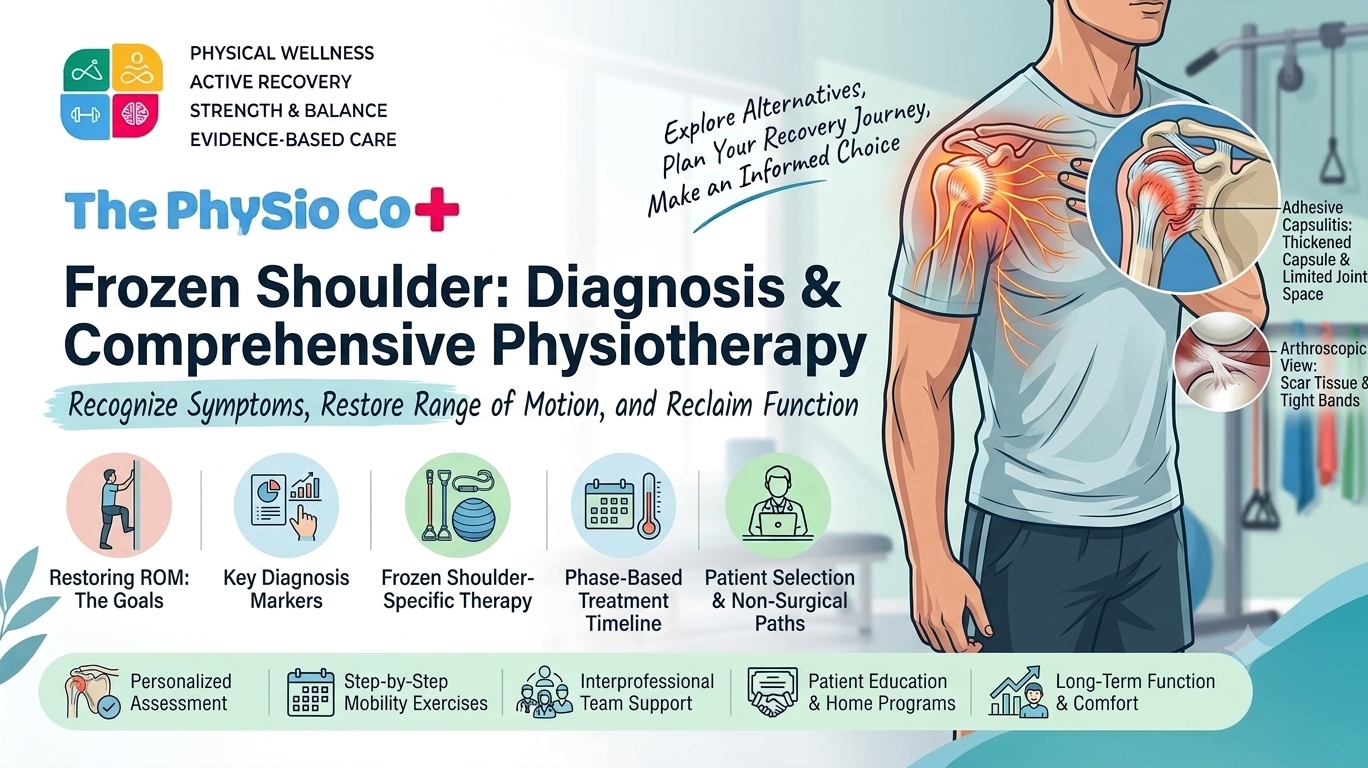
Frozen shoulder, or adhesive capsulitis, occurs when the tissues surrounding the shoulder joint become painful and progressively restrict movement.
The shoulder may become difficult to move both:
- Actively — when you move the arm yourself
- Passively — when someone else moves your arm
A typical feature is restriction of external rotation, although other shoulder movements can also become limited.
People may notice difficulty with:
- Reaching overhead
- Reaching behind the back
- Putting on or removing clothes
- Combing or washing the hair
- Reaching for objects on a high shelf
- Putting on a shirt or jacket
- Sleeping comfortably
- Performing gym or sports activities
What Causes Frozen Shoulder?
Frozen shoulder can occur without an obvious injury. This is sometimes referred to as primary or idiopathic adhesive capsulitis.
It can also develop after another condition or event, including prolonged shoulder immobilisation.
Certain health conditions are associated with a higher risk. A 2025 clinical practice guideline identified diabetes, thyroid disease and dyslipidemia as significant risk factors for frozen shoulder.
This does not mean that everyone with these conditions will develop frozen shoulder, but the association is clinically important.
What Are the Stages of Frozen Shoulder?
Frozen shoulder is commonly described in three stages.
1. Freezing Stage
This stage is often characterised by increasing shoulder pain and gradually worsening movement.
Pain may be present:
- During movement
- At rest
- At night
Sleeping can become particularly uncomfortable.
Because the shoulder becomes increasingly painful, people may naturally stop moving the arm as much, which can contribute to increasing stiffness.
2. Frozen Stage
Pain may become less intense for some people, but stiffness can become the dominant problem.
You may find that:
- Reaching overhead is difficult
- Reaching behind your back is restricted
- Shoulder rotation is limited
- Dressing becomes difficult
- Everyday activities require compensation
This is often the stage where restoring movement becomes a major rehabilitation goal.
3. Thawing Stage
During the thawing stage, shoulder movement gradually improves.
The recovery process can be slow, and the amount of improvement varies between individuals.
Importantly, frozen shoulder should not simply be left to progress without assessment. Persistent stiffness can interfere with work, exercise and everyday activities.
Can Physiotherapy Help Frozen Shoulder?
Yes.
Physiotherapy is an important component of conservative management for frozen shoulder.
A systematic review and meta-analysis found that exercise therapy can improve range of motion, function and pain in people with frozen shoulder. The evidence also suggests that supervised exercise can be beneficial for improving range of motion and function compared with unsupervised home exercise alone.
A separate systematic review found evidence supporting exercise and joint mobilisation for improving shoulder range of motion and symptoms, although the exact combination and dosage of treatment should be individualised.
More recent 2025 clinical practice guidelines also support non-invasive treatments—including exercise, manual therapy and other physical interventions—for reducing pain and improving shoulder function.
How Does Physiotherapy Treat Frozen Shoulder?
There is no single exercise or technique that works for every person with frozen shoulder.
Treatment should be based on:
- Stage of frozen shoulder
- Pain irritability
- Range of motion
- Strength
- Functional limitations
- Response to previous treatment
A physiotherapy programme may include the following.
1. Mobility Exercises
Gentle, progressive exercises can help maintain and improve available shoulder movement.
Depending on the individual, exercises may target:
- Shoulder flexion
- Abduction
- External rotation
- Internal rotation
- Functional reaching
The intensity should be adjusted according to symptoms.
More exercise is not automatically better.
Aggressive stretching that significantly increases pain may not be appropriate for a highly irritable shoulder.
2. Shoulder Stretching
Stretching can be used to gradually improve restricted shoulder movement.
Examples may include:
- Assisted shoulder flexion
- External rotation stretching
- Cross-body stretching
- Behind-the-back mobility exercises
The exercise selection and intensity should be adapted to the individual’s current range of motion and irritability.
3. Joint Mobilisation
A physiotherapist may use manual therapy techniques to address shoulder stiffness and improve movement.
However, manual therapy should generally be considered as part of a broader rehabilitation programme rather than a standalone “fix.”
Research comparing manual therapy and exercise has found inconsistent results and generally low-to-very-low certainty regarding the optimal dosage and combination.
4. Strengthening
As pain decreases and movement improves, strengthening can become increasingly important.
Exercises may target:
- Rotator cuff muscles
- Deltoid
- Scapular stabilisers
- Upper back muscles
Strengthening helps the shoulder return to normal functional activities rather than focusing only on flexibility.
5. Functional Rehabilitation
The ultimate goal is not simply to achieve a certain number on a range-of-motion measurement.
It is to help you return to activities such as:
- Dressing
- Reaching
- Lifting
- Working
- Exercising
- Sleeping comfortably
- Performing household activities
Your rehabilitation programme should therefore progress toward the activities that matter to you.
What Exercises Are Commonly Used for Frozen Shoulder?
Exercises should be individualised, but commonly used movements may include:
Pendulum Exercise
Stand with the affected arm relaxed and supported by the body.
Gently allow the arm to move in small forward/backward or circular movements.
The movement should be comfortable rather than forceful.
Assisted Shoulder Flexion
Lie down or sit and use the unaffected arm to assist the affected arm upward.
Move only within a tolerable range.
External Rotation Exercise
Keep your elbow close to your side and use a stick or your opposite hand to gently assist the affected shoulder into external rotation.
Wall Walk
Face a wall and slowly “walk” your fingers upward to a comfortable level.
Gradually work toward improving the height you can reach.
Behind-the-Back Mobility
Depending on your stage and irritability, gentle behind-the-back movement may be introduced to improve functional internal rotation.
Important: These exercises are examples, not a universal prescription. The appropriate exercise, repetitions and intensity depend on the individual.
Should You Push Through Pain?
This is one of the most common questions people ask.
With frozen shoulder, some discomfort during stretching or exercise can occur.
However, forcing the shoulder aggressively through severe pain is not necessarily better treatment.
Exercise intensity should be matched to the irritability of the condition.
A highly painful shoulder may require a gentler approach, while a less irritable but stiff shoulder may tolerate more intensive mobility work.
This is one reason an individual physiotherapy assessment can be useful.
Physiotherapy vs Steroid Injection for Frozen Shoulder
Physiotherapy and medical treatment do not necessarily need to be considered competing options.
The 2025 clinical practice guideline recommends intra-articular corticosteroid injections for appropriate patients and notes that physiotherapy or hydrodilatation combined with steroid injection can also be beneficial.
A corticosteroid injection may be considered particularly when pain is significantly limiting movement and rehabilitation.
The appropriate option depends on the individual’s symptoms, stage, medical history and clinical assessment.
Does Frozen Shoulder Need Surgery?
Usually, surgery is not the first treatment.
Most patients are initially managed with non-surgical approaches such as:
- Exercise
- Physiotherapy
- Activity modification
- Pain management
- Medication when appropriate
- Injection when clinically indicated
However, some people continue to experience significant pain and functional restriction despite appropriate conservative treatment.
In such cases, a specialist may consider additional interventions.
The important point is:
Frozen shoulder should not automatically be treated with surgery simply because movement is restricted.
A structured conservative programme is often appropriate before considering invasive options.
How Long Does Frozen Shoulder Take to Recover?
Recovery varies considerably.
Some people improve relatively quickly, while others experience symptoms and stiffness for a much longer period.
The traditional description of frozen shoulder as a condition that always completely resolves within a fixed timeframe is not supported by the available evidence.
A 2025 systematic review of frozen shoulder clinical practice guidelines highlighted the need for better and more up-to-date evidence, particularly regarding long-term outcomes and optimal treatment strategies.
Some patients can also experience persistent limitations even after the major painful phase has settled.
Therefore, recovery should be monitored based on:
- Pain
- Range of motion
- Strength
- Function
- Sleep
- Ability to perform daily activities
rather than simply waiting for a particular number of months.
Can Frozen Shoulder Come Back?
A frozen shoulder can recur, although recurrence patterns vary.
The opposite shoulder may also develop adhesive capsulitis in some individuals.
People with underlying risk factors such as diabetes may have a higher risk of developing frozen shoulder.
Maintaining shoulder mobility, strength and general physical activity after recovery may be useful for maintaining function, although there is no exercise programme that can guarantee prevention.
When Should You See a Physiotherapist?
Consider getting your shoulder assessed if you have:
- Shoulder pain lasting more than a few days or weeks
- Increasing stiffness
- Difficulty raising your arm
- Difficulty reaching behind your back
- Night-time shoulder pain
- Difficulty dressing
- Difficulty performing work or gym activities
- Persistent shoulder pain after an injury
- Progressive loss of shoulder movement
Early assessment can also help determine whether your symptoms are actually due to frozen shoulder.
Not every painful or stiff shoulder is adhesive capsulitis.
Rotator cuff disorders, osteoarthritis, cervical nerve problems and other shoulder conditions can produce overlapping symptoms.
Can Physiotherapy Completely Cure Frozen Shoulder?
It is better to think of physiotherapy as a way to manage symptoms, restore movement and improve function rather than promising a guaranteed cure.
Evidence supports exercise-based rehabilitation for improving pain, range of motion and function, but research does not establish one universally superior physiotherapy protocol.
The best treatment plan depends on the individual.
Final Takeaway
Frozen shoulder can be painful and frustrating, but it does not automatically mean that you need surgery.
Evidence supports exercise and physiotherapy as important components of non-surgical management. Treatment may include mobility exercises, progressive stretching, strengthening, manual therapy and functional rehabilitation, depending on the stage and irritability of the condition.
For some people, medical treatment such as a corticosteroid injection may also be appropriate.
The key is not to force the shoulder through severe pain or follow a generic exercise programme without considering the stage of the condition.
An individual assessment helps determine what your shoulder needs and how aggressively it should be treated.
If you have persistent shoulder pain and stiffness, a physiotherapist can assess your movement and help determine whether your symptoms are consistent with frozen shoulder or another shoulder condition.
Frequently Asked Questions
What is the best treatment for frozen shoulder?
There is no single treatment that is best for everyone. Exercise and physiotherapy are important non-surgical options, while medications or corticosteroid injections may be appropriate for some patients. Treatment should be individualised.
Can physiotherapy cure frozen shoulder?
Physiotherapy can help reduce pain, improve shoulder movement and restore function. However, recovery varies and physiotherapy cannot guarantee a specific recovery time or outcome.
How long does frozen shoulder take to heal?
Recovery varies between individuals and can take months or longer. Some people may have persistent limitations, so progress should be assessed based on pain, movement and function.
What are the best exercises for frozen shoulder?
Common exercises include pendulum movements, assisted shoulder flexion, external rotation exercises and progressive shoulder mobility exercises. The appropriate exercises depend on the stage and irritability of the shoulder.
Should I exercise if my frozen shoulder hurts?
Some discomfort may occur during rehabilitation, but severe or worsening pain is not the goal. Exercise intensity should be adjusted according to your symptoms and clinical assessment.
Can frozen shoulder be treated without surgery?
Yes. Many people are managed with non-surgical treatments such as exercise, physiotherapy, medication and, when appropriate, corticosteroid injections.
Is frozen shoulder the same as shoulder impingement?
No. Frozen shoulder primarily causes painful restriction of shoulder movement, particularly passive movement. Shoulder impingement-related conditions involve different structures and mechanisms. An assessment is needed to distinguish between them.
References
- Lee BC, et al. Clinical Practice Guidelines for Diagnosis and Non-Surgical Treatment of Primary Frozen Shoulder. Annals of Rehabilitation Medicine. 2025.
- Salamh P, et al. Quality of clinical practice guidelines for frozen shoulder: a systematic review. Physiotherapy Theory and Practice. 2025.
- Kelley MJ, et al. The effectiveness of physiotherapeutic interventions in treatment of frozen shoulder/adhesive capsulitis: a systematic review.
- Exercise Therapy Is Effective for Improvement in Range of Motion, Function, and Pain in Patients With Frozen Shoulder: A Systematic Review and Meta-analysis. Archives of Physical Medicine and Rehabilitation.
- Effects of Exercise Intervention (with and without Joint Mobilization) in Patients with Adhesive Capsulitis: A Systematic Review and Meta-Analysis.
- Manual therapy and exercise for adhesive capsulitis: a systematic review with meta-analysis.
- Non-Surgical and Rehabilitative Interventions in Patients with Frozen Shoulder: Umbrella Review of Systematic Reviews.
Medical note: This article is for general educational purposes and does not replace an individual assessment by a physiotherapist or other qualified healthcare professional.