

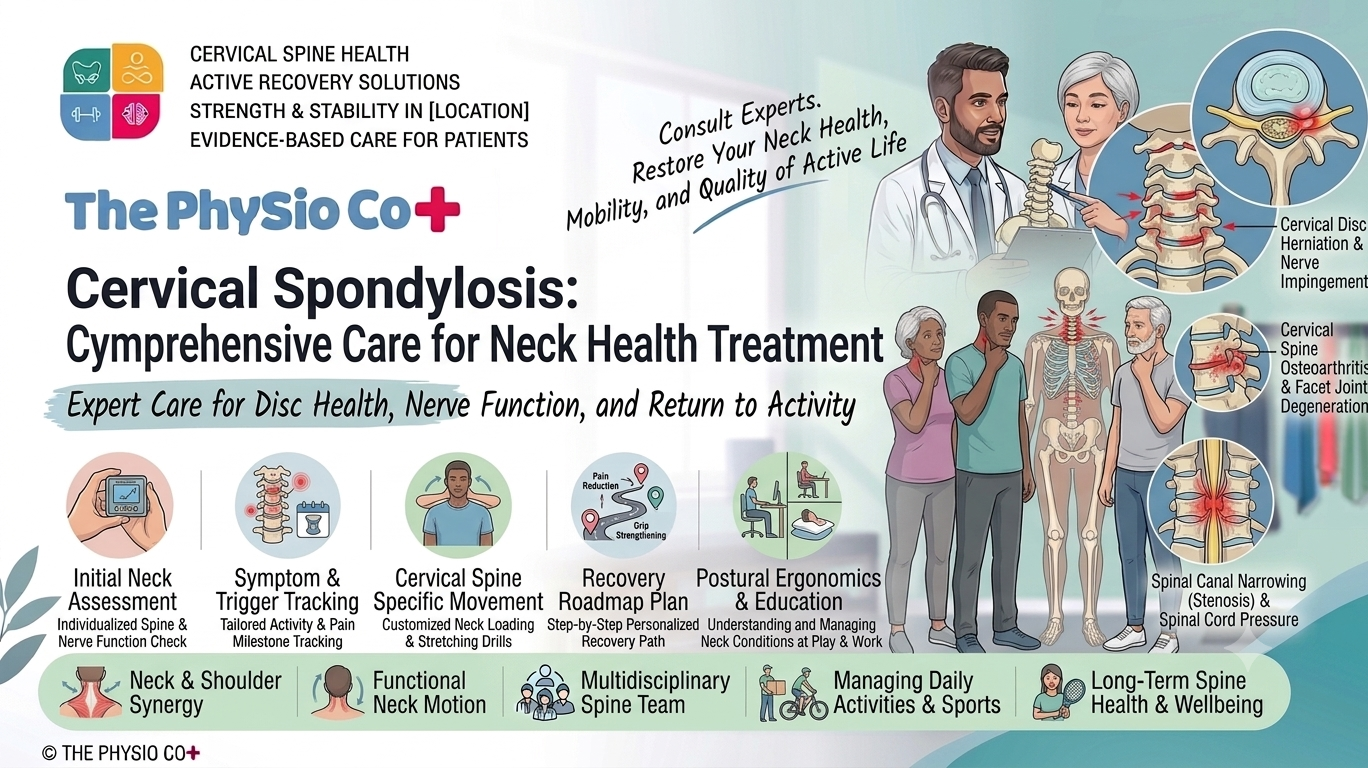

Cervical Spondylosis
Cervical spondylosis is a common condition affecting the bones, discs and joints of the neck. It is often associated with age-related changes in the cervical spine, although symptoms can vary considerably between individuals.
Some people have changes visible on an X-ray or MRI but have little or no pain. Others may experience neck pain, stiffness, headaches or symptoms extending into the shoulder and arm.
Physiotherapy can play an important role in managing symptoms, improving neck and upper-limb function, and helping people return to their usual activities.
If you are searching for cervical spondylosis physiotherapy in Delhi, understanding the condition and available treatment options can help you make an informed decision about your care.
What Is Cervical Spondylosis?
The cervical spine consists of seven vertebrae in the neck.
Between the vertebrae are discs that help absorb forces and allow movement. The cervical spine also contains facet joints, ligaments, muscles and nerves.
Over time, these structures can undergo degenerative changes.
These may include:
- Changes in the intervertebral discs
- Reduced disc height
- Formation of bone spurs
- Changes in the facet joints
- Stiffness of the cervical spine
- Changes around the spaces through which nerves pass
These age-related changes are commonly referred to as cervical spondylosis.
Importantly, the presence of degenerative changes on imaging does not automatically mean that they are the cause of someone’s pain.
Cervical Spondylosis vs Cervical Spondylitis
The terms are sometimes used interchangeably, but they are not exactly the same.
Cervical spondylosis generally refers to degenerative or age-related changes in the cervical spine.
Cervical spondylitis is a less precise term that is sometimes used to describe neck pain or inflammation-related conditions.
For degenerative changes in the cervical spine, cervical spondylosis is generally the more appropriate term.
What Causes Cervical Spondylosis?
The main factor associated with cervical spondylosis is the normal aging process.
Risk may also be influenced by:
- Previous neck injuries
- Repetitive physical loading
- Occupational demands
- Prolonged static postures
- Reduced physical activity
- Genetic factors
- Previous spinal problems
However, cervical spondylosis is not simply caused by “bad posture.”
Posture may influence symptoms in some people, but degenerative changes are influenced by multiple factors.
What Are the Symptoms of Cervical Spondylosis?
Symptoms can range from mild stiffness to more significant neck and neurological symptoms.
Common symptoms include:
- Neck pain
- Neck stiffness
- Reduced neck movement
- Pain around the shoulder
- Upper-back discomfort
- Headaches associated with neck problems
- Muscle tightness
- Pain that increases with certain movements
Some people may also develop nerve-related symptoms.
Cervical Spondylosis With Nerve Symptoms
If a nerve root becomes irritated or compressed, symptoms may travel from the neck into the arm.
This may include:
- Arm pain
- Tingling
- Numbness
- Pins and needles
- Weakness
- Altered sensation
This is sometimes referred to as cervical radiculopathy.
Not everyone with cervical spondylosis develops nerve compression.
Can Cervical Spondylosis Cause Headaches?
Neck problems can contribute to certain types of headaches, particularly headaches associated with the upper cervical region.
These headaches may be accompanied by:
- Neck stiffness
- Reduced neck movement
- Pain around the back of the head
- Pain that changes with neck movement
However, not every headache is caused by the cervical spine.
A new, severe or unusual headache should be medically assessed rather than automatically attributed to cervical spondylosis.
Can Cervical Spondylosis Cause Dizziness?
Some people report dizziness or imbalance along with neck symptoms.
However, dizziness has many possible causes and should not automatically be assumed to be caused by cervical spondylosis.
If dizziness is new, severe, recurrent or associated with neurological symptoms, medical assessment is important.
How Is Cervical Spondylosis Diagnosed?
Diagnosis generally involves a combination of:
- Medical history
- Symptom assessment
- Physical examination
- Neurological examination when indicated
- Functional assessment
- Imaging when clinically appropriate
An X-ray may show degenerative changes.
MRI can provide more information about discs, nerves and the spinal cord when clinically indicated.
However, imaging findings need to be interpreted alongside symptoms and examination findings.
Does Everyone With Cervical Spondylosis Need an MRI?
No.
Imaging is not automatically required for every person with neck pain.
A healthcare professional may recommend imaging when:
- Symptoms are persistent
- Neurological symptoms are present
- There is concern about nerve or spinal cord involvement
- There is a history of significant trauma
- Symptoms are unusual
- Conservative treatment has not produced the expected improvement
Imaging decisions should be based on the clinical presentation.
Can Physiotherapy Help Cervical Spondylosis?
Yes.
Physiotherapy can be an important part of conservative management for many people with neck pain associated with cervical spondylosis.
Treatment may focus on:
- Pain management
- Restoring neck movement
- Improving cervical and thoracic mobility
- Strengthening neck and upper-back muscles
- Improving shoulder function
- Addressing activity-related aggravating factors
- Improving confidence with movement
- Gradually returning to normal activities
The exact treatment should be individualized.
Physiotherapy Treatment for Cervical Spondylosis
1. Exercise Therapy
Exercise is an important component of rehabilitation.
Depending on the person’s presentation, exercises may target:
- Deep neck flexor muscles
- Cervical extensor muscles
- Scapular muscles
- Upper-back muscles
- Shoulder muscles
- Trunk muscles
The exercises should be progressed according to symptoms and physical capacity.
2. Cervical Mobility Exercises
Gentle mobility exercises may help people who have stiffness and restricted neck movement.
Examples include controlled:
- Neck rotation
- Neck flexion
- Neck extension
- Side bending
Movements should remain within a comfortable range and should not reproduce significant neurological symptoms.
3. Deep Neck Flexor Strengthening
Deep neck flexor exercises are often used to improve cervical muscle control.
One common approach involves gently drawing the chin backward without aggressively bending the neck.
The movement should be controlled rather than forceful.
4. Scapular Strengthening
The shoulder blades and upper back contribute to overall upper-quarter function.
Exercises may target:
- Mid trapezius
- Lower trapezius
- Serratus anterior
- Rhomboids
Examples include:
- Resistance-band rows
- Scapular retraction exercises
- Wall exercises
- Controlled shoulder movements
5. Thoracic Mobility
The upper back can influence overall neck movement.
Exercises may include:
- Thoracic extension
- Thoracic rotation
- Postural mobility exercises
Improving thoracic movement can help distribute movement demands across the upper spine.
Cervical Spondylosis Exercises at Home
A physiotherapist may recommend exercises such as:
Chin Tucks
- Sit or stand comfortably.
- Keep your eyes facing forward.
- Gently draw your chin backward.
- Avoid looking down.
- Hold briefly.
- Relax and repeat.
Gentle Neck Rotation
- Sit upright.
- Slowly turn your head to one side.
- Return to the centre.
- Repeat on the other side.
- Stay within a comfortable range.
Neck Side Flexion
- Sit upright.
- Slowly bring your ear toward your shoulder.
- Do not lift the shoulder.
- Return to the starting position.
- Repeat on the opposite side.
Resistance-Band Rows
- Secure the band safely.
- Hold the handles.
- Pull the arms backward while gently bringing the shoulder blades together.
- Return slowly.
- Repeat.
The appropriate repetitions and resistance depend on the individual’s condition.
Should You Exercise With Cervical Spondylosis?
In many cases, yes.
Exercise is generally an important part of managing persistent neck pain.
However, exercise should be appropriately selected and progressed.
A common mistake is either:
Doing nothing because the spine is “degenerative”
or
Doing too much too quickly.
The goal is to gradually improve movement and strength while monitoring symptoms.
Can Cervical Spondylosis Be Cured?
Cervical spondylosis involves structural changes that are commonly associated with aging.
Physiotherapy cannot reverse normal age-related changes in the spine.
However, treatment can help improve:
- Pain
- Movement
- Strength
- Physical function
- Exercise tolerance
- Ability to perform daily activities
The focus is therefore usually on managing symptoms and improving function, rather than trying to make the spine look normal on an X-ray or MRI.
Can Cervical Spondylosis Be Treated Without Surgery?
Many people with cervical spondylosis can initially be managed conservatively.
Treatment may include:
- Education
- Exercise therapy
- Activity modification
- Physiotherapy
- Medication when prescribed by a doctor
- Other appropriate conservative treatments
Surgery may be considered in selected cases, particularly when there is significant neurological involvement or symptoms that do not respond appropriately to conservative treatment.
The need for surgery should be assessed by an appropriate medical specialist.
What About Manual Therapy?
Manual therapy may be used as part of physiotherapy for selected patients.
It may include techniques directed at:
- Cervical or thoracic joints
- Soft tissues
- Muscles
However, manual therapy is generally best used alongside an active exercise program rather than as the only treatment.
The treatment approach should