
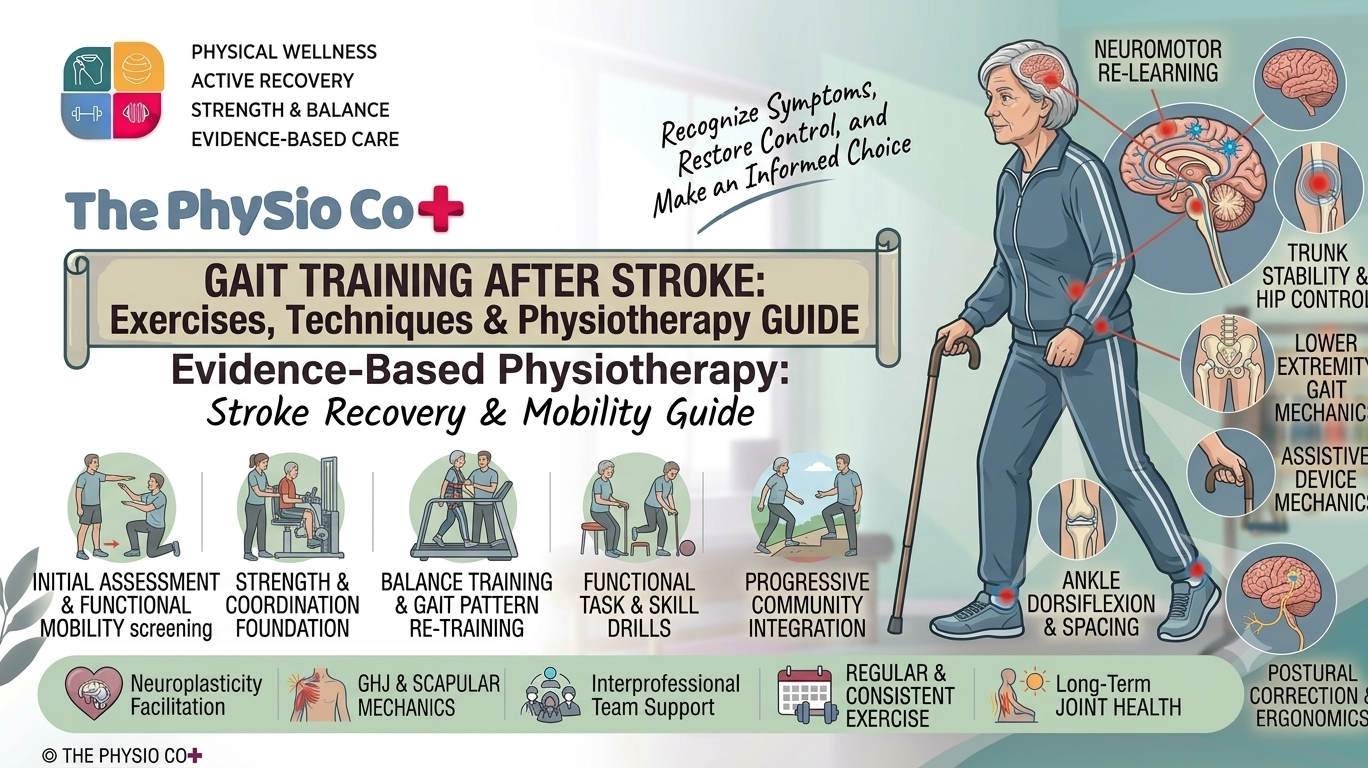

Gait Training After Stroke
Walking is one of the most important goals for many people after a stroke.
A stroke can affect muscle strength, balance, coordination, sensation and the ability to control one side of the body. As a result, a person may develop difficulty standing, taking steps, clearing the foot, maintaining balance or walking safely over different surfaces.
Gait training after stroke focuses on practising walking and the movements required for walking in a safe, repetitive and progressive way.
Modern stroke rehabilitation guidelines emphasise task-specific and repetitive practice, with walking practice forming an important part of rehabilitation for people who have mobility limitations.
The aim is not simply to make a person walk faster. Physiotherapy may also focus on improving safety, endurance, balance, independence and the ability to manage real-world walking situations.
What Is Gait Training After Stroke?
Gait training is a structured rehabilitation approach used to improve walking ability after stroke.
It may include:
- Practising standing and weight shifting
- Step training
- Walking with assistance
- Over-ground walking
- Treadmill walking
- Balance training
- Strengthening exercises
- Foot and ankle control
- Walking with an appropriate walking aid
- Stair practice
- Turning and changing direction
- Walking on different surfaces
- Dual-task walking
- Sport or community-specific walking activities
The exact programme depends on the person’s neurological impairments, strength, balance, cardiovascular fitness, goals and current walking ability.
Why Does Walking Become Difficult After a Stroke?
Stroke can affect different parts of the nervous system responsible for movement and coordination.
Common problems include:
Muscle weakness
Weakness on one side of the body can make it difficult to support body weight or move the leg forward.
Reduced balance
A person may feel unstable while standing or walking, particularly when turning or changing direction.
Poor motor control
The person may have difficulty controlling the timing and coordination of movements.
Foot drop
Weakness of the muscles that lift the foot can cause the toes to catch the ground during walking.
Spasticity
Increased muscle stiffness can interfere with normal movement patterns.
Reduced sensation
Changes in sensation can affect awareness of the position of the foot and leg.
Reduced endurance
Walking may require significantly more effort after stroke, resulting in fatigue during relatively short distances.
Fear of falling
Previous falls or poor balance can make a person hesitant to walk, which may further reduce activity.
These problems can occur individually or together.
What Does a Physiotherapist Assess Before Gait Training?
Gait rehabilitation should begin with an individual assessment.
A physiotherapist may assess:
- Muscle strength
- Joint range of motion
- Muscle tone and spasticity
- Balance
- Coordination
- Sensation
- Postural control
- Weight-bearing ability
- Standing ability
- Walking speed
- Walking endurance
- Step length
- Foot clearance
- Use of walking aids
- Risk of falls
- Cardiovascular response to exercise
- Ability to perform everyday activities
Assessment should also consider the person’s goals.
For example, one person may want to walk independently around their home, while another may want to walk outdoors, use public spaces or return to work.
Stroke guidelines recommend assessing mobility and periodically reviewing walking ability, including real-world tasks such as walking over uneven ground, managing inclines and dealing with busy environments.
What Are the Main Goals of Gait Training?
The goals vary from person to person.
Common goals include:
- Improving walking safety
- Increasing walking distance
- Improving walking speed
- Improving balance
- Improving step symmetry where appropriate
- Improving foot clearance
- Increasing leg strength
- Improving endurance
- Reducing dependence on assistance
- Improving confidence
- Making everyday walking easier
- Improving community mobility
The goal is not necessarily to create a “perfect” walking pattern.
Instead, rehabilitation should focus on safe, functional and meaningful walking.
Gait Training Exercises After Stroke
Exercises should be selected according to the person’s current abilities. A person who cannot stand safely should not begin with advanced walking drills.
Some commonly used components include:
1. Sit-to-Stand Practice
Sit-to-stand training helps develop the strength and control required for getting up from a chair.
It may help train:
- Quadriceps
- Gluteal muscles
- Trunk control
- Weight shifting
- Functional movement
The physiotherapist may modify the height of the chair or provide assistance depending on ability.
2. Weight-Shifting Exercises
The person practises transferring weight from one side to the other while standing safely.
Examples include:
- Side-to-side weight shifts
- Forward and backward weight shifts
- Reaching while standing
- Controlled loading of the affected leg
Weight-shifting practice can help prepare the person for taking steps.
3. Step Training
The patient may practise stepping forward, backward or sideways.
This can be progressed gradually from:
Supported stepping → independent stepping → repeated stepping → functional stepping
The amount of assistance is adjusted according to safety and ability.
4. Marching in Place
Marching can help practise:
- Hip flexion
- Alternating leg movement
- Weight transfer
- Single-leg loading
It should be performed with appropriate support if balance is limited.
5. Heel and Toe Control
The ability to control the foot during walking is important.
Exercises may target:
- Ankle dorsiflexion
- Plantarflexion
- Foot placement
- Toe clearance
For people with significant foot drop, an ankle-foot orthosis or functional electrical stimulation may sometimes be considered following an appropriate assessment.
Treadmill Gait Training After Stroke
Treadmill training can be used as part of stroke rehabilitation for appropriate patients.
It allows repetitive walking practice while speed and other variables can be adjusted.
Depending on the person’s ability, treadmill training may be performed:
- With therapist supervision
- With hand support
- With body-weight support
- With an appropriate safety harness
- With progression of speed or duration
Evidence-based stroke guidelines support intensive walking training, including treadmill-based approaches where appropriate.
However, treadmill training is not appropriate for everyone, particularly when a person cannot safely participate without additional support.
Body-Weight-Supported Gait Training
Some people cannot initially support their full body weight during walking.
Body-weight-supported systems can reduce the amount of weight that needs to be supported while allowing the person to practise stepping.
This may be useful in selected patients with significant mobility limitations.
As the person’s ability improves, the amount of support can be progressively reduced.
For people who cannot walk independently, stroke guidelines recommend considering electromechanical-assisted gait training, including body-weight support, as part of rehabilitation.
Gait Training With Walking Aids
A walking aid is not necessarily a sign that rehabilitation has failed.
A suitable walking aid can allow a person to practise walking more safely and independently.
Depending on the individual’s needs, this may include:
- Walking stick
- Quad cane
- Tripod cane
- Walking frame
- Rollator
- Other prescribed mobility equipment
The correct device depends on:
- Balance
- Strength
- Coordination
- Weight-bearing ability
- Home environment
- Walking goals
- Cognitive and visual factors
The physiotherapist should also teach the person how to use the aid safely.
Stroke guidelines recommend assessment and training in appropriate mobility aids when mobility is limited.
Foot Drop After Stroke
Foot drop is common after neurological injury.
The person may have difficulty lifting the front of the foot during the swing phase of walking.
This can cause:
- Toes catching the ground
- Reduced walking confidence
- Increased risk of tripping
- Compensatory movements
- Difficulty walking quickly
Depending on the individual’s assessment, options may include:
Exercise
Strengthening and motor-control exercises may be used where appropriate.
Ankle-Foot Orthosis
An AFO can help support the ankle and foot during walking.
Functional Electrical Stimulation
FES can stimulate the relevant nerves and muscles during walking in selected patients.
NICE recommends considering ankle-foot orthoses for people after stroke who have problems with foot clearance or stance-phase control that affect walking.
The device should be individually assessed and fitted rather than selected solely on the basis of diagnosis.
Balance Training After Stroke
Walking requires more than leg strength.
A person must continuously control their body while:
- Standing
- Stepping
- Turning
- Stopping
- Reaching
- Changing direction
- Walking around obstacles
Balance training may therefore include:
- Supported standing
- Weight shifting
- Reaching
- Stepping exercises
- Single-leg loading
- Turning
- Obstacle negotiation
- Dynamic balance exercises
Stroke guidelines recommend progressive balance training using repetitive and functional activities.
Strength Training After Stroke
Weakness can significantly affect walking.
A physiotherapist may prescribe strengthening exercises for:
- Quadriceps
- Hamstrings
- Gluteal muscles
- Calf muscles
- Hip muscles
- Trunk muscles
Exercises may include:
- Sit-to-stand
- Step-ups
- Bridging
- Supported squats
- Resistance exercises
- Calf raises
- Functional strengthening
Strength training should be progressed according to the person’s ability and medical status.
Stroke rehabilitation guidelines recommend task-specific and repetitive strengthening exercises for people whose weakness limits activity.
Walking Speed and Endurance
Walking faster is not always the first goal.
Initially, the focus may be:
Safe walking → controlled walking → longer walking → faster walking
As the person improves, rehabilitation may include cardiovascular conditioning and longer periods of walking.
Walking-based cardiorespiratory training can help improve fitness, walking capacity and mobility after stroke.
Exercise intensity should be individualised, particularly in people with cardiovascular disease or other medical conditions.
Real-World Gait Training
Walking inside a clinic is only one part of recovery.
Real life may involve:
- Uneven ground
- Slopes
- Stairs
- Crowded areas
- Doorways
- Obstacles
- Different surfaces
- Carrying an object
- Talking while walking
- Crossing roads
- Walking longer distances
Therefore, advanced gait rehabilitation may gradually include these situations when they are safe.
The National Clinical Guideline for Stroke specifically recommends assessment of real-world walking, including uneven ground, distances, inclines, dual-tasking, vision, neglect and confidence in busy environments.
Dual-Task Walking After Stroke
Some people can walk reasonably well when concentrating only on walking but struggle when another task is added.
For example:
Walking + talking
or
Walking + carrying an object
or
Walking + looking around
This is called dual-tasking.
It can be particularly relevant for community mobility because everyday walking rarely happens in a completely distraction-free environment.
Dual-task training should only be introduced when appropriate and with suitable safety precautions.
How Often Should Gait Training Be Done?
There is no single schedule that is suitable for every person after stroke.
The amount of training depends on:
- Stroke severity
- Medical stability
- Fatigue
- Cardiovascular fitness
- Balance
- Current walking ability
- Rehabilitation goals
- Ability to tolerate exercise
Current stroke guidelines emphasise that greater amounts of appropriately selected, task-specific practice can support recovery. The National Clinical Guideline for Stroke recommends intensive rehabilitation where tolerated and individualised to the person’s goals and impairments.
Importantly, “intensive” does not mean pushing every patient to exhaustion.
Training should be appropriately dosed and monitored.
Can Gait Improve Years After a Stroke?
Yes, rehabilitation can remain relevant beyond the early phase.
Stroke rehabilitation is not limited to the first few months.
People may continue to work on:
- Walking speed
- Endurance
- Balance
- Strength
- Community mobility
- Stair climbing
- Confidence
- Fitness
- Functional independence
The National Clinical Guideline for Stroke states that people with stroke should be considered to have potential to benefit from rehabilitation at any point after their stroke.
However, the amount and type of improvement varies between individuals.
How Long Does It Take to Improve Walking After Stroke?
There is no fixed timeline.
Recovery depends on:
- Location and severity of the stroke
- Initial weakness
- Balance
- Sensory changes
- Cognitive function
- Medical complications
- Fitness
- Age and general health
- Rehabilitation intensity
- Ability to practise outside therapy
- Individual goals
Some people improve significantly during the early stages, while others continue making functional gains much later.
Instead of asking only:
“How many days will it take?”
it is often more useful to track measurable changes such as:
- Walking distance
- Walking speed
- Number of steps
- Level of assistance
- Balance
- Ability to climb stairs
- Ability to walk outdoors
When Should a Person With Stroke See a Physiotherapist?
A neurological physiotherapy assessment may be useful if a person:
- Has difficulty walking after stroke
- Needs help getting out of a chair
- Has frequent falls
- Has foot drop
- Walks with significant asymmetry
- Feels unstable
- Gets tired quickly while walking
- Uses a walking aid but is unsure how to use it
- Has difficulty climbing stairs
- Wants to improve outdoor walking
- Has stopped progressing with their current rehabilitation
- Wants to become more independent at home
A physiotherapist can assess the person’s current abilities and design an individualised gait rehabilitation programme.
Safety During Gait Training
Stroke rehabilitation should be appropriately supervised when there is a risk of falling or medical instability.
Seek medical attention for new or sudden neurological symptoms such as:
- New facial weakness
- Sudden weakness or numbness
- New speech difficulty
- Sudden severe dizziness
- New vision problems
- Sudden severe headache
- Sudden loss of coordination
These can be warning signs of another stroke or another medical emergency and should not be managed simply as a physiotherapy problem.
Gait Training After Stroke at Home
Home practice can be valuable, but it should be based on the person’s assessed abilities.
A home programme may include:
- Sit-to-stand practice
- Supported weight shifting
- Repeated stepping
- Walking short distances
- Strengthening exercises
- Balance exercises
- Foot and ankle exercises
The exact exercises and level of supervision should be individualised.
A person with significant balance problems should not practise unsupported walking alone.
Family members and caregivers can also be taught safe ways to support practice without unnecessarily doing the movement for the patient.
Common Mistakes During Stroke Gait Rehabilitation
1. Focusing only on walking speed
Faster walking is useful, but safety, balance, endurance and independence also matter.
2. Avoiding the affected side
People may unconsciously place more weight on the stronger side.
Rehabilitation may include appropriate practice of loading and using the affected side.
3. Walking only in the clinic
Real-world walking skills should gradually be incorporated into rehabilitation.
4. Using a walking aid incorrectly
The wrong aid or incorrect technique can increase difficulty and reduce safety.
5. Stopping rehabilitation once walking returns
Walking independently does not necessarily mean that endurance, balance and community mobility have fully recovered.
6. Doing exercises without considering fatigue
Post-stroke fatigue can significantly affect participation. Training needs to be adjusted accordingly.
Gait Training and Neurological Physiotherapy in Delhi
Gait rehabilitation after stroke requires more than simply practising walking.
A physiotherapist may combine:
Assessment → Strengthening → Balance training → Weight shifting → Step training → Walking practice → Gait correction → Endurance training → Community mobility
At The Physio Co+, neurological physiotherapy can be tailored according to the individual’s walking ability, functional limitations and rehabilitation goals.
For people looking for stroke physiotherapy in Delhi, stroke rehabilitation in Vasant Kunj, or neuro physiotherapy in Delhi, an individual assessment can help determine the most appropriate rehabilitation approach.
Learn more about physiotherapy and neurological rehabilitation.
FAQs
Can physiotherapy help a stroke patient walk again?
Physiotherapy can help improve walking ability in many people after stroke through repetitive, task-specific practice, strengthening, balance training and progressive walking exercises. The amount of recovery varies considerably between individuals.
Is treadmill training good after stroke?
Treadmill training can be useful for selected people after stroke, particularly when it allows safe and repetitive walking practice. It should be prescribed according to the person’s abilities and goals.
Can a stroke patient walk without a walker?
Some people can progress from a walker to a cane and eventually to independent walking, while others may continue to require an assistive device. The decision should be based on safety, balance, strength and functional ability rather than simply trying to stop using the device.
What if the patient has foot drop?
Foot drop should be assessed by a neurological physiotherapist. Depending on the cause and severity, treatment may include exercises, an ankle-foot orthosis or functional electrical stimulation.
Can gait training help after an old stroke?
Yes. People can continue to benefit from appropriately designed rehabilitation even long after the initial stroke.
How can I improve walking speed after stroke?
Walking speed can be addressed through progressive walking practice, strengthening, balance training, cardiovascular conditioning and task-specific gait exercises when appropriate.
Should stroke patients walk every day?
Activity is generally encouraged when medically appropriate, but the amount and intensity should be individualised. Fatigue, cardiovascular status, balance and fall risk should be considered.
Key Takeaway
Gait training after stroke is not simply about making someone walk.
It involves practising the skills needed for safe and functional mobility:
- Standing
- Weight shifting
- Stepping
- Balance
- Strength
- Foot clearance
- Walking
- Turning
- Stairs
- Uneven surfaces
- Endurance
- Community mobility
Current stroke rehabilitation guidance supports repetitive, task-specific and appropriately intensive practice, with walking training and functional activities forming important parts of rehabilitation.
The right programme depends on the individual’s neurological impairments, current mobility, medical status and personal goals.
References
- National Institute for Health and Care Excellence (NICE). Stroke rehabilitation in adults (NG236). 2023.
- National Clinical Guideline for Stroke. Rehabilitation and recovery – motor recovery and physical effects of stroke. 2023.
- National Clinical Guideline for Stroke. Walking – rehabilitation and recovery after stroke. 2023.
- National Clinical Guideline for Stroke. Balance and falls – rehabilitation after stroke. 2023.
- National Clinical Guideline for Stroke. Principles of rehabilitation and recovery. 2023.