

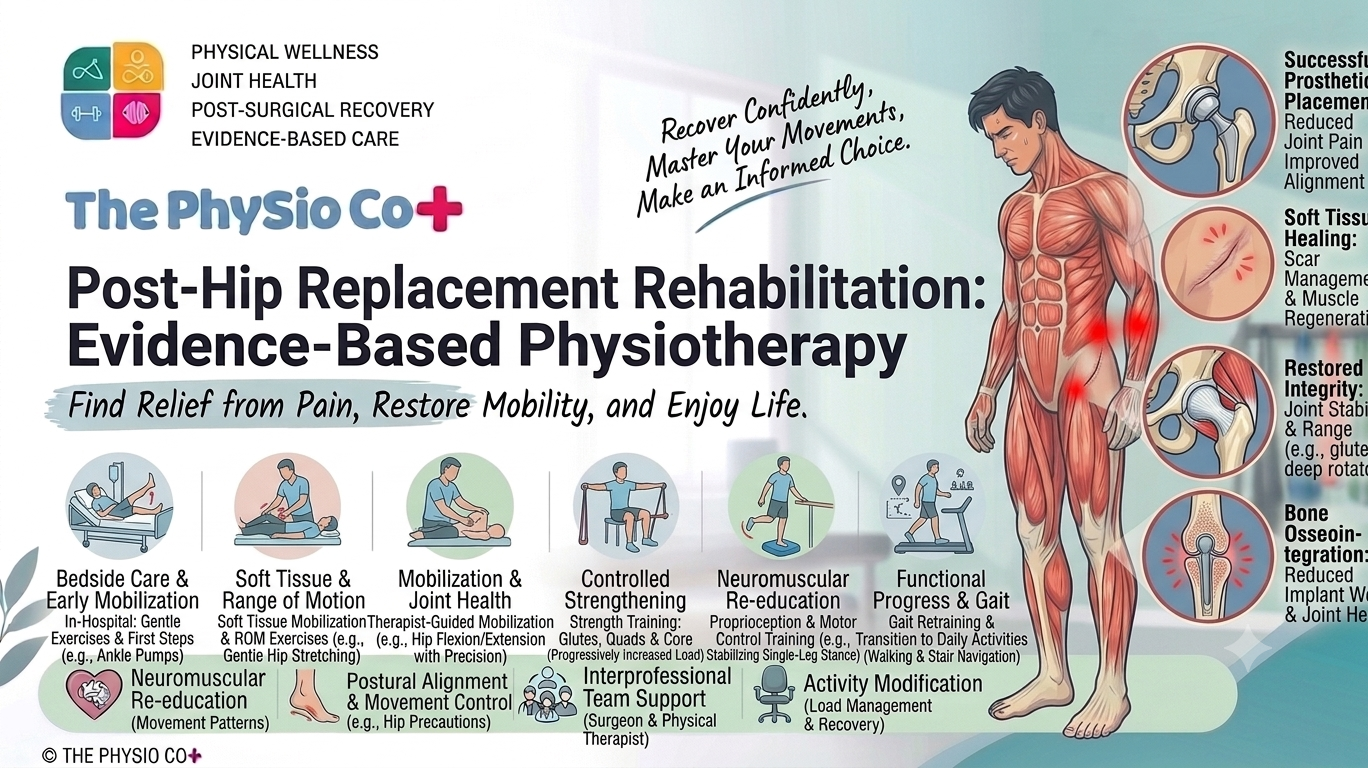

Post Hip Replacement Rehabilitation
Hip replacement surgery can help reduce pain and improve movement when a damaged hip joint is significantly affecting daily life.
But surgery is only one part of recovery.
After a total hip replacement (THR), rehabilitation helps you gradually restore strength, mobility, balance and confidence so that you can return to your normal activities.
If you are looking for post hip replacement physiotherapy in Delhi or THR rehabilitation in Delhi, this guide explains what recovery usually involves, which exercises may be used and when you can gradually return to everyday activities.
What Is Hip Replacement Surgery?
Hip replacement surgery involves replacing damaged parts of the hip joint with artificial components.
A total hip replacement generally replaces:
- The damaged femoral head
- The damaged surface of the hip socket
Hip replacement may be recommended for people with significant joint damage and persistent symptoms, commonly due to conditions such as osteoarthritis.
The exact surgical approach and precautions can vary between patients.
Why Is Physiotherapy Important After Hip Replacement?
After surgery, it is normal to experience:
- Pain
- Swelling
- Muscle weakness
- Stiffness
- Reduced walking ability
- Reduced balance
- Fear of putting weight through the operated leg
Physiotherapy helps you gradually work through these problems.
The main goals are to:
Reduce unnecessary limitations → Restore movement → Build strength → Improve balance → Improve walking → Return to daily activities
When Does Rehabilitation Start After Hip Replacement?
Rehabilitation usually begins early after surgery, often during the hospital stay.
Early rehabilitation may focus on:
- Getting safely out of bed
- Sitting and standing
- Walking with appropriate support
- Basic exercises
- Learning how to move safely
The exact timing depends on the surgical procedure, medical condition and surgeon’s instructions.
Hip Replacement Rehabilitation Stages
Recovery is not exactly the same for everyone.
A typical rehabilitation program can be divided into stages.
Stage 1: Early Recovery
The initial focus is on safe movement and basic independence.
Goals may include:
- Managing pain and swelling
- Getting in and out of bed
- Standing safely
- Walking with a walker or other appropriate aid
- Performing basic exercises
- Managing everyday activities
At this stage, quality of movement is more important than doing a large number of repetitions.
Stage 2: Improving Walking and Strength
As recovery progresses, rehabilitation focuses more on:
- Increasing walking distance
- Improving hip strength
- Improving leg strength
- Improving balance
- Reducing dependence on walking aids
- Improving confidence
Your physiotherapist may gradually increase exercise resistance and walking demands.
Stage 3: Functional Rehabilitation
Once basic strength and movement improve, exercises can become more functional.
This may include:
- Sit-to-stand exercises
- Step-ups
- Controlled squats
- Balance exercises
- Longer walks
- Stair practice
The goal is to make everyday activities easier.
Stage 4: Return to Normal Activities
Later rehabilitation focuses on returning to your normal lifestyle.
Depending on your age, strength, occupation and activity goals, this may include:
- Longer walks
- Cycling
- Swimming
- Recreational activities
- Gym exercises
- Selected sports
High-impact activities should only be resumed after discussing them with your surgeon or physiotherapist.
Hip Replacement Exercises
The exercises used after surgery depend on your stage of recovery.
1. Ankle Pumps
This is often introduced early after surgery.
- Lie or sit comfortably.
- Move your ankle up and down.
- Repeat gently.
Ankle movements can help maintain circulation while you are less active.
2. Quadriceps Contractions
- Lie comfortably with your leg supported.
- Gently tighten the muscles at the front of your thigh.
- Hold briefly.
- Relax.
This helps maintain activation of the quadriceps muscles.
3. Gluteal Contractions
- Lie comfortably.
- Gently tighten your buttock muscles.
- Hold for a few seconds.
- Relax.
This helps activate the muscles around the hip.
4. Heel Slides
- Lie on your back.
- Slowly slide your heel towards your body.
- Move only within your comfortable range.
- Slowly return the leg.
Your physiotherapist can advise whether this exercise is appropriate for your surgical approach and stage of recovery.
5. Sit-to-Stand
Once you are ready:
- Sit on a stable chair.
- Place your feet comfortably.
- Lean forward appropriately.
- Stand using controlled movement.
- Sit down slowly.
This is an important functional exercise because getting up from a chair is part of everyday life.
6. Step-Ups
As strength improves:
- Stand near a secure step.
- Step up with control.
- Bring the other leg up.
- Step down carefully.
- Repeat as appropriate.
This can help prepare you for stairs and everyday activities.
How Much Should You Walk After Hip Replacement?
Walking is usually an important part of recovery.
However, more walking is not always better.
Your walking distance should increase gradually according to:
- Pain
- Swelling
- Strength
- Walking quality
- Fatigue
- Your surgeon’s instructions
If your walking becomes increasingly painful or your gait becomes significantly worse after increasing activity, your rehabilitation load may need to be adjusted.
When Can You Walk Without a Walker?
There is no universal timeline.
Some people progress from:
Walker → Cane → Independent walking
Others may require a walking aid for longer.
The important factor is not how quickly you stop using the walker.
You should be able to walk safely with appropriate control before removing an aid.
When Can You Climb Stairs After Hip Replacement?
Stair practice is often introduced early when medically appropriate.
Initially, you may use a specific technique and a handrail.
As strength and balance improve, you can gradually work toward a more natural stair pattern.
Your physiotherapist can assess whether you are ready to progress.
When Can You Drive After Hip Replacement?
Driving should only be resumed when you can safely control the vehicle and perform emergency movements without significant limitation.
Your surgeon’s advice, local driving regulations, medication use and the type of surgery should all be considered.
Do not drive simply because a certain number of weeks has passed.
When Can You Return to Work?
This depends on the type of work.
A person with a desk-based job may return earlier than someone whose job involves:
- Heavy lifting
- Repeated squatting
- Long periods of standing
- Climbing
- Manual labour
Your physiotherapist can help assess whether your strength and movement are appropriate for your work demands.
Can You Sleep on the Operated Side?
This depends on your recovery and your surgeon’s instructions.
Some people are advised to avoid certain positions during the early recovery period.
Do not force yourself into a position simply because it feels comfortable.
Follow the specific precautions provided by your surgical team.
Hip Replacement Precautions
Hip precautions vary depending on factors such as:
- Surgical approach
- Surgeon preference
- Individual risk factors
- Stability of the hip
Some patients may receive restrictions on certain hip movements during the early recovery period.
Do not assume that every hip replacement patient has exactly the same precautions.
Your surgeon or physiotherapist should explain the movements and positions you need to avoid.
Can You Bend After Hip Replacement?
You may have temporary restrictions on how far you can bend your hip, depending on your surgical approach and your surgeon’s instructions.
As healing progresses, movement is generally reintroduced gradually.
Your physiotherapist can teach you safer ways to perform activities such as:
- Putting on clothes
- Picking something up
- Getting into a car
- Getting out of bed
- Sitting down
Why Is My Leg Weak After Hip Replacement?
Weakness after surgery is common.
Several factors can contribute:
- Pain
- Reduced activity before surgery
- Surgical trauma
- Time spent resting
- Reduced muscle use
- Fear of movement
The hip muscles, quadriceps and other lower-limb muscles may need progressive strengthening.
Why Am I Limping After Hip Replacement?
A limp may occur because of:
- Weak hip muscles
- Pain
- Reduced balance
- Reduced confidence
- Habitual movement patterns
- Unequal strength between the legs
Physiotherapy can help identify the reason for the limp and gradually improve walking mechanics.
Using a walking aid temporarily is not a failure. It can sometimes help you walk more safely while strength returns.
How Long Does Hip Replacement Rehabilitation Take?
Recovery varies considerably.
Many people continue improving for several months after surgery.
Factors affecting recovery include:
- Age
- Pre-surgery strength
- Overall health
- Surgical approach
- Pain levels
- Muscle weakness
- Activity requirements
- Consistency with rehabilitation
There is no single date when everyone is expected to be completely recovered.
Can You Exercise After Hip Replacement?
Yes.
Exercise is an important part of long-term recovery.
Once your surgeon and physiotherapist have cleared you for progression, exercise may include:
- Walking
- Strength training
- Stationary cycling
- Swimming
- Balance exercises
- Mobility exercises
- Functional strengthening
Exercise intensity should increase gradually.
Can You Go to the Gym After Hip Replacement?
Many people return to gym-based exercise after hip replacement.
However, the exercises should be selected according to your stage of recovery.
Early rehabilitation may focus on simple movements and controlled resistance.
Later, you may progress to:
- Leg strengthening
- Hip strengthening
- Core exercises
- Balance training
- Cardiovascular exercise
Heavy or high-impact exercises should be discussed with your surgical and rehabilitation team.
Can You Squat After Hip Replacement?
Squatting ability depends on your recovery, strength, mobility and surgical precautions.
You may initially perform only shallow, supported squats.
As rehabilitation progresses, squat depth and resistance can be increased if appropriate.
The goal is controlled movement rather than forcing maximum range.
Can You Cross Your Legs After Hip Replacement?
This depends on the surgical approach and precautions given by your surgeon.
Some patients are advised to avoid crossing their legs during early recovery because certain positions may increase the risk of hip dislocation.
Follow your own surgical instructions rather than general advice from the internet.
Can You Sleep Normally After Hip Replacement?
Sleep can be uncomfortable during the early recovery period.
Finding a comfortable position may take time.
Your physiotherapist can help you understand appropriate positioning based on your surgical precautions.
Common Mistakes During Hip Replacement Recovery
1. Doing Too Much Too Soon
Feeling better does not mean that the tissues are ready for a sudden increase in activity.
Increase your activity gradually.
2. Avoiding Movement Completely
Too much rest can contribute to stiffness and weakness.
Appropriate movement is an important part of recovery.
3. Focusing Only on Pain
Pain is one important factor, but rehabilitation should also consider:
- Strength
- Balance
- Walking quality
- Function
- Confidence
4. Stopping Exercises Once Walking Improves
Walking is important, but it does not replace progressive strengthening.
5. Comparing Your Recovery With Someone Else
Two people can have very different recovery timelines.
Your rehabilitation should be based on your own function and medical advice.
When Should You Contact Your Doctor?
Contact your medical team if you develop symptoms such as:
- Increasing severe pain
- Significant swelling
- Fever
- Redness or drainage around the wound
- Sudden inability to put weight through the leg
- A sudden change in leg position
- New severe hip pain after a fall
- Sudden shortness of breath or chest pain
These symptoms should not be managed by simply increasing physiotherapy exercises.
Post Hip Replacement Physiotherapy in Delhi
If you are searching for post hip replacement physiotherapy in Delhi, hip replacement rehabilitation in Delhi, THR physiotherapy in Delhi or hip replacement rehab in Vasant Kunj, a structured rehabilitation program can help you gradually regain strength, balance, walking ability and confidence.
At The Physio Co+, post-operative rehabilitation can be tailored to your stage of recovery and may include:
- Walking rehabilitation
- Hip and leg strengthening
- Balance training
- Mobility exercises
- Functional training
- Stair practice
- Return-to-activity planning
The rehabilitation program should always take into account the instructions and precautions provided by your surgeon.
Related services: Post-Surgery Rehabilitation | Physiotherapy in Delhi | Clinical Pilates | Knee Replacement Rehabilitation
Frequently Asked Questions
How long does physiotherapy continue after hip replacement?
The duration varies depending on your recovery, strength and functional goals. Some people require a shorter rehabilitation period, while others benefit from physiotherapy for several months.
When can I walk normally after hip replacement?
Walking normally depends on strength, balance, pain and movement control. There is no single timeline that applies to everyone.
When can I stop using a walker?
You can usually progress away from a walker when you can walk safely with appropriate control. Your physiotherapist can assess when you are ready.
What exercises are good after hip replacement?
Exercises may include ankle pumps, quadriceps and gluteal contractions, heel slides, sit-to-stand exercises, strengthening, balance work and walking.
Can I exercise after hip replacement?
Yes. Exercise is an important part of recovery, but the intensity and type should progress gradually.
Can I climb stairs after hip replacement?
Stair training is commonly included in rehabilitation. Initially, you may need a specific technique and support.
Can I return to the gym after hip replacement?
Many people can return to gym-based exercise after recovery. Exercise selection and resistance should be progressed gradually.
Can I drive after hip replacement?
Driving should only resume when you can safely control the vehicle and meet your surgeon’s and local requirements.
Why am I still limping after hip replacement?
Weakness, pain, reduced balance or an altered walking pattern can contribute to a limp. Targeted rehabilitation can help address these factors.
Can physiotherapy prevent problems after hip replacement?
Physiotherapy can help restore strength, movement and function and can support a gradual return to activity. It cannot guarantee that complications will not occur.
Key Takeaway
Hip replacement surgery is the beginning of recovery, not the end of it.
A structured rehabilitation program can help you progress from:
Bed mobility → Standing → Supported walking → Independent walking → Strength training → Balance → Functional activities → Return to normal life
Your recovery should be gradual and individualized.
If you are looking for post hip replacement physiotherapy in Delhi, THR rehabilitation in Delhi or hip replacement physiotherapy in Vasant Kunj, an individual assessment can help create a rehabilitation plan appropriate for your current stage of recovery.
References
- National Institute for Health and Care Excellence (NICE). Joint replacement (primary): hip, knee and shoulder.
- American Academy of Orthopaedic Surgeons (AAOS). Total Hip Replacement and patient education resources on hip replacement recovery.
- American Association of Hip and Knee Surgeons (AAHKS). Patient education resources on total hip replacement and recovery.
- European Hip Society. Guidance and educational resources relating to total hip arthroplasty and rehabilitation.
- Artz N, Elvers KT, Lowe CM, et al. Effectiveness of physiotherapy exercise following total knee replacement: systematic review and meta-analysis. BMC Musculoskeletal Disorders.
- Coulter CL, Scarvell JM, Neeman TM, Smith PN. Physiotherapist-directed rehabilitation exercises in the outpatient or home setting improve strength, gait speed and cadence after total hip replacement: a systematic review. Journal of Physiotherapy.