

Pes Planus
Pes planus is the medical term commonly used for a foot with a reduced or flattened arch.
You may know it as flat feet or fallen arches.
Having pes planus does not automatically mean that your feet are weak or damaged. Many people have a naturally low arch and can walk, run and play sports without any problems.
However, some people develop foot pain, fatigue, balance problems or difficulty with activities.
If you are searching for pes planus physiotherapy in Delhi, this guide explains what pes planus means, its causes, symptoms, exercises and how physiotherapy can help.
What Is Pes Planus?
The foot normally has an arch along its inner side, called the medial longitudinal arch.
This arch changes shape when we stand, walk and move.
With pes planus, the arch appears lower than usual, particularly when the foot is bearing weight.
The amount of arch height can naturally vary from person to person, so there is no single “perfect” foot shape.
The important question is whether the foot is causing pain, weakness or difficulty with movement.
Is Pes Planus the Same as Flat Feet?
Yes.
Pes planus is the medical term commonly used to describe flat feet.
Other terms you may hear include:
- Flat feet
- Fallen arches
- Low arches
- Flexible flat feet
- Acquired flatfoot
These terms can describe slightly different situations, so a proper assessment is useful when symptoms are present.
What Causes Pes Planus?
Pes planus can occur for several reasons.
1. Natural Foot Development
Some people simply develop with lower arches.
This can run in families and may never cause symptoms.
2. Childhood Flat Feet
Flat-looking feet are common in young children.
The arch develops gradually as the child grows and becomes more physically active.
Many children with flexible flat feet do not require treatment.
3. Ligament and Muscle Factors
The muscles, tendons and ligaments around the foot and ankle contribute to foot stability.
Changes in their strength or function can affect the shape and control of the foot.
4. Injury
Previous injuries to the foot or ankle can change how the foot moves and bears load.
5. Tendon Problems
Problems affecting structures that support the medial side of the foot can contribute to progressive flattening of the arch in some adults.
6. Age-Related Changes
The shape and function of the foot can change over time.
Some people develop a flatter foot as they get older.
7. Increased Mechanical Load
Changes in body weight, activity levels or training load can increase the demands placed on the feet.
Types of Pes Planus
Pes planus can be broadly described based on how the foot behaves.
Flexible Pes Planus
With flexible pes planus, the arch may appear when the foot is not bearing weight but flatten when standing.
This is common and often does not cause symptoms.
Rigid Pes Planus
With rigid pes planus, the foot remains relatively flat even when it is not bearing weight.
A rigid flat foot, especially when painful, may require further assessment.
Acquired Pes Planus
Some adults develop a flatter foot after previously having a more noticeable arch.
A new change in foot shape accompanied by pain should be assessed.
What Are the Symptoms of Pes Planus?
Pes planus does not always cause symptoms.
When symptoms are present, they may include:
- Pain along the inside of the foot
- Arch pain
- Heel pain
- Ankle discomfort
- Foot fatigue
- Pain after prolonged standing
- Difficulty walking long distances
- Reduced balance
- Discomfort during running
- Difficulty with certain sports
Some people may also experience symptoms higher up the leg, but flat feet should not automatically be blamed for every knee, hip or back problem.
Can Pes Planus Cause Foot Pain?
It can be associated with foot pain in some people.
However, pain may have several possible causes.
For example:
- Plantar fasciitis
- Tendon problems
- Arthritis
- Previous injury
- Overuse
- Poorly tolerated training loads
A proper assessment helps determine whether the flat foot is actually contributing to the symptoms.
What Happens When You Stand With Pes Planus?
When you stand, body weight passes through your feet.
In a person with pes planus, the inner arch may lower and the foot may roll inward to some degree.
This movement is commonly called pronation.
Some pronation is completely normal.
The problem is not simply that the foot pronates. What matters is whether the movement is excessive for that person’s capacity and whether it is associated with pain or functional problems.
Does Pes Planus Always Need Treatment?
No.
If you have pes planus but:
- Have no pain
- Walk normally
- Can exercise comfortably
- Have no functional limitations
you may not need treatment.
Treatment becomes more relevant when symptoms or movement difficulties are present.
How Is Pes Planus Diagnosed?
Assessment usually involves looking at the foot while:
- Sitting
- Standing
- Walking
- Performing single-leg movements
A physiotherapist may assess:
- Foot posture
- Ankle movement
- Calf flexibility
- Foot strength
- Balance
- Hip strength
- Walking pattern
- Running mechanics when relevant
In some situations, a doctor may recommend imaging if there is significant pain, injury or a structural concern.
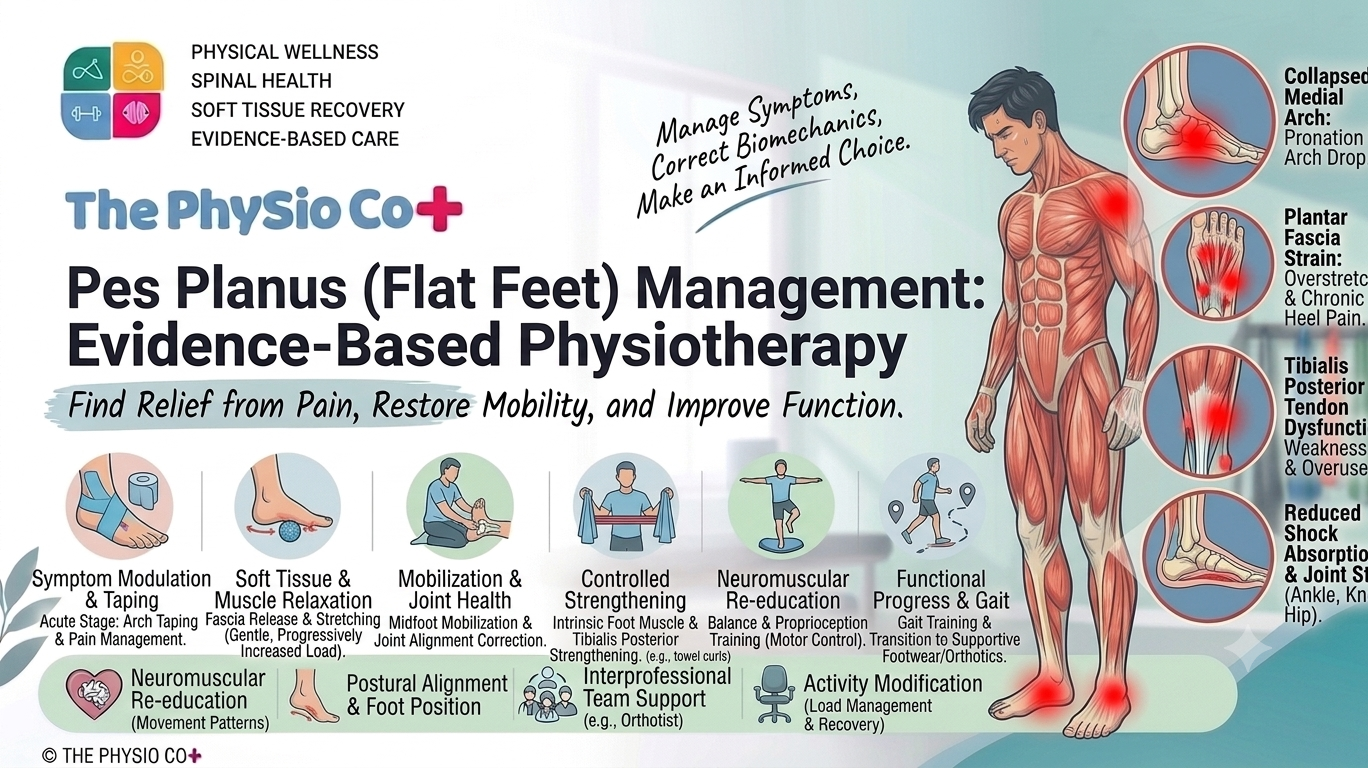
Pes Planus Physiotherapy Treatment
Physiotherapy does not necessarily aim to create a permanently higher arch.
Instead, treatment usually focuses on improving strength, control, comfort and the ability to handle daily or sporting activities.
1. Foot Strengthening
Small muscles within the foot contribute to foot control.
Exercises can help improve their strength and coordination.
2. Calf Strengthening
The calf muscles play an important role in walking, running and pushing the body forward.
Calf strengthening may therefore be included in a rehabilitation program.
3. Hip and Lower-Limb Strengthening
The foot is part of a larger movement system.
A physiotherapist may also work on:
- Gluteal strength
- Hip control
- Quadriceps strength
- Hamstring strength
- Calf strength
4. Balance Training
Balance exercises can improve the ability of the foot and ankle to control the body during standing and movement.
5. Gait Retraining
If symptoms occur during walking or running, movement patterns may be assessed.
The goal is not to force everyone into one “perfect” walking pattern, but to find a comfortable and effective way to move.
Pes Planus Exercises
The right exercises depend on the person’s symptoms and strength.
Here are some exercises that may be included in rehabilitation.
1. Short Foot Exercise
- Sit or stand comfortably.
- Keep the heel and toes on the floor.
- Gently draw the ball of the foot toward the heel.
- Avoid curling the toes.
- Hold briefly.
- Relax.
The movement should be subtle rather than forceful.
2. Calf Raises
- Stand near a stable support.
- Slowly raise your heels.
- Pause at the top.
- Lower under control.
As strength improves, this can be progressed to single-leg calf raises.
3. Single-Leg Balance
- Stand near a stable surface.
- Lift one foot.
- Maintain your balance.
- Keep the standing foot controlled.
- Repeat on the other side.
This can be progressed by adding reaching movements or other controlled tasks.
4. Toe Control Exercises
Try lifting the big toe while keeping the smaller toes down.
Then reverse the movement.
These exercises can improve awareness and control of the foot.
5. Hip Strengthening
Exercises such as:
- Bridges
- Side-lying leg raises
- Resistance-band exercises
may be included when hip weakness or poor lower-limb control is present.
Do Exercises Cure Pes Planus?
It depends on what you mean by “cure.”
Exercises can improve:
- Muscle strength
- Foot control
- Balance
- Movement quality
- Exercise tolerance
However, strengthening exercises do not necessarily permanently change the shape of an adult foot.
The goal is generally better function rather than simply changing how the arch looks.
Do Orthotics Help Pes Planus?
Foot orthoses may help some people who have painful or symptomatic pes planus.
However, having a flat foot does not automatically mean you need an orthotic.
Orthoses may be considered when they improve:
- Comfort
- Walking tolerance
- Exercise tolerance
- Symptoms
They are generally best considered alongside an overall rehabilitation plan rather than as the only treatment.
Do Flat Feet Need Special Shoes?
Not necessarily.
If you have pes planus without pain, there may be no reason to change your footwear simply because your arch is low.
If you have symptoms, comfortable footwear appropriate for your activity may help.
The right choice depends on the individual rather than one specific shoe type being suitable for everyone with pes planus.
Can Pes Planus Cause Knee Pain?
Pes planus can influence lower-limb mechanics, but this does not mean that flat feet automatically cause knee pain.
Knee pain has many possible causes.
If someone has both pes planus and knee pain, the entire lower limb should be assessed rather than assuming that the foot is the only problem.
Can Pes Planus Cause Back Pain?
There is no simple rule that pes planus causes back pain.
Walking and posture are influenced by many different factors.
If you have both flat feet and back pain, each condition should be assessed according to its symptoms and contributing factors.
Pes Planus in Children
Flat feet are common during childhood.
Young children often have a naturally flatter-looking foot, and the arch can become more noticeable as they grow.
Many children with flexible pes planus do not require treatment.
An assessment is more important if a child has:
- Persistent foot pain
- Difficulty walking
- Frequent falls
- Significant asymmetry
- Reduced physical activity
- A rigid foot
- A sudden change in foot shape
Pes Planus in Adults
Adults can have flexible flat feet without any symptoms.
However, a new or progressively worsening flat foot deserves more attention, especially if it is accompanied by:
- Pain
- Weakness
- Swelling
- Difficulty walking
- Difficulty standing on one leg
This can sometimes indicate a problem with the structures supporting the arch.
Can You Run With Pes Planus?
Yes.
Having pes planus does not automatically mean that you need to stop running.
If running is comfortable, there may be no reason to avoid it.
If running causes pain, rehabilitation may focus on:
- Strength
- Running load
- Recovery
- Foot and ankle control
- Hip strength
- Gradual progression
Suddenly increasing running distance or intensity can contribute to symptoms regardless of foot shape.
Can You Play Sports With Pes Planus?
Yes.
Many people with pes planus participate in sports without limitations.
Examples include:
- Football
- Cricket
- Badminton
- Tennis
- Basketball
- Running
- Gym training
The goal should be to improve your ability to perform the activity rather than trying to make every foot look identical.
How Long Does Pes Planus Rehabilitation Take?
There is no fixed recovery period.
If pes planus is associated with weakness or pain, improvement may occur gradually over several weeks or months.
Progress depends on:
- Severity of symptoms
- Strength
- Activity level
- Training demands
- Previous injuries
- Consistency with rehabilitation
Can Pes Planus Get Worse With Age?
Foot structure can change with age.
Some people experience progressive flattening of the arch, particularly when supporting muscles or tendons become less effective.
However, not everyone with flat feet develops worsening symptoms.
A new change in foot shape, particularly if it is painful or occurs on only one side, should be assessed.
When Should You See a Physiotherapist?
A physiotherapy assessment may be helpful if you have:
- Persistent foot pain
- Pain while walking
- Pain during running
- Repeated ankle problems
- Poor balance
- Difficulty standing for long periods
- Difficulty returning to sport
- A noticeable change in foot function
A physiotherapist can assess the foot, ankle, knee and hip as part of the overall movement pattern.
When Should You See a Doctor?
Medical assessment is recommended if:
- Your arch suddenly becomes flatter
- One foot changes significantly
- There is significant swelling
- You have severe pain
- You cannot bear weight
- The foot becomes rigid
- There has been significant trauma
- Symptoms are progressively worsening
A new adult flat foot with pain should not simply be dismissed as normal flat feet.
Pes Planus Physiotherapy in Delhi
If you are searching for pes planus physiotherapy in Delhi, pes planus treatment in Delhi, flat foot physiotherapy in Delhi or fallen arch treatment in Vasant Kunj, treatment should be based on your symptoms and functional needs.
At The Physio Co+, physiotherapy can include foot and ankle strengthening, calf strengthening, balance training, lower-limb strengthening, movement assessment and gradual return to walking, running or sports.
The aim is not simply to make the arch look higher. The focus is on helping you move comfortably and improving your ability to handle everyday and sporting activities.
Related services: Physiotherapy in Delhi | Sports Injury Physiotherapy | Pediatric Physiotherapy | Clinical Pilates
Frequently Asked Questions
What is pes planus?
Pes planus is the medical term commonly used for flat feet or a reduced foot arch.
Is pes planus the same as flat feet?
Yes. Pes planus is commonly used to describe a flat or low-arched foot.
Does pes planus always cause pain?
No. Many people have pes planus without pain or functional problems.
Can exercises correct pes planus?
Exercises can improve foot strength, control and balance, but they do not necessarily permanently change the structure of an adult foot.
What are the best exercises for pes planus?
Exercises may include short-foot exercises, calf raises, balance training, toe-control exercises and hip strengthening.
Do I need orthotics for pes planus?
Not necessarily. Orthotics may help people with painful or symptomatic flat feet, but they are not required simply because the arch is low.
Can I run with pes planus?
Yes. Many people with pes planus run normally. If running causes pain, training load and lower-limb strength may need to be assessed.
Can children outgrow pes planus?
Many children’s feet naturally change as they grow. Painful, rigid or unusual flat feet should be assessed.
Can adults develop pes planus?
Yes. Some adults develop a flatter foot over time. A new painful or progressively changing flat foot should be assessed.
Can physiotherapy help pes planus?
Yes. Physiotherapy can improve strength, balance, foot control and activity tolerance, particularly when pes planus is associated with symptoms.
Key Takeaway
Pes planus does not automatically mean that something is wrong with your feet.
A low arch can be a normal variation, especially when there is no pain or functional limitation.
When symptoms are present, treatment should focus on what your feet need to function better rather than simply trying to change their appearance.
A rehabilitation program may involve:
Assess → Strengthen → Improve balance → Train foot control → Gradually increase activity
If you are looking for pes planus physiotherapy in Delhi or flat foot treatment in Vasant Kunj, an individual assessment can help de