


Muscle Sprain and Strain Rehabilitation
Muscle and soft-tissue injuries are common in sports, exercise and everyday life. A sudden movement, awkward landing, heavy lift or overstretch can cause pain and make normal activities difficult.
People often use the words “sprain” and “strain” interchangeably, but they actually describe different types of injuries.
A strain affects a muscle or tendon, while a sprain affects a ligament.
The good news is that many mild-to-moderate sprains and strains can be managed with appropriate rehabilitation and a gradual return to activity.
If you are searching for muscle strain physiotherapy in Delhi or sprain rehabilitation in Delhi, this guide explains the difference, symptoms, treatment, exercises and recovery process.
What Is a Muscle Strain?
A muscle strain happens when a muscle or tendon is overstretched or injured.
It can occur because of:
- Sudden acceleration
- Sudden stopping
- Heavy lifting
- Jumping
- Sprinting
- Overstretching
- Repetitive activity
Common areas affected include:
- Hamstrings
- Calf muscles
- Quadriceps
- Groin muscles
- Lower back
- Shoulder muscles
What Is a Sprain?
A sprain is an injury to a ligament.
Ligaments connect one bone to another and help provide stability to joints.
Sprains commonly affect:
- Ankle
- Knee
- Wrist
- Thumb
- Shoulder
An ankle sprain, for example, can happen when the foot suddenly rolls inward and overstretches the ligaments around the ankle.
Sprain vs Strain: What Is the Difference?
| Sprain | Strain |
|---|---|
| Affects a ligament | Affects a muscle or tendon |
| Common around joints | Common in muscles and their tendons |
| Often caused by twisting or sudden force | Often caused by overstretching or excessive force |
| Ankle sprains are common | Hamstring and calf strains are common |
| Can cause joint swelling and instability | Can cause muscle pain, weakness and reduced movement |
A simple way to remember it:
Sprain = Ligament
Strain = Muscle/Tendon
What Causes Muscle Strains?
Muscle strains can occur during both exercise and everyday activities.
Common causes include:
- Sudden movements
- Sprinting
- Jumping
- Heavy lifting
- Poor warm-up
- Fatigue
- Sudden increase in training
- Repetitive movements
- Returning to exercise too quickly after an injury
However, a muscle strain is not simply caused by “not stretching enough.”
Training load, fatigue, previous injuries and the demands of the activity can all play a role.
What Causes Sprains?
Sprains usually happen when a joint is forced beyond its normal movement.
Examples include:
- Rolling the ankle
- Twisting the knee
- Falling onto the wrist
- Landing awkwardly
- A sudden change of direction
- Contact during sports
Sports such as football, basketball, badminton and cricket can involve movements that place significant stress on ligaments.
What Are the Symptoms of a Muscle Strain?
A muscle strain may cause:
- Localised pain
- Tenderness
- Swelling
- Bruising
- Muscle weakness
- Difficulty moving
- Pain when contracting the muscle
- Pain when stretching the muscle
A more severe injury may make it difficult to use the affected limb normally.
What Are the Symptoms of a Sprain?
A sprain may cause:
- Pain around a joint
- Swelling
- Bruising
- Tenderness
- Reduced movement
- Difficulty putting weight through the joint
- Feeling of instability in more severe injuries
The symptoms depend on the joint and severity of the injury.
Grades of Muscle Strain
Muscle strains are sometimes described in grades according to severity.
Grade 1
A mild injury involving a small amount of muscle damage.
Symptoms may include:
- Mild pain
- Slight weakness
- Minimal loss of function
You may still be able to perform the activity, although it may be uncomfortable.
Grade 2
A moderate injury involving greater disruption of muscle fibres.
You may experience:
- More significant pain
- Weakness
- Swelling
- Bruising
- Reduced function
Running or normal movement may become difficult.
Grade 3
A severe injury involving a major or complete tear.
There may be:
- Significant pain
- Major weakness
- Loss of function
- Significant swelling or bruising
A suspected severe tear requires medical assessment.
Grades of Ligament Sprain
Ligament sprains are also commonly described according to severity.
Grade 1
The ligament is stretched but remains largely intact.
Grade 2
There is partial ligament tearing and some loss of stability.
Grade 3
The ligament is completely torn and the joint may be significantly unstable.
Not every sprain requires surgery, but severe injuries need appropriate assessment.
What Should You Do Immediately After a Sprain or Strain?
The first priority is to protect the injured area from further damage.
Depending on the injury, you may need to:
- Stop the activity that caused the pain
- Protect the injured area
- Avoid movements that significantly increase symptoms
- Use compression when appropriate
- Elevate an injured limb if swelling is present
- Gradually reintroduce comfortable movement
Older advice often focused heavily on prolonged rest and ice.
Current rehabilitation approaches generally emphasize appropriate movement and progressive loading rather than unnecessary prolonged rest.
Should You Use Ice for a Muscle Strain?
Ice can temporarily reduce pain for some people after an acute injury.
However, it does not repair the injured tissue.
If you choose to use ice:
- Protect your skin
- Avoid prolonged application
- Do not rely on ice as the main treatment
The focus should eventually shift toward restoring movement and strength.
Should You Massage a Fresh Muscle Strain?
Aggressive massage directly over a freshly injured area is generally not necessary.
During the early stage, the priority is to avoid aggravating the injury.
Once the acute symptoms settle, hands-on treatment may sometimes be used as part of a broader rehabilitation program.
Exercise and progressive loading remain important for recovery.
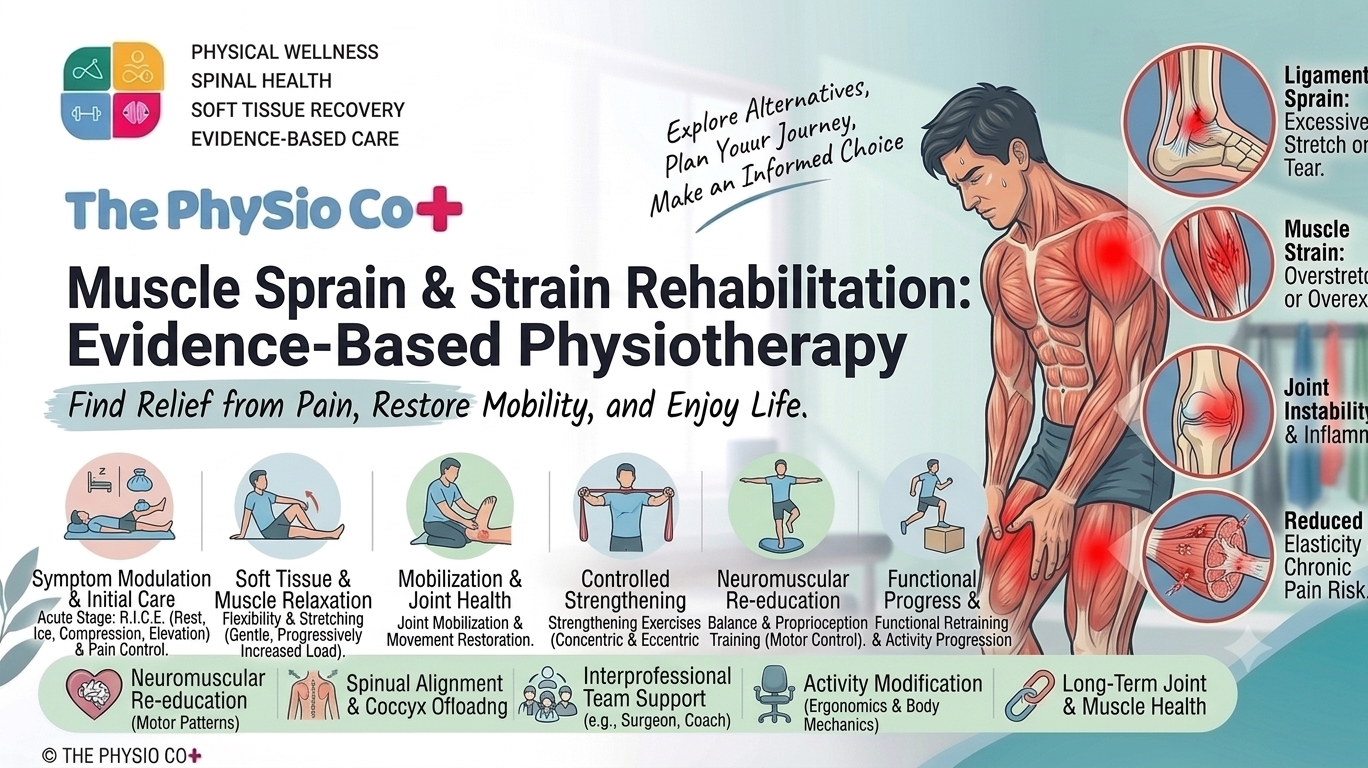
Muscle Sprain and Strain Rehabilitation
Recovery should generally progress through several stages.
Stage 1: Protect the Injury
Immediately after the injury, the goal is to reduce further irritation.
This may involve:
- Reducing painful activities
- Supporting the injured area if necessary
- Maintaining comfortable movement
- Managing swelling
- Avoiding aggressive stretching
Complete rest is usually not necessary unless the injury is severe.
Stage 2: Restore Movement
Once the initial pain begins to settle, gentle movement can be introduced.
The goal is to prevent unnecessary stiffness.
Depending on the injury, this may include:
- Gentle joint movements
- Comfortable muscle movements
- Walking
- Range-of-motion exercises
Movement should be increased gradually.
Stage 3: Restore Strength
Strengthening is one of the most important parts of rehabilitation.
Exercises may begin with light resistance and gradually become more challenging.
For example:
Isometric exercise → Light resistance → Moderate resistance → Heavy resistance
The exact progression depends on the injured muscle or ligament.
Stage 4: Improve Balance and Control
For ligament sprains, especially around the ankle and knee, rehabilitation may include:
- Balance exercises
- Single-leg exercises
- Coordination drills
- Controlled changes of direction
This helps prepare the joint for everyday activities and sport.
Stage 5: Return to Sport or Exercise
The final stage involves gradually returning to the activity that caused the injury.
For an athlete, this may progress from:
Walking → Jogging → Running → Acceleration → Direction changes → Sport-specific drills → Full training
Returning directly from rest to full training can increase the chance of symptoms returning.
Muscle Strain Rehabilitation Exercises
The exercises depend on the location and severity of the injury.
Here are examples that may be used during rehabilitation.
1. Isometric Muscle Contraction
An isometric exercise involves contracting a muscle without significant joint movement.
For example, after an appropriate lower-limb muscle injury, you may gently contract the affected muscle and hold the contraction.
This can help maintain muscle activation while limiting movement.
2. Glute Bridge
- Lie on your back.
- Bend your knees.
- Keep your feet on the floor.
- Tighten your buttocks.
- Lift your hips.
- Lower slowly.
This can be progressed by increasing repetitions or resistance.
3. Calf Raises
- Stand near a stable support.
- Slowly raise your heels.
- Pause briefly.
- Lower with control.
This can be useful during calf and lower-limb rehabilitation when appropriate.
4. Squats
Once the injured area is ready for greater loading:
- Stand with your feet comfortably apart.
- Bend your hips and knees.
- Lower into a controlled squat.
- Push through your feet to return to standing.
The depth and resistance can be increased gradually.
5. Resistance-Band Exercises
Resistance bands can be used to gradually strengthen muscles around an injured joint.
The resistance should be increased as strength improves rather than starting with a heavy band immediately.
Should You Stretch a Strained Muscle?
Not necessarily in the early stage.
Aggressive stretching of an acutely injured muscle can irritate the area further.
Once healing has progressed, gentle mobility and stretching may be introduced if there is a specific reason for them.
Stretching should be only one part of rehabilitation rather than the entire treatment.
How Long Does a Muscle Strain Take to Heal?
There is no single recovery time.
A mild strain may improve relatively quickly, while a more severe tear can require considerably longer rehabilitation.
Recovery depends on:
- Severity
- Location
- Previous injury
- Age
- Training demands
- Rehabilitation
- Overall health
- Whether the person returns to activity too quickly
Pain improving does not necessarily mean that the muscle is ready for maximum effort.
How Long Does a Sprain Take to Heal?
Mild sprains can improve over a few weeks.
More significant ligament injuries may require several weeks or months before full sport-specific function returns.
The recovery timeline depends on:
- Which ligament is injured
- Severity of the injury
- Joint stability
- Strength
- Balance
- Activity requirements
Can You Exercise With a Sprain or Strain?
Usually, yes—but the type and intensity of exercise should be appropriate for the stage of recovery.
You may be able to continue exercises that do not significantly increase symptoms while temporarily reducing the activity that caused the injury.
For example, someone with a lower-limb injury may be able to perform upper-body training if it does not aggravate the injured area.
Can You Prevent Muscle Strains?
There is no guaranteed way to prevent every muscle injury.
However, useful strategies include:
- Gradually increasing training load
- Building strength
- Allowing adequate recovery
- Avoiding sudden changes in exercise intensity
- Maintaining overall fitness
- Practising sport-specific movements
- Returning gradually after previous injury
A warm-up can prepare you for exercise, but simply stretching before exercise does not guarantee that you will avoid injury.
Can You Prevent Sprains?
Again, there is no guaranteed method.
However, injury risk can sometimes be reduced by improving:
- Strength
- Balance
- Coordination
- Joint control
- Sport-specific fitness
For athletes with previous ankle sprains, structured balance and strengthening exercises can be particularly useful.
Why Do Sprains and Strains Keep Coming Back?
Recurring injuries may happen when the body returns to high-level activity before it has regained enough:
- Strength
- Mobility
- Balance
- Coordination
- Load tolerance
Another common problem is returning to the same training volume immediately after symptoms disappear.
Pain-free does not always mean fully ready for maximum load.
A gradual return is usually a better approach.
When Should You See a Physiotherapist?
Consider physiotherapy if:
- Pain is not improving
- You have significant weakness
- Swelling continues
- You cannot return to normal activity
- You have repeated injuries
- You are unsure when to return to sport
- You have difficulty walking or using the affected limb
- You want a structured rehabilitation program
A physiotherapist can assess strength, movement, balance and functional ability and help plan your return to activity.
When Should You See a Doctor?
Medical assessment is important when you have:
- Severe pain after a significant injury
- Major swelling
- Significant bruising
- Inability to bear weight
- Obvious deformity
- A joint that feels severely unstable
- Sudden loss of strength
- Suspected complete muscle or ligament tear
Some injuries may require imaging or specialist assessment.
Muscle Sprain and Strain Physiotherapy in Delhi
If you are searching for muscle strain physiotherapy in Delhi, sprain rehabilitation in Delhi or sports injury physiotherapy in Vasant Kunj, rehabilitation should focus on gradually restoring the body’s ability to handle normal and sport-specific loads.
At The Physio Co+, rehabilitation can include pain management, mobility exercises, progressive strengthening, balance training, movement retraining and a gradual return to exercise or sport.
The rehabilitation plan can be adapted according to the injured area, severity of the injury and your activity goals.
Related services: Sports Injury Physiotherapy | Physiotherapy in Delhi | Clinical Pilates | Post-Surgery Rehabilitation
Frequently Asked Questions
What is the difference between a sprain and a strain?
A sprain affects a ligament, while a strain affects a muscle or tendon.
How long does a muscle strain take to heal?
It depends on the severity and location of the injury. Mild injuries may recover relatively quickly, while severe tears can take considerably longer.
Can physiotherapy help muscle strains?
Yes. Physiotherapy can help restore movement, strength and function and guide a gradual return to activity.
Should I rest after a muscle strain?
Short-term activity modification may be helpful, but prolonged complete rest is usually not necessary. Gradual movement and loading are important for recovery.
Should I stretch a strained muscle?
Aggressive stretching is generally not appropriate immediately after an acute strain. Gentle mobility can be introduced as recovery progresses.
Can I exercise with a sprain?
You may be able to continue selected exercises that do not significantly increase symptoms, while modifying the activity that caused the injury.
Can a sprain or strain happen again?
Yes. Returning to high-level activity too quickly or failing to restore strength and function can increase the chance of recurrence.
What exercises help muscle strain recovery?
Exercises depend on the injured muscle and stage of recovery. They may include isometric exercises, resistance training, mobility exercises and functional movements.
When can I return to sports after a strain?
Return to sport should be gradual. You should generally regain appropriate strength, movement and sport-specific ability before returning to full training.
Is massage enough to treat a muscle strain?
Massage may provide short-term symptom relief in some situations, but it should not replace progressive strengthening and rehabilitation.
Key Takeaway
A sprain and a strain are different injuries, but both can benefit from a structured rehabilitation approach.
The goal is not simply to wait until the pain disappears.
A better approach is:
Protect → Restore movement → Build strength → Improve control → Gradually increase load → Return to sport or normal activity
If you are looking for muscle strain physiotherapy in Delhi, sprain rehabilitation in Delhi or sports injury physiotherapy in Vasant Kunj, an individual assessment can help determine the appropriate rehabilitation plan.
References
- National Institute for Health and Care Excellence (NICE). Major trauma: assessment and initial management.
- American Academy of Orthopaedic Surgeons (AAOS). Patient education resources on sprains, strains and soft-tissue injuries.
- Bleakley CM, Glasgow P, MacAuley DC. PRICE needs updating, should we call the POLICE? British Journal of Sports Medicine.
- Dubois B, Esculier JF. Soft-tissue injuries simply need PEACE and LOVE. British Journal of Sports Medicine.
- Brukner P, Khan K. Clinical Sports Medicine. McGraw-Hill.
- National Athletic Trainers’ Association. Position statements and clinical guidance relating to acute musculoskeletal injuries and rehabilitation.