

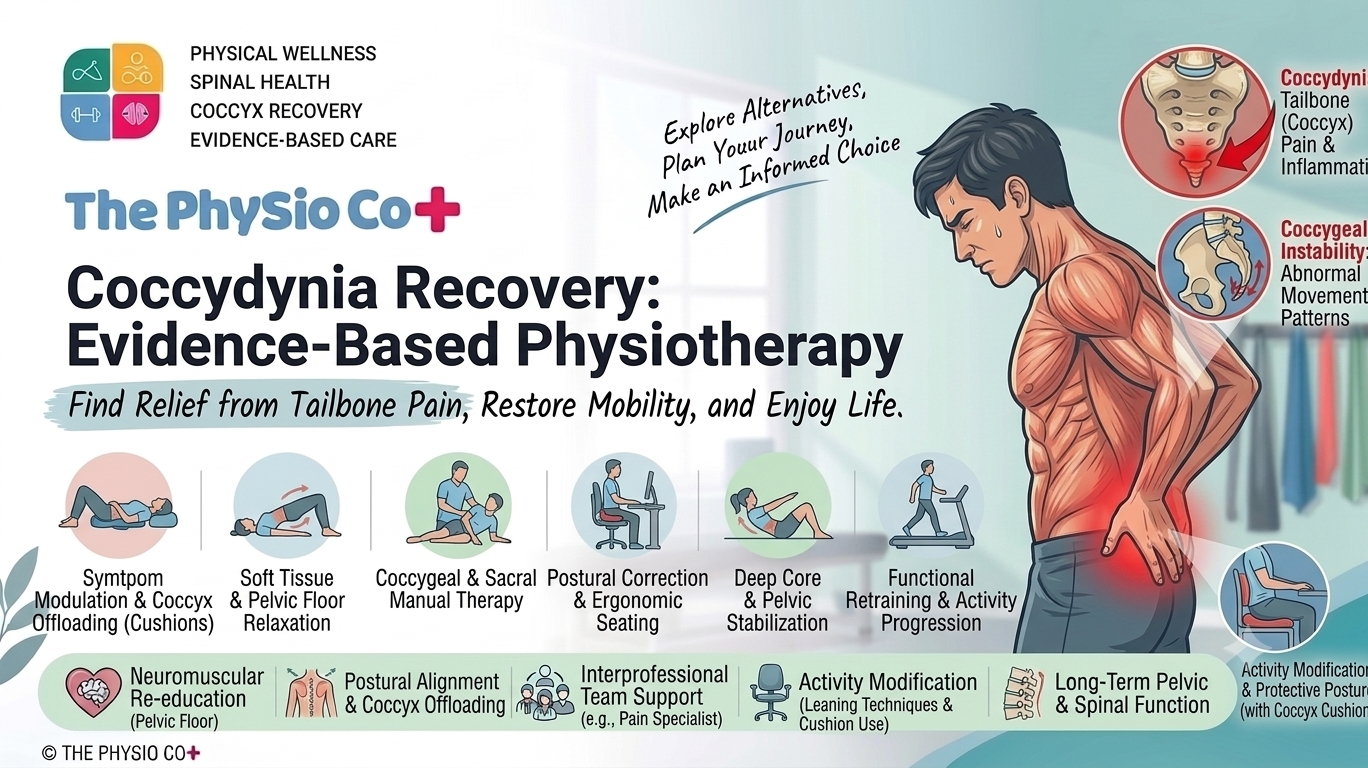

Pain around the tailbone can make simple activities surprisingly uncomfortable.
Coccydynia: Causes, Symptoms, Exercises & Physiotherapy Treatment
Pain around the tailbone can make simple activities surprisingly uncomfortable.
Sitting on a chair, getting up from a seat, driving, cycling or even leaning backwards can become painful when the coccyx is irritated.
This condition is commonly called coccydynia, which simply means pain around the coccyx or tailbone.
Coccyx pain can happen after a fall or direct injury, but it can also develop gradually without one obvious cause. In many cases, the pain improves with appropriate activity modification and rehabilitation.
If you are searching for coccyx pain physiotherapy in Delhi, this guide explains the common causes, symptoms, exercises, treatment options and when you should seek medical advice.
What Is the Coccyx?
The coccyx, commonly known as the tailbone, is the small bone at the very bottom of the spine.
It consists of several small vertebral segments that are joined together.
Although the coccyx is small, several muscles and ligaments attach around this area. These structures are involved in supporting the pelvis and helping with sitting and pelvic movement.
What Is Coccyx Pain?
Coccyx pain, or coccydynia, refers to pain around the tailbone.
The pain may be felt:
- Directly over the tailbone
- Around the lower buttocks
- Between the buttocks
- Around the pelvic area
It may be worse when sitting or when moving from sitting to standing.
What Causes Coccyx Pain?
There are several possible causes.
1. Falling Directly on the Tailbone
A fall backwards onto a hard surface can irritate or injure the coccyx and surrounding tissues.
For example:
- Falling on stairs
- Falling while skating
- Falling during sport
- Slipping on a wet floor
2. Prolonged Sitting
Sitting for long periods can increase pressure around the coccyx.
This may be particularly noticeable when sitting on:
- Hard chairs
- Wooden benches
- Uncomfortable office chairs
- Car seats
3. Poor Sitting Habits
Certain sitting positions can increase pressure around the tailbone.
Slouching may change the way pressure is distributed through the pelvis and can make symptoms worse in some people.
4. Cycling
Long periods of cycling can place repeated pressure on the pelvic and coccyx region.
This can contribute to pain, particularly if there has been a sudden increase in cycling time.
5. Pregnancy and Childbirth
Pregnancy can change the way the pelvis and surrounding tissues are loaded.
During childbirth, the coccyx can also be exposed to increased forces.
Some women develop tailbone pain during pregnancy or after delivery.
6. Repeated Strain
Activities involving repeated sitting, bending or pressure around the pelvis may contribute to symptoms.
7. Less Common Causes
In some cases, pain around the coccyx may be related to other conditions, including:
- Infection
- Skin problems
- Cysts
- Arthritis
- Referred pain from the lower back
- Pelvic conditions
This is why persistent or unexplained tailbone pain should be assessed rather than automatically assuming it is a coccyx problem.
What Are the Symptoms of Coccyx Pain?
Common symptoms include:
- Pain directly over the tailbone
- Pain while sitting
- Pain when getting up from a chair
- Pain when leaning backwards
- Pain during prolonged sitting
- Tenderness around the coccyx
- Pain during bowel movements in some people
- Pain during sexual activity in some people
The severity can range from mild discomfort to significant pain that affects daily activities.
Why Does Sitting Hurt With Coccyx Pain?
When you sit, your body weight is transferred through the pelvis.
Depending on your sitting position, pressure can be placed around the coccyx and surrounding tissues.
If these tissues are sensitive or irritated, prolonged sitting can increase pain.
Some people notice that leaning slightly forward or changing their sitting position reduces discomfort.
Is Coccyx Pain Common After a Fall?
Yes.
A direct fall onto the buttocks can irritate the coccyx and surrounding soft tissues.
A fall does not necessarily mean that the coccyx is fractured.
Many cases involve bruising or irritation of the surrounding tissues and improve with time and appropriate management.
Can Coccyx Pain Happen Without an Injury?
Yes.
You can develop coccyx pain without remembering a specific injury.
Possible contributing factors include:
- Prolonged sitting
- Sudden changes in activity
- Cycling
- Pregnancy
- Childbirth
- Changes in sitting posture
- Repeated pressure on the area
How Is Coccyx Pain Diagnosed?
Diagnosis usually begins with a detailed history and physical examination.
A healthcare professional may ask about:
- When the pain started
- Any previous falls or injuries
- Sitting habits
- Bowel symptoms
- Pregnancy or childbirth
- Physical activity
- Back or pelvic symptoms
The painful area may also be examined.
Imaging is not automatically required for every case of coccyx pain.
If symptoms are unusual, persistent or associated with concerning features, further investigation may be recommended.
Can Coccyx Pain Get Better on Its Own?
Yes.
Many cases improve with conservative treatment.
This may include:
- Reducing prolonged sitting
- Changing sitting position
- Using an appropriate cushion
- Staying gently active
- Pain management
- Physiotherapy
Recovery can take time, especially when symptoms have been present for a long period.
Coccyx Pain Physiotherapy Treatment
Physiotherapy can be useful when coccyx pain continues to interfere with daily activities.
Treatment may include:
1. Activity Modification
The goal is not complete rest.
Instead, activities that repeatedly aggravate the pain can be temporarily modified.
For example:
- Take regular breaks from sitting
- Change sitting positions
- Reduce prolonged driving
- Temporarily reduce cycling
- Avoid activities that repeatedly increase pain
2. Sitting Position Advice
A physiotherapist can help you find a sitting position that reduces pressure on the painful area.
This may involve:
- Sitting with better pelvic support
- Avoiding prolonged slouching
- Taking frequent movement breaks
- Adjusting your chair
Small changes can make a significant difference when you spend many hours sitting.
3. Cushion Support
A suitable coccyx cushion can help reduce direct pressure on the tailbone while sitting.
Different people respond differently to cushion shapes, so comfort and pressure relief are more important than choosing one particular design.
4. Pelvic and Hip Exercises
The muscles around the pelvis and hips can be strengthened when appropriate.
Exercises may target:
- Gluteal muscles
- Hip muscles
- Abdominal muscles
- Pelvic floor muscles
The exact program should depend on the person’s symptoms.
5. Pelvic Floor Physiotherapy
In some people, pelvic floor muscles can become overactive or sensitive along with coccyx pain.
A physiotherapist with appropriate pelvic health training may assess pelvic floor function and determine whether relaxation, coordination or strengthening exercises are appropriate.
Strengthening is not automatically the answer for everyone.
6. Manual Therapy
Depending on the cause and symptoms, a physiotherapist may use hands-on techniques to address surrounding muscles and joints.
Treatment should be comfortable and appropriate for the individual.
Internal techniques are not required for everyone and should only be considered when clinically appropriate and with informed consent.
Coccyx Pain Exercises
There is no single exercise that cures every case of coccyx pain.
The following exercises may be useful for some people once they are comfortable enough to exercise.
1. Pelvic Tilts
- Lie on your back with your knees bent.
- Keep your feet comfortably on the floor.
- Gently move your pelvis.
- Avoid forcing the movement.
- Repeat slowly.
This can help you become comfortable with controlled pelvic movement.
2. Glute Bridge
- Lie on your back.
- Bend your knees.
- Keep your feet on the floor.
- Gently tighten your buttocks.
- Lift your hips slowly.
- Lower with control.
If the exercise increases coccyx pain, stop and discuss it with your physiotherapist.
3. Hip Stretch
A gentle hip stretch may be appropriate if surrounding muscles feel stiff.
The stretch should feel comfortable rather than painful.
4. Gentle Walking
Walking is often a useful way to maintain general activity without prolonged pressure on the tailbone.
Start with a comfortable duration and gradually increase it.
Should You Stretch the Coccyx?
The coccyx itself is not something that should be aggressively stretched.
The surrounding muscles and joints may be addressed through appropriate mobility exercises, but forcing movement around a painful tailbone can make symptoms worse.
A physiotherapist can determine whether mobility work is appropriate for you.
Should You Use Heat or Ice?
Both may provide temporary relief for some people.
Ice may be useful after an acute injury, while heat may feel more comfortable for some people with muscle tension.
Always protect the skin and avoid prolonged application.
Heat or ice should be considered a symptom-management tool rather than a complete treatment.
Can You Exercise With Coccyx Pain?
Usually, yes.
You may need to temporarily avoid activities that put direct pressure on the tailbone.
For example, you may need to modify:
- Cycling
- Rowing
- Sit-ups
- Prolonged sitting exercises
- Contact sports
Walking and other activities that do not significantly increase symptoms may often be continued.
How Should You Sit With Coccyx Pain?
Try to avoid sitting in one position for a long time.
Helpful strategies may include:
- Use a comfortable cushion
- Keep both feet supported
- Avoid prolonged slouching
- Change position regularly
- Stand up and walk around periodically
- Adjust your chair if necessary
There is no single “perfect” sitting posture.
The most useful position is often one that feels comfortable and can be changed regularly.
Coccyx Pain After Childbirth
Tailbone pain can occur during or after pregnancy and childbirth.
During delivery, the coccyx can experience increased pressure and movement.
Postnatal rehabilitation may involve assessment of:
- Pelvic floor function
- Hip strength
- Pelvic movement
- Sitting tolerance
- Core strength
- Daily activities
A pelvic floor physiotherapist can help determine which exercises are appropriate after childbirth.
Persistent pain after delivery should not simply be accepted as something you have to live with.
How Long Does Coccyx Pain Take to Heal?
Recovery varies significantly.
Some people improve within a few weeks, while persistent cases may take several months.
Recovery can depend on:
- Cause of the pain
- Severity of symptoms
- Duration of symptoms
- Daily sitting time
- Previous injury
- Activity levels
- Pregnancy or childbirth
- Response to treatment
Gradual improvement is generally more useful to monitor than expecting pain to disappear immediately.
Can Coccyx Pain Become Chronic?
Yes.
Some people develop persistent coccyx pain lasting for months.
Long-standing pain can be affected by several factors, including:
- Ongoing irritation
- Reduced activity
- Fear of movement
- Muscle sensitivity
- Sleep problems
- Stress
- Changes in daily habits
Persistent pain does not necessarily mean that there is permanent damage.
A comprehensive assessment can help identify factors that may be maintaining the symptoms.
Can Coccyx Pain Be Prevented?
Not every case can be prevented.
However, you can reduce avoidable pressure on the tailbone by:
- Taking regular sitting breaks
- Avoiding sudden increases in cycling
- Using appropriate seating
- Staying physically active
- Strengthening the hips and trunk
- Taking care on slippery surfaces
After a previous injury, gradually returning to normal activity can also be helpful.
When Should You See a Physiotherapist?
Consider a physiotherapy assessment if:
- Tailbone pain lasts for several weeks
- Sitting is becoming difficult
- Pain affects work or driving
- You cannot return to exercise
- Symptoms keep returning
- Pain continues after childbirth
- You are unsure which exercises are safe
A physiotherapist can assess the coccyx, lower back, hips and surrounding muscles to determine what may be contributing to the symptoms.
When Should You See a Doctor?
Coccyx pain is not always caused by a musculoskeletal problem.
Medical assessment is particularly important if you have:
- Severe pain after significant trauma
- Fever
- Unexplained weight loss
- Unexplained night pain
- Bleeding
- A lump or unusual swelling
- Skin changes or discharge
- New bowel or bladder problems
- Numbness or weakness
- Pain that is getting progressively worse
These symptoms require appropriate medical assessment rather than relying only on exercises.
Coccyx Pain Physiotherapy in Delhi
If you are searching for coccyx pain physiotherapy in Delhi, tailbone pain treatment in Delhi or coccydynia physiotherapy in Delhi, treatment should be based on the cause and your individual symptoms.
At The Physio Co+, rehabilitation can focus on reducing pressure around the coccyx, improving pelvic and hip function, addressing contributing muscle problems and gradually restoring comfortable movement and activity.
For patients in and around Vasant Kunj, the treatment plan can be adapted according to daily sitting requirements, work, exercise and postnatal needs.
Related services: Physiotherapy in Delhi | Pelvic Floor Physiotherapy | Women’s Health Physiotherapy | Clinical Pilates
Frequently Asked Questions
What is coccyx pain?
Coccyx pain, also called coccydynia, is pain around the tailbone at the bottom of the spine.
What causes tailbone pain?
It can result from a fall, prolonged sitting, cycling, pregnancy, childbirth or irritation of the tissues around the coccyx.
Why does my tailbone hurt when I sit?
Sitting places pressure through the pelvis and coccyx. If the area is irritated or sensitive, prolonged sitting can increase pain.
Can physiotherapy help coccyx pain?
Yes. Physiotherapy may help through activity modification, exercise, pelvic and hip rehabilitation, sitting advice and other appropriate treatment techniques.
What exercises are good for coccyx pain?
Depending on the individual, exercises may include gentle pelvic movements, glute strengthening, hip exercises and walking.
Should I sit on a cushion for coccyx pain?
A suitable cushion may reduce pressure on the tailbone and make sitting more comfortable.
Can coccyx pain happen after childbirth?
Yes. Pregnancy and childbirth can place additional stress on the pelvic and coccyx region.
How long does coccyx pain take to heal?
Some cases improve within weeks, while persistent cases can take several months. Recovery depends on the cause and individual circumstances.
Can coccyx pain go away without treatment?
Yes, some cases improve naturally. However, persistent pain may benefit from professional assessment and rehabilitation.
Is coccyx pain serious?
Most coccyx pain is not caused by a serious condition, but persistent or unusual symptoms should be assessed, especially when accompanied by red-flag symptoms.
Key Takeaway
Coccyx pain can make sitting, driving and everyday activities difficult, but it is often manageable with the right approach.
Treatment may involve:
Reducing irritation → Improving sitting comfort → Staying active → Building pelvic and hip strength → Gradually returning to normal activities
There is no single treatment that works for everyone. The most appropriate rehabilitation depends on why your coccyx is painful and what activities are currently difficult.
If you are looking for coccyx pain physiotherapy in Delhi, tailbone pain physiotherapy in Delhi or coccydynia treatment in Vasant Kunj, an individual assessment can help identify the most appropriate treatment plan.
References
- Lirette LS, Chaiban G, Tolba R, Eissa H. Coccydynia: An Overview of the Anatomy, Etiology, and Treatment of Coccyx Pain. Ochsner Journal.
- Lirette LS, et al. Coccydynia: an overview of the anatomy, etiology, and treatment of coccyx pain. Ochsner Journal.
- Maigne JY, Doursounian L, Chatellier G. Causes and mechanisms of common coccydynia: role of body mass index and coccygeal trauma. Spine.
- Fogel GR, Cunningham PY, Esses SI. Coccydynia: evaluation and management. Journal of the American Academy of Orthopaedic Surgeons.
- National Institute for Health and Care Excellence (NICE). Evidence and guidance relating to musculoskeletal pain and pelvic health.
- American Academy of Orthopaedic Surgeons (AAOS). Patient education resources relating to lower back and pelvic musculoskeletal conditions.