

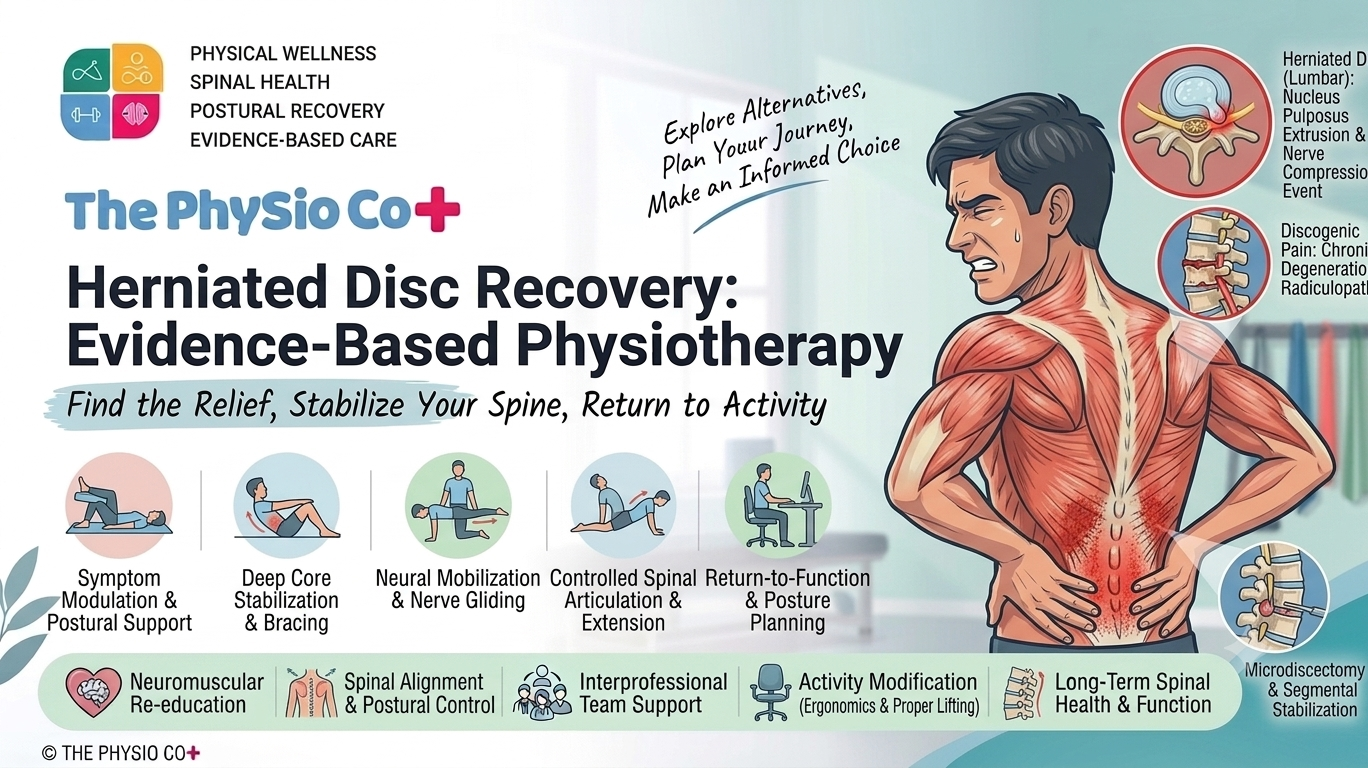

Herniated Disc
A herniated disc is a common cause of back and leg pain. You may have also heard it called a “slipped disc.”
The name can sound serious, but having a herniated disc does not automatically mean that you need surgery.
Many people improve with non-surgical treatment, activity modification and a progressive exercise program. Physiotherapy can help reduce symptoms, improve movement and strength, and gradually return you to normal activities.
If you are searching for herniated disc physiotherapy in Delhi, this guide explains what a herniated disc is, its symptoms, exercises, treatment options and when medical attention is needed.
What Is a Herniated Disc?
Your spine is made up of bones called vertebrae. Between many of these bones are soft structures called intervertebral discs.
A disc has:
- A tougher outer layer
- A softer inner part
A herniated disc occurs when part of the disc material moves through a weakened or damaged area of the outer layer.
If the displaced disc material irritates or compresses a nearby spinal nerve, it can cause symptoms such as pain, tingling, numbness or weakness.
What Is a Slipped Disc?
“Slipped disc” is a common term used by patients to describe a disc problem.
However, a disc does not literally slide out of place.
Healthcare professionals may use terms such as:
- Disc herniation
- Disc protrusion
- Disc extrusion
- Disc bulge
These describe different types of disc changes.
An MRI report may use one of these terms, but the scan needs to be interpreted alongside your symptoms and physical examination.
What Causes a Herniated Disc?
A herniated disc can develop because of a combination of factors.
These may include:
- Natural changes in the disc with age
- Repeated loading
- Sudden heavy lifting
- Repetitive movements
- Previous back injury
- Smoking
- Higher body weight
- Reduced physical activity
Sometimes a disc herniates after a specific movement, but it is not always possible to identify one exact cause.
Importantly, disc changes can also be present in people who have no pain.
Where Does a Herniated Disc Usually Occur?
Herniated discs are most commonly seen in the:
- Lower back
- Neck
A herniated disc in the lower back is called a lumbar disc herniation.
A disc problem in the neck is called a cervical disc herniation.
This article focuses mainly on lumbar disc herniation because it is a common cause of lower back and leg symptoms.
What Are the Symptoms of a Herniated Disc?
Some people with a herniated disc have no symptoms.
When symptoms occur, they may include:
- Lower back pain
- Buttock pain
- Leg pain
- Tingling
- Numbness
- Muscle weakness
- Difficulty sitting
- Difficulty standing
- Pain with certain movements
If a nerve is irritated, symptoms may travel down the leg.
What Is Sciatica?
Sciatica refers to pain and other symptoms related to irritation or compression of the sciatic nerve or its contributing nerve roots.
It can cause symptoms such as:
- Pain in the buttock
- Pain travelling down the leg
- Tingling
- Numbness
- Weakness
A herniated disc is one possible cause of sciatica, but it is not the only cause.
This is why an assessment is important rather than assuming that every case of leg pain is caused by a disc.
Can a Herniated Disc Cause Leg Pain?
Yes.
If the herniated disc affects a spinal nerve, you may experience pain that travels from the lower back or buttock into the leg.
The pain may feel:
- Sharp
- Burning
- Electric
- Shooting
Some people also experience tingling or numbness.
Can You Have a Herniated Disc Without Back Pain?
Yes.
Some people may have little or no back pain but experience symptoms mainly in the leg.
Others may have a disc herniation that causes no symptoms at all.
This is why an MRI finding should not automatically be considered the cause of pain.
How Is a Herniated Disc Diagnosed?
Diagnosis usually starts with a medical history and physical examination.
A healthcare professional may assess:
- Back movement
- Leg movement
- Muscle strength
- Sensation
- Reflexes
- Walking
- Nerve-related symptoms
An MRI may be considered when symptoms are severe, persistent or when there are neurological findings that require further investigation.
Imaging is not automatically required for every episode of lower back pain.
Does Every Herniated Disc Need an MRI?
No.
Many people with back pain or sciatica can initially be managed without imaging.
MRI may be appropriate when:
- Symptoms are persistent
- There is significant weakness
- Symptoms are severe
- Surgery is being considered
- Another serious condition needs to be ruled out
The decision should be based on the individual’s symptoms and clinical assessment.
Can a Herniated Disc Heal Without Surgery?
Yes.
Many people improve with conservative treatment.
This may include:
- Staying active within comfortable limits
- Exercise
- Physiotherapy
- Pain management
- Gradual return to normal activities
Some herniated discs also reduce in size over time as part of the body’s natural healing process.
However, recovery varies from person to person.
Can Physiotherapy Help a Herniated Disc?
Yes.
Physiotherapy can be useful for many people with herniated disc-related back and leg symptoms.
Treatment may focus on:
- Reducing pain
- Improving movement
- Building strength
- Increasing activity gradually
- Improving confidence with movement
- Returning to work, exercise and daily activities
The program should be based on your symptoms rather than simply the wording of an MRI report.
Herniated Disc Physiotherapy Treatment
1. Education
Understanding your condition is an important part of treatment.
You should know:
- What may be causing your symptoms
- Which activities currently aggravate them
- Which movements are safe
- How to gradually increase activity
- When you need medical review
This can help reduce unnecessary fear of movement.
2. Activity Modification
You may need to temporarily modify activities that significantly increase your symptoms.
This does not mean avoiding movement completely.
For example, you may temporarily reduce:
- Heavy lifting
- Repeated bending
- Long periods of sitting
- High-impact exercise
As symptoms improve, these activities can be gradually reintroduced.
3. Walking
Walking is often a useful way to stay active.
You can start with a comfortable duration and gradually increase it.
For example:
Short walks → Longer walks → Faster walking → Normal daily activity
The goal is gradual improvement rather than forcing yourself through severe pain.
4. Mobility Exercises
Depending on your symptoms, your physiotherapist may prescribe exercises to improve:
- Spinal movement
- Hip movement
- Pelvic control
Some people respond better to movements that involve bending the spine, while others feel better with movements in the opposite direction.
There is no single exercise that works for every herniated disc.
5. Strengthening
As symptoms settle, strengthening becomes an important part of rehabilitation.
Exercises may target:
- Abdominal muscles
- Back muscles
- Gluteal muscles
- Hip muscles
- Leg muscles
The aim is to gradually increase your body’s ability to handle everyday activities and physical loads.
Herniated Disc Exercises
The appropriate exercises depend on your symptoms and stage of recovery.
Some exercises that may be used include:
1. Walking
Start with a comfortable distance and gradually increase it.
Walking can help you remain active without placing a large training load on the body.
2. Pelvic Tilts
- Lie on your back with your knees bent.
- Keep your feet on the floor.
- Gently tighten your abdominal muscles.
- Slowly move your pelvis.
- Return to a comfortable position.
- Repeat.
The movement should be controlled and comfortable.
3. Glute Bridges
- Lie on your back.
- Bend your knees.
- Keep your feet on the floor.
- Tighten your buttocks.
- Lift your hips slowly.
- Hold briefly.
- Lower with control.
This can help strengthen the gluteal and trunk muscles.
4. Bird Dog
- Start on your hands and knees.
- Keep your back controlled.
- Slowly extend one arm and the opposite leg.
- Hold briefly.
- Return to the starting position.
- Repeat on the opposite side.
The focus should be on control rather than how high you lift your arm or leg.
5. Gentle Core Strengthening
Depending on your symptoms, your physiotherapist may introduce exercises that gradually challenge the abdominal and trunk muscles.
The difficulty should increase progressively rather than starting with demanding exercises immediately.
Should You Rest in Bed With a Herniated Disc?
Usually, prolonged bed rest is not recommended.
Too much inactivity can contribute to:
- Muscle weakness
- Stiffness
- Reduced fitness
- Fear of movement
- Difficulty returning to normal activities
Short periods of rest may be helpful during a severe flare-up, but gradually returning to activity is generally an important part of recovery.
Should You Avoid Bending With a Herniated Disc?
Not permanently.
Bending may aggravate symptoms during an acute episode, especially if the movement repeatedly increases leg pain.
However, completely avoiding bending for months can make normal activities more difficult.
Once symptoms settle, bending can usually be gradually reintroduced.
The goal is to help the back become comfortable with normal movement again.
Can You Lift Weights With a Herniated Disc?
Many people can eventually return to weight training.
During a painful episode, you may need to reduce heavy or demanding exercises.
As symptoms improve, loading can be gradually increased.
Your rehabilitation may progress from:
Light resistance → Controlled strength training → Heavier resistance → Functional lifting → Normal training
There is no need to assume that you can never lift weights again.
Can You Go to the Gym With a Herniated Disc?
In many cases, yes.
You may need to temporarily modify exercises that significantly increase your symptoms.
Depending on your condition, your physiotherapist may help you modify:
- Squats
- Deadlifts
- Rows
- Leg exercises
- Core exercises
- Running
- Jumping
The goal is to maintain fitness where possible while gradually rebuilding tolerance to the activities you want to perform.
Can a Herniated Disc Cause Permanent Nerve Damage?
Most people with disc-related nerve symptoms do not develop permanent nerve damage.
However, significant or worsening neurological symptoms need medical assessment.
Pay particular attention to:
- Increasing muscle weakness
- Loss of sensation
- Difficulty walking
- Changes in bladder or bowel control
- Numbness around the groin area
These symptoms should not be managed with exercises alone.
When Is Surgery Needed for a Herniated Disc?
Most people do not need surgery simply because an MRI shows a herniated disc.
Surgery may be considered when:
- Symptoms remain severe despite appropriate non-surgical treatment
- Significant neurological weakness develops
- There is serious nerve compression
- There are emergency symptoms
The decision should be made by an appropriately qualified medical specialist after considering symptoms, examination and imaging.
Can Physiotherapy Prevent Herniated Disc Surgery?
Physiotherapy can help many people manage symptoms without surgery, but it cannot guarantee that surgery will never be needed.
A structured rehabilitation program can help improve:
- Pain
- Strength
- Movement
- Activity tolerance
- Function
If neurological symptoms worsen or serious warning signs appear, medical assessment becomes more important.
Red Flags: When Should You Seek Urgent Medical Attention?
Most back pain and sciatica are not emergencies.
However, seek urgent medical attention if you develop:
- New loss of bladder or bowel control
- Difficulty starting urination
- Numbness around the groin or inner thighs
- Severe or rapidly worsening weakness
- Significant symptoms affecting both legs
These symptoms may indicate serious nerve compression.
You should also seek medical advice for back pain associated with major trauma, fever, unexplained weight loss or other concerning symptoms.
How Long Does a Herniated Disc Take to Recover?
There is no fixed recovery period.
Many people experience significant improvement over several weeks, while others may take longer.
Recovery depends on:
- Severity of symptoms
- Nerve involvement
- Duration of symptoms
- Activity levels
- General health
- Sleep and stress
- Rehabilitation
- Work and sport demands
Improvement in pain and function is more important than waiting for an MRI to look completely normal.
Can a Herniated Disc Happen Again?
Yes.
A previous disc problem does not guarantee that symptoms will never return.
However, staying physically active, building strength and gradually increasing physical loads can help you manage your back over the long term.
A recurrence does not necessarily mean that the disc has become permanently damaged.
How Can You Reduce the Risk of Future Back Problems?
There is no guaranteed way to prevent all episodes of back pain.
Helpful habits include:
- Staying physically active
- Building strength gradually
- Avoiding sudden increases in exercise
- Taking regular movement breaks
- Gradually increasing lifting loads
- Maintaining general fitness
- Getting adequate sleep
- Addressing recurring symptoms early
You do not need to maintain one “perfect posture” throughout the day.
Herniated Disc Physiotherapy in Delhi
If you are searching for herniated disc physiotherapy in Delhi, treatment should focus on your symptoms and ability to function rather than only your MRI findings.
At The Physio Co+, rehabilitation can focus on reducing pain, restoring movement, improving strength and gradually returning you to work, exercise and daily activities.
Treatment may include therapeutic exercise, progressive strengthening, mobility work, activity modification and education about managing your back.
For patients in and around Vasant Kunj, the rehabilitation plan can be customized according to symptoms, lifestyle and activity goals.
Related services: Physiotherapy in Delhi | Back Pain Physiotherapy | Sciatica Physiotherapy | Clinical Pilates
Frequently Asked Questions
What is a herniated disc?
A herniated disc occurs when part of the inner disc material moves through a weakened area of the outer disc layer. It can sometimes irritate a nearby nerve.
Is a herniated disc the same as a slipped disc?
“Slipped disc” is a common term used for disc problems. A herniated disc is one specific type of disc problem.
Can a herniated disc heal without surgery?
Yes. Many people improve with non-surgical treatment, exercise, physiotherapy and gradual return to activity.
Can physiotherapy help a herniated disc?
Yes. Physiotherapy can help improve pain, movement, strength and function in many people with disc-related symptoms.
Can a herniated disc cause sciatica?
Yes. A herniated disc can irritate a spinal nerve and cause pain, tingling, numbness or weakness in the leg.
Can I exercise with a herniated disc?
Usually, yes. Exercise should be adjusted according to your symptoms and progressed gradually.
Can I go to the gym with a herniated disc?
Many people can continue or return to gym training. Exercises that aggravate symptoms may need to be modified initially.
Should I avoid bending with a herniated disc?
You may need to reduce painful bending during an acute flare-up, but permanently avoiding bending is generally not the goal.
Do I need surgery if my MRI shows a herniated disc?
Not necessarily. MRI findings need to be considered alongside your symptoms and physical examination.
How long does a herniated disc take to recover?
Recovery varies. Many people improve over several weeks, while persistent or more severe symptoms can take longer.
Key Takeaway
A herniated disc does not automatically mean surgery or permanent damage.
Many people improve with appropriate non-surgical care.
A good rehabilitation program focuses on:
Managing symptoms → Staying active → Restoring movement → Building strength → Gradually increasing load → Returning to normal activities
The aim is not to protect your back from every movement. It is to gradually make your back strong and confident enough to handle normal life again.
If you are looking for herniated disc physiotherapy in Delhi, slip disc physiotherapy in Delhi or back pain physiotherapy in Vasant Kunj, an individual assessment can help determine the most appropriate rehabilitation plan.
References
- National Institute for Health and Care Excellence (NICE). Low back pain and sciatica in over 16s: assessment and management (NG59).
- World Health Organization. WHO guideline for non-surgical management of chronic primary low back pain in adults in primary and community care settings.
- American College of Physicians. Noninvasive treatments for acute, subacute, and chronic low back pain: clinical practice guideline.
- North American Spine Society. Diagnosis and Treatment of Lumbar Disc Herniation with Radiculopathy: Clinical Guidelines.
- Brinjikji W, et al. Systematic review of imaging features of spinal degeneration in asymptomatic populations. American Journal of Neuroradiology.
- Chiu CC, et al. The probability of spontaneous regression of lumbar disc herniation: a systematic review. Clinical Rehabilitation.