


Shoulder Dislocation Rehabilitation
A shoulder dislocation can be painful and frightening. It usually happens when the upper arm bone moves out of its normal position in the shoulder joint.
After the shoulder is put back into position, many people assume that the problem is over. However, rehabilitation is an important part of recovery.
The shoulder may feel weak, stiff or unstable after a dislocation. Without appropriate rehabilitation, some people may experience repeated dislocations or a feeling that the shoulder is “giving way.”
A structured physiotherapy program can help restore movement, strength, stability and confidence.
If you are searching for shoulder dislocation physiotherapy in Delhi, this guide explains the recovery process, exercises, precautions and when physiotherapy may be appropriate.
What Is a Shoulder Dislocation?
The shoulder is a ball-and-socket joint.
The rounded top of the upper arm bone, called the humeral head, normally sits inside a shallow part of the shoulder blade called the glenoid.
A shoulder dislocation occurs when the humeral head moves out of this normal position.
Most shoulder dislocations are anterior dislocations, where the ball moves toward the front of the body.
Less commonly, the shoulder can dislocate in other directions.
What Causes a Shoulder Dislocation?
A shoulder can dislocate when a strong force pushes the arm beyond its normal range.
Common causes include:
- Falling onto the arm
- Sports injuries
- Contact sports
- Road accidents
- Sudden forceful movements
- Landing awkwardly
- Previous shoulder instability
Younger athletes involved in contact or overhead sports may have a higher risk of experiencing another dislocation after an initial injury.
What Are the Symptoms of a Dislocated Shoulder?
A shoulder dislocation can cause:
- Sudden severe shoulder pain
- Difficulty moving the arm
- Visible change in shoulder shape
- Swelling
- Muscle spasm
- Weakness
- Numbness or tingling in the arm
A suspected dislocation should be treated as a medical problem.
Do not try to force the shoulder back into place yourself.
What Should You Do After a Shoulder Dislocation?
If you suspect that your shoulder has dislocated:
- Keep the arm as comfortable and supported as possible.
- Avoid trying to relocate the shoulder yourself.
- Seek urgent medical attention.
- Follow the advice given after the shoulder has been relocated.
A healthcare professional may perform an examination and imaging to check the joint and look for associated injuries.
What Happens After the Shoulder Is Put Back?
The process of returning the shoulder to its normal position is called reduction.
After reduction, the shoulder may remain:
- Painful
- Weak
- Stiff
- Swollen
- Unstable
Further assessment may be required to check for injuries to structures around the shoulder.
Depending on the injury, age, activity level and recurrence risk, treatment may involve rehabilitation or, in selected cases, surgery.
Why Is Rehabilitation Important After a Shoulder Dislocation?
A dislocation can affect the tissues that help keep the shoulder stable.
These may include:
- Ligaments
- Joint capsule
- Labrum
- Rotator cuff muscles
- Other muscles around the shoulder blade
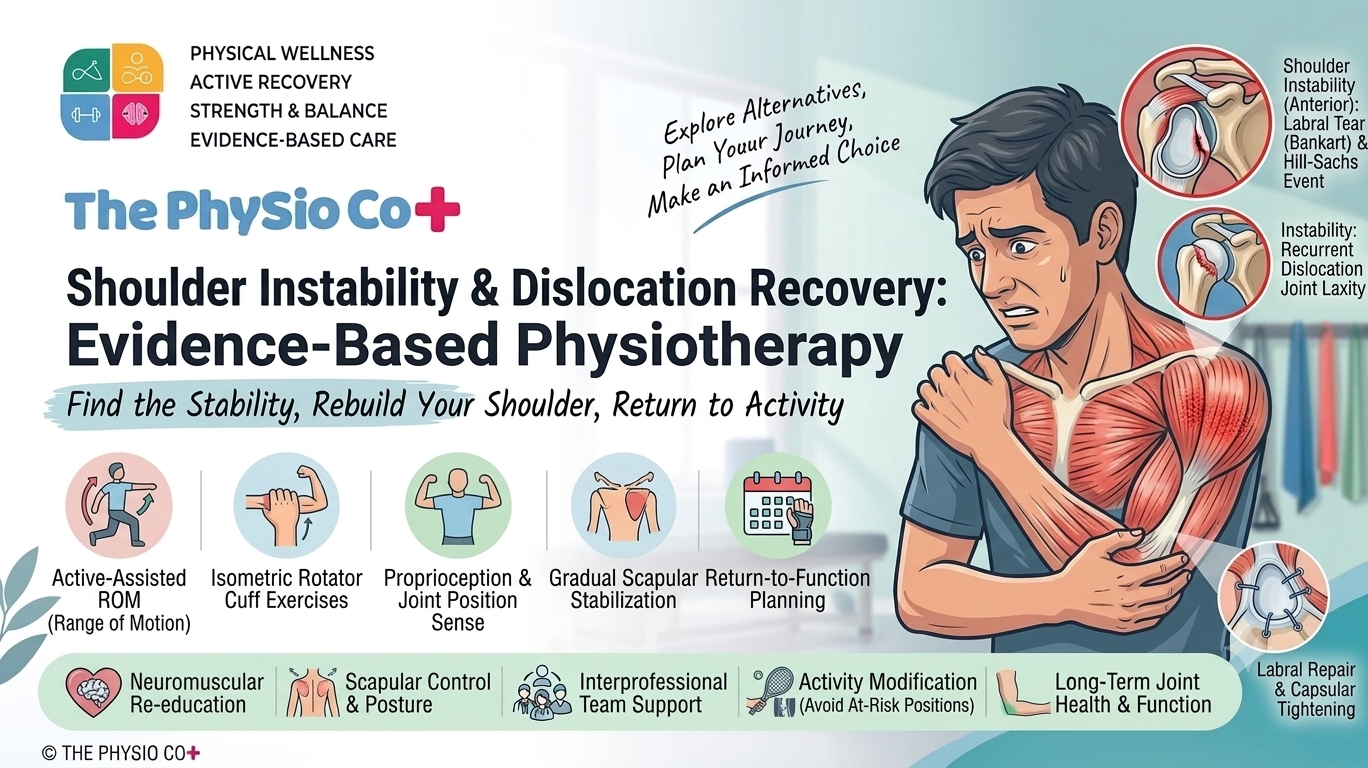
Rehabilitation aims to gradually restore the shoulder’s ability to control movement.
The goals are usually to:
- Reduce pain
- Restore safe movement
- Improve shoulder strength
- Improve shoulder-blade control
- Improve stability
- Restore confidence
- Return to work, gym or sport
Stages of Shoulder Dislocation Rehabilitation
The rehabilitation program should be progressed gradually.
The exact timeline depends on the injury and medical advice.
Stage 1: Protection and Pain Management
Immediately after a dislocation, the shoulder may need protection.
Your doctor may recommend a sling for a specific period.
During this stage, rehabilitation may focus on:
- Pain management
- Appropriate positioning
- Maintaining movement in unaffected areas
- Gentle exercises when cleared
- Maintaining hand, wrist and elbow movement
Do not start shoulder exercises simply because the pain has decreased.
The injured tissues still need time to recover.
Stage 2: Restore Shoulder Movement
Once appropriate, gentle shoulder movement can be gradually introduced.
The aim is to prevent unnecessary stiffness while respecting the healing tissues.
Exercises may include controlled:
- Shoulder flexion
- Shoulder rotation
- Assisted shoulder movements
The range of movement should be progressed according to the type of dislocation and medical advice.
Stage 3: Strengthening
After adequate healing, strengthening becomes an important part of rehabilitation.
The program may target:
- Rotator cuff muscles
- Shoulder muscles
- Shoulder-blade muscles
- Upper-back muscles
- Core muscles
Resistance bands and light weights may be introduced gradually.
Stage 4: Stability and Control
A strong shoulder also needs good control.
Exercises may include:
- Weight-bearing exercises
- Wall exercises
- Controlled reaching
- Resistance-band exercises
- Closed-chain exercises
- Proprioception exercises
The difficulty is gradually increased as control improves.
Stage 5: Return to Gym or Sport
The final stage focuses on the activities you want to return to.
For an athlete, rehabilitation may progress from:
Basic strengthening → Functional exercises → Running → Throwing/jumping → Sport-specific drills → Full training
The progression depends on the sport and the individual’s recovery.
Shoulder Dislocation Rehabilitation Exercises
The exercises below are examples of exercises that may be used during rehabilitation.
They should not replace an individual assessment, particularly during the early stages after a dislocation.
1. Elbow, Wrist and Hand Movement
If the shoulder is protected in a sling, gently moving the:
- Fingers
- Wrist
- Elbow
can help maintain movement in the rest of the arm, when permitted by your treating clinician.
2. Pendulum Exercise
Once cleared by your healthcare professional:
- Lean forward while supporting yourself with the unaffected arm.
- Allow the affected arm to hang comfortably.
- Make small, gentle movements.
- Avoid forcing the shoulder.
This exercise should be comfortable rather than aggressive.
3. Assisted Shoulder Flexion
A stick or the opposite arm can sometimes be used to assist shoulder movement.
The movement should be controlled and performed within the range recommended during your rehabilitation stage.
4. Shoulder Blade Exercises
Good shoulder-blade control is important for shoulder function.
Simple exercises may involve:
- Gentle shoulder-blade setting
- Controlled shoulder-blade movement
- Wall-based exercises
Avoid shrugging the shoulder excessively.
5. Resistance-Band External Rotation
Once strengthening is appropriate:
- Attach a resistance band securely.
- Keep the elbow close to your side.
- Slowly rotate the forearm outward.
- Return with control.
The resistance should be light enough to maintain good technique.
Important: The appropriate range of rotation depends on the stage of rehabilitation and the direction of the original dislocation.
6. Resistance-Band Internal Rotation
- Attach a resistance band securely.
- Keep your elbow near your side.
- Slowly rotate your forearm inward.
- Return to the starting position.
Perform the movement slowly and under control.
7. Wall Push-Up
Once appropriate strength has returned:
- Stand facing a wall.
- Place your hands on the wall.
- Slowly bend your elbows.
- Bring your body toward the wall.
- Push yourself away.
- Repeat.
This can later be progressed toward more challenging weight-bearing exercises.
Which Exercises Should You Avoid After a Shoulder Dislocation?
The exercises you should avoid depend on the stage of recovery and the direction of the dislocation.
After an anterior shoulder dislocation, early rehabilitation may require caution with positions involving:
- The arm being taken far out to the side
- The arm being rotated strongly outward
- The arm going into a combined overhead/outward position
These positions can place stress on healing structures.
You should also avoid immediately returning to:
- Heavy bench pressing
- Heavy overhead pressing
- Pull-ups
- Heavy dips
- Contact sports
- Aggressive throwing
until your healthcare professional considers the shoulder ready.
How Long Does Shoulder Dislocation Rehabilitation Take?
There is no single recovery time for everyone.
Recovery depends on:
- Age
- Severity of the injury
- Associated tissue damage
- Whether the dislocation was traumatic
- Previous dislocations
- Treatment approach
- Sport or work requirements
- Rehabilitation progress
Some people can return to normal daily activities relatively quickly, while returning to contact or overhead sports can require considerably more rehabilitation.
Your physiotherapist and doctor can guide the progression.
Can a Shoulder Dislocation Happen Again?
Yes.
A previous shoulder dislocation can increase the risk of future instability.
The risk of recurrence can be particularly important in younger people and athletes involved in contact or overhead sports.
This is why rehabilitation should not stop as soon as everyday pain improves.
Strength, stability and movement control should also be restored.
What Is Shoulder Instability?
Shoulder instability means that the shoulder does not feel sufficiently stable during movement.
You may experience:
- A feeling that the shoulder is slipping
- Clicking or catching
- Fear during certain movements
- Repeated subluxations
- Repeated dislocations
- Reduced confidence using the arm
If these symptoms continue after a dislocation, further assessment may be required.
Shoulder Dislocation vs Shoulder Subluxation
A dislocation means the joint surfaces have completely lost their normal contact.
A subluxation is a partial slipping or movement of the joint.
Both can cause:
- Pain
- Instability
- Weakness
- Apprehension during movement
Repeated episodes should be assessed because they can affect shoulder stability.
Can Physiotherapy Prevent Another Shoulder Dislocation?
Physiotherapy can help improve the factors that contribute to shoulder stability, including:
- Rotator cuff strength
- Shoulder-blade control
- Muscle coordination
- Joint position awareness
- Functional strength
However, physiotherapy cannot guarantee that another dislocation will never occur.
Some people have structural injuries or recurrent instability that may require assessment by an orthopaedic specialist.
When Is Surgery Considered?
Not everyone with a shoulder dislocation needs surgery.
Surgery may be considered in selected people, particularly when there is:
- Recurrent instability
- Significant structural damage
- High demands from contact or overhead sports
- Certain associated bone or soft-tissue injuries
The decision depends on the individual rather than simply the fact that a dislocation has occurred.
A physiotherapist can work alongside the orthopaedic team before or after surgery.
Can You Go to the Gym After a Shoulder Dislocation?
Eventually, many people can return to gym training.
However, returning too quickly can place unnecessary stress on the shoulder.
Your rehabilitation may progress through:
Light resistance → Controlled strengthening → Heavier strengthening → Functional exercises → Sport-specific training
Exercises should be selected according to your recovery stage.
Can You Sleep Normally After a Shoulder Dislocation?
Sleep can be uncomfortable during the early stages.
Some people find it more comfortable to:
- Sleep on their back
- Support the arm with a pillow
- Follow the sling instructions given by their healthcare professional
Avoid positions that cause pain or place the shoulder into a vulnerable position.
Can You Drive After a Shoulder Dislocation?
Driving should be avoided while the shoulder is painful, significantly restricted or while you are using a sling if you cannot safely control the vehicle.
You should be able to control the vehicle safely and comfortably before returning to driving.
Follow medical and local driving guidance where applicable.
When Should You See a Physiotherapist?
Physiotherapy can be useful when you have been medically cleared to begin rehabilitation.
Consider physiotherapy if you have:
- Shoulder weakness
- Reduced movement
- Fear of moving the arm
- Difficulty returning to the gym
- Difficulty returning to sport
- Ongoing instability
- Previous shoulder dislocations
A physiotherapist can assess your strength, movement and shoulder control and build a gradual rehabilitation plan.
When Should You Seek Urgent Medical Attention?
Seek urgent medical attention after a suspected new dislocation or if you experience:
- Severe sudden shoulder pain
- Obvious shoulder deformity
- Inability to move the arm
- New numbness
- Significant weakness
- Loss of sensation
- A cold or unusually pale hand
Do not attempt to put a suspected dislocated shoulder back into position yourself.
Shoulder Dislocation Physiotherapy in Delhi
If you are searching for shoulder dislocation physiotherapy in Delhi, rehabilitation should be progressive and based on the type of injury, stage of healing and your functional goals.
At The Physio Co+, shoulder rehabilitation can focus on restoring movement, rebuilding rotator cuff and shoulder-blade strength, improving stability and gradually returning you to gym, work or sport.
For patients in and around Vasant Kunj, the rehabilitation plan can be adapted according to your daily activities and sporting requirements.
Related services: Shoulder Physiotherapy | Sports Injury Physiotherapy | Post-Surgery Rehabilitation | Physiotherapy in Delhi
Frequently Asked Questions
What is shoulder dislocation?
A shoulder dislocation occurs when the upper arm bone moves completely out of its normal position in the shoulder joint.
How long does shoulder dislocation rehabilitation take?
Recovery varies depending on the severity of the injury, age, associated damage and activity requirements. Returning to sports generally takes longer than returning to basic daily activities.
Can physiotherapy help after a shoulder dislocation?
Yes. Physiotherapy can help restore movement, strength, shoulder control and stability after appropriate medical clearance.
Can a dislocated shoulder happen again?
Yes. Previous dislocation can increase the risk of recurrent instability, particularly in younger people and some athletes.
What exercises are good after shoulder dislocation?
Exercises may include gentle mobility, shoulder-blade exercises, rotator cuff strengthening and progressive weight-bearing exercises. The appropriate exercises depend on the stage of recovery.
Can I go to the gym after a shoulder dislocation?
Yes, many people eventually return to gym training. However, resistance and exercise selection should be progressed gradually.
Can I play sports after a shoulder dislocation?
Many people can return to sports, but the timing depends on recovery, shoulder stability, strength and the demands of the sport.
Do I need surgery after a shoulder dislocation?
Not always. Some people recover with non-surgical treatment and rehabilitation, while others with recurrent instability or significant structural injury may require surgical assessment.
Why does my shoulder still feel unstable after dislocation?
The injury may affect the tissues and muscles responsible for shoulder stability. Weakness, reduced coordination or structural damage can contribute to ongoing instability.
Key Takeaway
A shoulder dislocation is not simply a problem that ends once the joint has been put back into place.
Proper rehabilitation is important for restoring movement, strength, stability and confidence.
A typical rehabilitation journey may progress from:
Protection → Mobility → Strength → Stability → Functional training → Return to sport
The exact program should be individualized according to the injury and medical advice.
If you are looking for shoulder dislocation physiotherapy in Delhi, shoulder rehabilitation in Delhi or shoulder physiotherapy in Vasant Kunj, an assessment can help determine the appropriate rehabilitation plan.
References
- American Academy of Orthopaedic Surgeons (AAOS). Shoulder Dislocation. OrthoInfo.
- Olds M, Ellis R, Parmar P, Kersten P. Who will redislocate their shoulder? Predicting recurrent instability following a first traumatic anterior shoulder dislocation. British Journal of Sports Medicine.
- Longo UG, et al. Management of primary anterior shoulder dislocations: systematic review and network meta-analysis. British Journal of Sports Medicine.
- Warby SA, et al. The effect of exercise-based rehabilitation on recurrent shoulder instability: a systematic review.
- Australian Orthopaedic Association. Clinical resources relating to shoulder instability and dislocation management.
- National Institute for Health and Care Excellence (NICE). Evidence and guidance relating to musculoskeletal injuries and rehabilitation.