


Iliotibial Band Syndrome
Pain on the outside of the knee is common among runners, cyclists and people who regularly perform activities involving repeated bending and straightening of the knee.
One possible cause is Iliotibial Band Syndrome (ITBS).
ITBS is commonly associated with activities that involve repetitive knee movement, particularly running. The pain usually develops gradually rather than from one sudden injury.
The good news is that most people with IT Band-related pain can improve with appropriate activity modification, strengthening and a gradual return to their normal activities.
If you are searching for IT Band syndrome physiotherapy in Delhi, this guide explains the symptoms, causes, exercises, treatment and recovery process in simple language.
What Is the Iliotibial Band?
The iliotibial band, commonly called the IT band, is a strong strip of connective tissue that runs along the outside of the thigh.
It extends from the area around the hip down toward the outside of the knee.
The IT band helps provide support and stability around the hip and knee during activities such as:
- Walking
- Running
- Cycling
- Climbing stairs
- Squatting
It works together with the muscles around the hip and thigh to control movement.
What Is Iliotibial Band Syndrome?
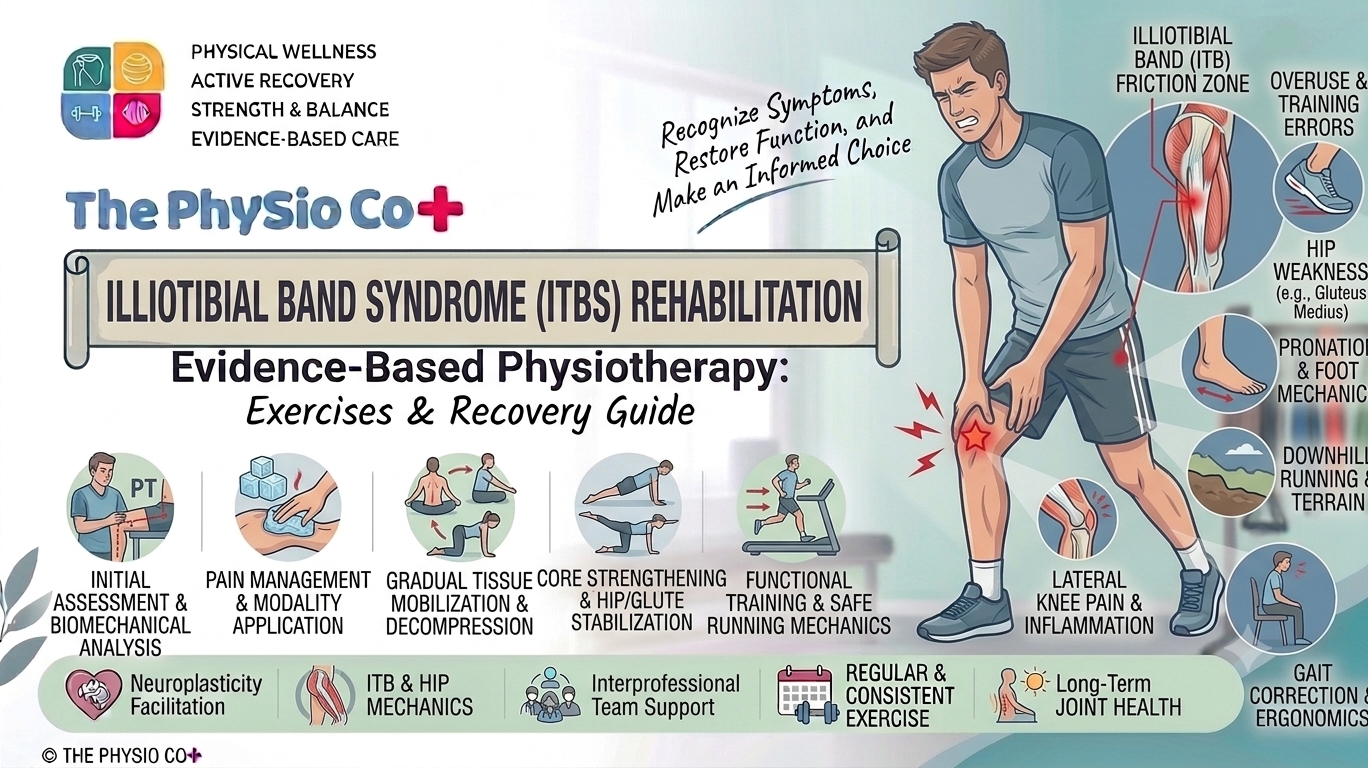
Iliotibial Band Syndrome is an overuse-related pain condition that usually causes pain around the outside of the knee.
It is particularly common in:
- Runners
- Cyclists
- Hikers
- Athletes
- People who suddenly increase their exercise
The pain often appears during activity and may improve after stopping.
As the condition progresses, the pain may start earlier during exercise or continue after the activity.
What Causes IT Band Syndrome?
IT Band Syndrome is usually not caused by one single problem.
It can develop when the amount of activity increases faster than the body can adapt.
Common contributing factors include:
- Suddenly increasing running distance
- Increasing running speed too quickly
- Running more frequently
- Hill running
- Repetitive downhill running
- Sudden changes in training
- Poor recovery between sessions
- Weakness around the hip and leg
- Reduced control of the leg during movement
Training errors are often more important than simply blaming “tight muscles.”
Who Is More Likely to Develop IT Band Syndrome?
ITBS is commonly seen in people who participate in repetitive activities such as:
Runners
Especially when training volume or intensity increases quickly.
Cyclists
Repeated knee movement can place significant demands on the tissues around the outside of the knee.
Hikers
Long-distance hiking, particularly downhill walking, can increase symptoms.
Athletes
Sports involving repeated running and changes in direction may increase the demand on the hip and knee.
What Are the Symptoms of IT Band Syndrome?
The most common symptom is pain on the outside of the knee.
You may notice:
- Sharp or burning pain on the outer knee
- Pain during running
- Pain while cycling
- Pain when walking downhill
- Pain while climbing stairs
- Pain that appears after a certain amount of exercise
- Tenderness around the outside of the knee
Some people describe a clicking or snapping sensation around the outside of the knee.
Where Is IT Band Pain Located?
IT Band Syndrome usually causes pain around the outer part of the knee, near the area where the IT band passes close to the knee joint.
The pain can sometimes extend upward along the outer thigh.
If your pain is mainly at the front, inside or back of the knee, another condition may be responsible.
This is why an assessment is useful before assuming that all outer-knee pain is ITBS.
Why Does IT Band Syndrome Hurt During Running?
Running involves thousands of repeated movements of the hip and knee.
When training load increases too quickly, the tissues around the outside of the knee may become sensitive.
You may notice a pattern such as:
Start running → Feel okay initially → Pain develops after a certain distance → Stop running → Pain gradually settles
If this pattern continues, the pain may start earlier in the run.
Continuing to push through increasing pain without changing the training load can make recovery more difficult.
Is IT Band Syndrome a Muscle Injury?
No.
The IT band is not a muscle.
It is a strong band of connective tissue that connects structures around the hip and outer thigh with the area around the knee.
However, the muscles around the hip and thigh play an important role in controlling how the leg moves.
This is why strengthening these muscles is often included in rehabilitation.
How Is IT Band Syndrome Diagnosed?
ITBS is usually diagnosed based on:
- Your symptoms
- Activity history
- Pain location
- Physical examination
- Movement assessment
A physiotherapist may assess:
- Hip strength
- Knee movement
- Single-leg control
- Running technique
- Training load
- Lower-limb movement
Imaging is not usually necessary for straightforward IT Band Syndrome.
However, further investigation may be considered if the symptoms do not fit the usual pattern or do not improve with appropriate treatment.
Can IT Band Syndrome Heal Without Surgery?
Yes.
Most cases can be managed without surgery.
Treatment commonly involves:
- Modifying the activity that aggravates symptoms
- Gradual return to running or sport
- Strengthening the hip and leg
- Improving movement control
- Managing training load
Surgery is rarely required.
IT Band Syndrome Physiotherapy Treatment
Physiotherapy treatment focuses on helping the body tolerate the activity that caused the problem.
1. Reduce the Irritating Activity
You may not need to stop all exercise.
Instead, the activity that repeatedly triggers the pain may need to be temporarily reduced.
For example, a runner may need to:
- Reduce running distance
- Reduce speed
- Avoid hills temporarily
- Take additional recovery days
You can often continue other activities that do not significantly increase symptoms.
2. Strengthening the Hip
Hip strength is an important part of rehabilitation.
Exercises may target:
- Gluteal muscles
- Hip abductors
- Hip extensors
- Core muscles
The goal is to improve your ability to control the leg during activities such as running and single-leg movements.
3. Strengthening the Leg
Rehabilitation may also include:
- Squats
- Step-ups
- Lunges
- Single-leg exercises
- Calf strengthening
The exercises should be progressed gradually.
4. Improving Movement Control
A physiotherapist may assess how your:
- Hip
- Knee
- Foot
move together during activities such as squatting, stepping and running.
Exercises can then be selected to improve control where necessary.
5. Gradual Return to Running
Once daily activities are comfortable and strength has improved, running can be gradually reintroduced.
For example:
Walking → Walk/jog → Easy running → Longer running → Faster running → Hills → Normal training
The exact progression depends on the individual.
IT Band Syndrome Exercises
Here are some exercises commonly used during rehabilitation.
1. Side-Lying Hip Abduction
- Lie on your side.
- Keep the lower leg comfortably bent.
- Straighten the upper leg.
- Slowly lift the upper leg.
- Keep the toes pointing mostly forward.
- Lower the leg slowly.
You should feel the muscles around the side of the hip working.
2. Glute Bridge
- Lie on your back.
- Bend both knees.
- Keep your feet on the floor.
- Tighten your abdominal and buttock muscles.
- Lift your hips.
- Hold briefly.
- Lower slowly.
As strength improves, the exercise can be progressed.
3. Clamshell
- Lie on your side.
- Bend your knees.
- Keep your feet together.
- Slowly lift the top knee.
- Keep your pelvis steady.
- Lower the knee slowly.
Avoid rotating your whole body backward.
4. Step-Up
- Stand in front of a low step.
- Place one foot on the step.
- Push through that leg to step up.
- Control the movement as you step down.
- Repeat.
Focus on keeping the knee controlled rather than allowing it to collapse inward.
5. Single-Leg Squat Progression
Once basic strength has improved:
- Stand on one leg.
- Slowly bend the knee and hip.
- Keep the knee controlled over the foot.
- Return to standing.
Start with a small range and use support if needed.
Should You Stretch the IT Band?
This is a common question.
The IT band itself is a strong connective tissue structure and is not something that can simply be “stretched out” like a muscle.
Some people may benefit from mobility exercises for the hip and surrounding muscles, but rehabilitation should not rely solely on trying to stretch the IT band.
Strengthening and managing training load are usually more important parts of recovery.
Should You Use a Foam Roller for IT Band Syndrome?
Foam rolling may temporarily change how the area feels, but aggressively rolling directly over a painful IT band is not necessary for recovery.
If foam rolling is uncomfortable, there is no need to force it.
A better long-term strategy is to address:
- Training load
- Hip and leg strength
- Movement control
- Running progression
Can You Keep Running With IT Band Syndrome?
It depends on the severity of your symptoms.
If running consistently produces increasing pain, continuing the same training program is unlikely to help.
You may be able to maintain fitness through activities that are more comfortable, such as:
- Swimming
- Upper-body training
- Cycling, if comfortable
- Walking
- Other low-impact activities
Once symptoms settle, running can be gradually reintroduced.
How Long Does IT Band Syndrome Take to Heal?
There is no fixed recovery period.
Mild cases may improve relatively quickly after training is modified.
Long-standing symptoms may require several weeks or longer of structured rehabilitation.
Recovery depends on:
- How long symptoms have been present
- Training load
- Strength
- Activity level
- Rehabilitation consistency
- How gradually you return to running
Trying to return to your previous training volume too quickly can cause symptoms to return.
Can IT Band Syndrome Come Back?
Yes.
Recurrence can happen if the underlying training or movement factors have not been addressed.
To reduce the risk of recurrence:
- Increase training gradually
- Avoid sudden changes in mileage
- Include strength training
- Allow adequate recovery
- Progress running volume gradually
- Address symptoms early
How Can Runners Prevent IT Band Syndrome?
There is no guaranteed way to prevent ITBS.
However, runners can reduce avoidable training-related risks by:
- Increasing running distance gradually
- Avoiding sudden increases in intensity
- Including strength training
- Allowing recovery days
- Avoiding large sudden changes in terrain
- Gradually introducing hill running
- Maintaining overall fitness
You do not need to completely change your running technique just because you have experienced IT Band pain.
Any changes should be based on an individual assessment.
IT Band Syndrome and Running Form
Running form is sometimes blamed for ITBS, but there is no single running style that causes every case.
A physiotherapist can assess your running pattern if symptoms repeatedly return.
Depending on the individual, rehabilitation may address:
- Cadence
- Stride pattern
- Hip control
- Strength
- Training volume
- Running terrain
The focus should be on what is relevant to your particular symptoms rather than trying to achieve a “perfect” running style.
When Should You See a Physiotherapist?
Consider seeing a physiotherapist if:
- Outer knee pain keeps returning
- Running consistently causes pain
- Pain is affecting your daily activities
- You have reduced your training but symptoms continue
- You are unable to return to sport
- You are unsure which exercises to perform
- You have had repeated episodes of knee pain
Early assessment can help identify the factors contributing to the problem.
When Should You See a Doctor?
Outer-knee pain is not always caused by IT Band Syndrome.
Medical assessment may be appropriate if:
- Pain is severe
- The knee is significantly swollen
- You cannot put weight on the leg
- The knee locks or repeatedly gives way
- There was a significant injury
- You have unexplained fever or illness
- Symptoms are getting worse despite appropriate management
Other knee conditions can cause similar symptoms, so persistent pain should not automatically be labelled as ITBS.
IT Band Syndrome Physiotherapy in Delhi
If you are searching for IT Band Syndrome physiotherapy in Delhi, treatment should focus on more than simply stretching or massaging the painful area.
At The Physio Co+, rehabilitation can include activity modification, hip and leg strengthening, movement retraining, balance exercises and a gradual return to running or sport.
The program can be adjusted according to your activity level, training schedule and goals.
For runners and athletes in and around Vasant Kunj, rehabilitation can also focus on safely returning to their usual training routine.
Related services: Sports Injury Physiotherapy | Physiotherapy in Delhi | Knee Physiotherapy | Clinical Pilates
Frequently Asked Questions
What is IT Band Syndrome?
IT Band Syndrome is a common overuse-related cause of pain on the outside of the knee, particularly in runners and other active people.
What are the symptoms of IT Band Syndrome?
The main symptom is pain on the outside of the knee, often during running, cycling, walking downhill or other repetitive activities.
Can physiotherapy help IT Band Syndrome?
Yes. Physiotherapy can help address activity levels, hip and leg strength, movement control and gradual return to sport.
Should I stop running if I have IT Band Syndrome?
You may need to temporarily reduce or modify running if it repeatedly increases your pain. Running can usually be reintroduced gradually once symptoms improve.
Is IT Band Syndrome caused by a tight IT band?
Not necessarily. ITBS is more complicated than simply having a “tight” IT band. Training load, strength and movement factors can all contribute.
Should I stretch my IT band?
Directly stretching the IT band is not usually the main focus of rehabilitation. Strengthening and gradually managing activity are generally more important.
Does foam rolling cure IT Band Syndrome?
No. Foam rolling may temporarily change how the area feels, but it does not address all the factors involved in ITBS.
Can cycling cause IT Band Syndrome?
Yes. Repetitive cycling can contribute to outer-knee pain in some people, particularly when training volume or bike-related factors change.
How long does IT Band Syndrome take to recover?
Recovery varies. Some people improve within a few weeks, while persistent cases may require longer rehabilitation.
Can IT Band Syndrome come back?
Yes. Returning to high training loads too quickly or not addressing contributing factors can increase the chance of symptoms returning.
Key Takeaway
Iliotibial Band Syndrome is a common cause of outer-knee pain, especially among runners and other active people.
It does not mean that you have to stop exercising permanently.
Successful rehabilitation usually involves:
Reduce irritating activity → Build hip and leg strength → Improve movement control → Gradually return to running → Progress training safely
The goal is not simply to make the pain disappear. It is to help your body handle the demands of your sport or daily activities again.
If you are looking for IT Band Syndrome physiotherapy in Delhi, IT Band physiotherapy in Vasant Kunj or knee physiotherapy in Delhi, an individual assessment can help identify the most appropriate rehabilitation plan.
References
- Fredericson M, Wolf C. Iliotibial band syndrome in runners: innovations in treatment. Sports Medicine.
- Louw M, Deary C. The biomechanical variables involved in the aetiology of iliotibial band syndrome in distance runners: a systematic review of the literature. Physical Therapy in Sport.
- Aderem J, Louw QA. Biomechanical risk factors associated with iliotibial band syndrome in runners: a systematic review. BMC Musculoskeletal Disorders.
- Fairclough J, Hayashi K, Toumi H, et al. The functional anatomy of the iliotibial band during flexion and extension of the knee. Journal of Anatomy.
- National Institute for Health and Care Excellence (NICE). Guidance and evidence relating to assessment and management of musculoskeletal pain.
- American Academy of Orthopaedic Surgeons (AAOS). Patient education resources relating to knee pain and sports injuries.