

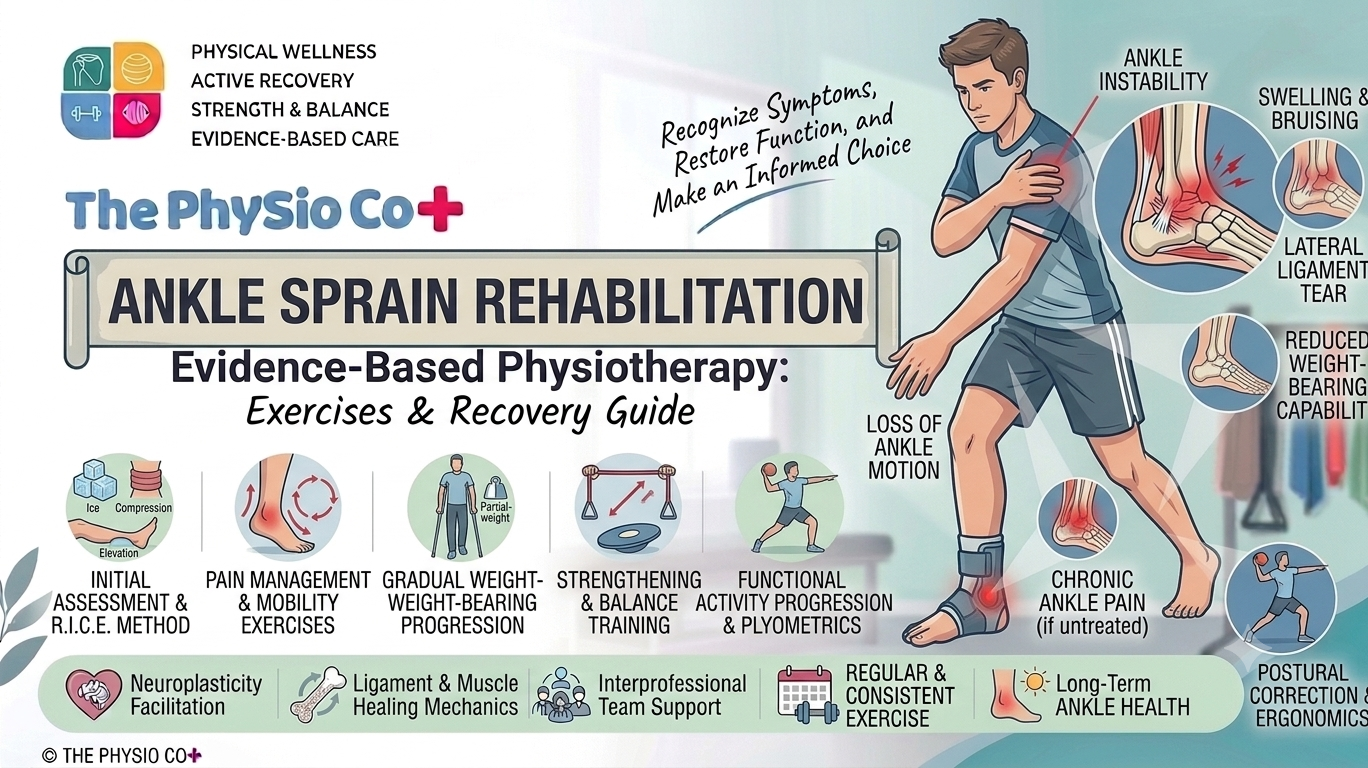

Ankle Sprain Rehabilitation
An ankle sprain is one of the most common injuries, especially during sports and physical activity. It can happen when the ankle suddenly rolls, twists or moves beyond its normal range.
A sprain can cause pain, swelling, bruising and difficulty putting weight on the foot. While some mild ankle sprains improve within a few weeks, more severe injuries can take longer and may need structured rehabilitation.
The important thing to remember is that feeling better does not always mean the ankle is fully ready for sports or demanding activity. Strength, balance and confidence also need to be restored.
If you are searching for ankle sprain physiotherapy in Delhi, this guide explains the recovery process, exercises and when physiotherapy may be helpful.
What Is an Ankle Sprain?
An ankle sprain happens when one or more of the strong bands of tissue that support the ankle, called ligaments, are stretched beyond their normal range or damaged.
Most ankle sprains affect the ligaments on the outer side of the ankle.
This commonly happens when the foot rolls inward while the body continues moving.
An ankle sprain can happen while:
- Running
- Jumping
- Playing football
- Playing badminton
- Playing basketball
- Playing tennis
- Walking on an uneven surface
- Missing a step
- Landing awkwardly after a jump
What Are the Different Grades of Ankle Sprain?
Ankle sprains are often described according to how much the ligament has been damaged.
Grade 1
The ligament is stretched or has minor damage.
Common symptoms include:
- Mild pain
- Mild swelling
- Little or no bruising
- Usually some ability to walk
Grade 2
There is a partial tear of the ligament.
You may experience:
- More swelling
- Bruising
- Pain with walking
- Reduced ankle movement
- Difficulty putting full weight on the foot
Grade 3
There is a complete tear of a ligament.
Symptoms can include:
- Significant swelling
- Bruising
- Difficulty or inability to walk normally
- Feeling of instability
- Significant pain
The severity of an ankle sprain should be assessed rather than determined only from the amount of pain.
What Are the Symptoms of an Ankle Sprain?
Common symptoms include:
- Ankle pain
- Swelling
- Bruising
- Tenderness
- Difficulty walking
- Reduced ankle movement
- Feeling unstable
- Pain when putting weight on the foot
Some people may also experience stiffness after sitting or resting.
How Does an Ankle Sprain Happen?
The most common mechanism is an inward rolling movement of the foot.
For example, you may land from a jump and your foot turns inward.
This can put excessive stress on the ligaments on the outside of the ankle.
Ankle sprains are particularly common in sports that involve:
- Jumping
- Running
- Sudden stops
- Quick direction changes
- Uneven surfaces
Can You Walk With an Ankle Sprain?
It depends on the severity of the injury.
With a mild sprain, you may be able to walk, although it may initially be uncomfortable.
With a more severe sprain, putting weight on the foot can be very difficult.
If you cannot take several steps after an injury, especially if there is significant tenderness or swelling, medical assessment may be appropriate to rule out a fracture or more serious injury.
Ankle Sprain vs Ankle Fracture
A sprain affects the ligaments, while a fracture involves a broken bone.
The symptoms can sometimes look similar.
A fracture may be more likely when there is significant tenderness directly over certain ankle or foot bones, severe swelling or difficulty bearing weight.
Because it can be difficult to distinguish the two yourself, an assessment may be necessary after a significant injury.
When Should You Get an X-Ray?
Not every ankle sprain requires an X-ray.
Healthcare professionals may use clinical decision rules, such as the Ottawa Ankle Rules, to determine whether an X-ray is appropriate.
An X-ray may be considered when there is specific bone tenderness or difficulty taking weight-bearing steps.
If you are unsure whether you have a sprain or fracture, it is better to get assessed rather than repeatedly testing the ankle yourself.
What Should You Do Immediately After an Ankle Sprain?
During the early stage, the main priorities are to:
- Protect the ankle
- Reduce activities that significantly increase pain
- Manage swelling
- Maintain safe movement
- Gradually return to weight-bearing as tolerated
Crutches or other support may sometimes be needed temporarily after a more significant injury.
Complete bed rest is usually not necessary.
As symptoms allow, gradual movement and loading are important parts of recovery.
Should You Use Ice for an Ankle Sprain?
Ice may provide short-term pain relief for some people.
However, ice should not be considered a treatment that directly heals the ligament.
If you use ice:
- Keep it wrapped in a cloth
- Avoid placing ice directly on the skin
- Use it for a short period
- Stop if the skin becomes painful or excessively numb
Pain and swelling should guide activity during the early stage.
Should You Rest Completely After an Ankle Sprain?
Not usually.
Too much rest can result in:
- Stiffness
- Muscle weakness
- Reduced confidence
- Delayed return to normal activity
The aim is relative rest, meaning you temporarily reduce activities that aggravate symptoms while maintaining safe movement.
As your symptoms improve, activity should gradually increase.
Stages of Ankle Sprain Rehabilitation
Recovery can broadly be divided into several stages.
The exact timeline varies according to the severity of the injury.
Stage 1: Protect and Settle Symptoms
During the early phase, the focus is on:
- Managing pain
- Controlling swelling
- Protecting the ankle
- Maintaining safe movement
- Gradually restoring weight-bearing
Gentle ankle movement may be introduced when appropriate.
Stage 2: Restore Movement
Once pain and swelling begin to settle, the focus shifts toward restoring ankle movement.
Exercises may include:
- Ankle circles
- Ankle pumps
- Gentle calf stretching
- Controlled ankle movements
The goal is to avoid prolonged stiffness.
Stage 3: Build Strength
After a sprain, the muscles around the ankle may become weaker.
Strengthening may target:
- Calf muscles
- Foot muscles
- Ankle muscles
- Lower-leg muscles
- Hip muscles
Resistance bands can be useful for gradually increasing resistance.
Stage 4: Balance Training
This is one of the most important parts of ankle rehabilitation.
After an ankle sprain, your sense of where the ankle is in space can be affected.
Balance exercises help the ankle and nervous system respond better to changes in position.
Exercises may progress from:
Two-leg balance → Single-leg balance → Dynamic balance → Sport-specific balance
Stage 5: Return to Running and Sport
The final stage involves gradually exposing the ankle to the demands of your activity.
This may include:
- Fast walking
- Jogging
- Running
- Hopping
- Jumping
- Direction changes
- Agility exercises
- Sport-specific drills
You should not return directly from walking to full-speed sport.
Ankle Sprain Exercises
The exercises you need depend on the stage of recovery.
Here are some commonly used exercises.
1. Ankle Pumps
- Sit or lie comfortably.
- Slowly point your foot away from you.
- Then pull your toes back toward you.
- Move through a comfortable range.
- Repeat slowly.
This can help maintain ankle movement during the early stages.
2. Ankle Circles
- Lift the foot slightly off the ground.
- Slowly move the ankle in a circle.
- Change direction.
- Keep the movement controlled.
Avoid forcing the movement if it increases pain.
3. Calf Stretch
- Stand facing a wall.
- Place your hands on the wall.
- Put the injured leg behind you.
- Keep the heel down.
- Gently move your body forward.
- Hold the stretch comfortably.
Do not force the stretch into pain.
4. Resistance-Band Ankle Exercises
A resistance band can be used to strengthen the muscles around the ankle.
Exercises may include:
- Pulling the foot upward
- Pushing the foot downward
- Moving the foot inward
- Moving the foot outward
Resistance should be increased gradually.
5. Calf Raises
- Stand near a wall or stable surface.
- Slowly rise onto your toes.
- Hold briefly.
- Lower your heels slowly.
As strength improves, the exercise can progress from two legs to one leg.
6. Single-Leg Balance
- Stand near a stable support.
- Lift the unaffected foot.
- Balance on the injured leg.
- Hold for a comfortable period.
- Use support if needed.
As balance improves, the exercise can become more challenging.
Why Is Balance Training Important After an Ankle Sprain?
One of the biggest problems after an ankle sprain is that the ankle can remain less stable even after pain has improved.
This can increase the chance of another sprain.
Balance training helps improve the body’s ability to respond to changes in position and movement.
For athletes, balance training should eventually progress into:
- Hopping
- Landing
- Cutting
- Jumping
- Quick direction changes
Can an Ankle Sprain Become a Long-Term Problem?
Yes.
Some people develop chronic ankle instability after repeated sprains.
Symptoms may include:
- Repeated ankle rolling
- Feeling that the ankle is giving way
- Poor balance
- Persistent swelling
- Reduced confidence during sports
- Pain during certain activities
This is one reason rehabilitation should continue beyond the point where basic walking becomes comfortable.
Why Do I Keep Spraining My Ankle?
Repeated ankle sprains can happen for several reasons.
These may include:
- Incomplete rehabilitation
- Poor balance
- Reduced ankle strength
- Limited ankle movement
- Returning to sport too quickly
- Previous ankle injury
- Poor movement control
If you repeatedly sprain the same ankle, a physiotherapy assessment can help identify factors that may be contributing to the problem.
Can Physiotherapy Help an Ankle Sprain?
Yes.
Physiotherapy can help restore:
- Ankle movement
- Strength
- Balance
- Walking ability
- Confidence
- Running ability
- Sport-specific movement
A physiotherapist can also help determine when it is appropriate to progress from one stage of rehabilitation to the next.
Ankle Sprain Physiotherapy Treatment
A physiotherapy program may include:
Movement Exercises
To restore ankle mobility.
Strength Training
To rebuild the muscles around the ankle and lower limb.
Balance Training
To improve stability and reduce the risk of another sprain.
Gait Training
If the injury has changed the way you walk.
Manual Therapy
In selected cases, hands-on techniques may be used to help with pain or restricted movement.
Return-to-Sport Training
For athletes, rehabilitation can gradually introduce running, jumping, landing and direction changes.
Can You Exercise With an Ankle Sprain?
Yes, but exercise needs to be adjusted according to the stage of recovery.
Early on, you may need to avoid:
- Running
- Jumping
- Sudden direction changes
- Competitive sport
As your ankle improves, these activities can be gradually reintroduced.
The goal is not to avoid loading the ankle forever.
The goal is to build the ankle’s ability to handle load again.
When Can You Start Running After an Ankle Sprain?
There is no single number of days that applies to everyone.
Before returning to running, you should generally be able to perform everyday activities comfortably and demonstrate adequate:
- Walking ability
- Ankle movement
- Strength
- Balance
- Control
Running should then be introduced gradually.
A physiotherapist can help develop a return-to-running plan.
When Can You Return to Sports After an Ankle Sprain?
Returning to sport should involve more than simply asking whether the ankle still hurts.
You should gradually rebuild the activities required by your sport.
For example:
Walking → Jogging → Running → Hopping → Jumping → Direction changes → Sport-specific drills → Full sport
The ankle should demonstrate appropriate strength, balance and confidence before returning to unrestricted play.
Can You Prevent Another Ankle Sprain?
You cannot prevent every ankle injury, but rehabilitation can reduce the risk of recurrent problems.
Useful strategies include:
- Strengthening the ankle
- Improving balance
- Gradually increasing training load
- Working on landing technique
- Wearing appropriate footwear
- Completing rehabilitation after an injury
- Using a brace or taping when recommended for higher-risk athletes
Balance and strength training are particularly important for people with a history of ankle sprains.
Should You Wear an Ankle Brace?
An ankle brace can be useful for some people, particularly during the return to sport after an ankle sprain.
However, a brace should not replace rehabilitation.
Strength and balance training remain important.
A physiotherapist can help determine whether bracing or taping is appropriate for your activity.
How Long Does an Ankle Sprain Take to Heal?
Recovery time varies significantly.
A mild sprain may improve within a few weeks, while a more severe injury can take considerably longer.
Factors affecting recovery include:
- Severity of the ligament injury
- Swelling
- Pain
- Previous ankle injuries
- Strength
- Balance
- Rehabilitation
- Sport or work demands
The important point is that symptom improvement and full recovery are not always the same thing.
When Should You See a Physiotherapist?
Consider seeing a physiotherapist if:
- Pain continues after the initial injury
- Swelling does not settle
- You have difficulty walking normally
- The ankle feels unstable
- You have repeated ankle sprains
- You are struggling to return to sport
- You are unsure which exercises are appropriate
Early rehabilitation can help you return to normal activity safely.
When Should You See a Doctor?
Medical assessment is recommended if:
- You cannot put weight on the foot
- There is severe swelling
- There is significant bone tenderness
- The ankle looks deformed
- You heard a significant crack at the time of injury
- You have numbness or unusual colour changes
- Pain is severe or getting worse
- Symptoms are not improving as expected
These symptoms may indicate a fracture or another significant injury.
Ankle Sprain Physiotherapy in Delhi
If you are searching for ankle sprain physiotherapy in Delhi, treatment should go beyond simply reducing pain.
At The Physio Co+, ankle rehabilitation can focus on restoring movement, rebuilding strength, improving balance and gradually returning you to walking, running, gym training or sport.
Treatment may include therapeutic exercises, progressive strengthening, balance training, movement retraining and return-to-sport rehabilitation.
For patients in and around Vasant Kunj, the program can be customized according to the severity of the injury, daily activities and sporting requirements.
Related services: Sports Injury Physiotherapy | Physiotherapy in Delhi | Post-Surgery Rehabilitation | Clinical Pilates
Frequently Asked Questions
What is an ankle sprain?
An ankle sprain occurs when one or more ankle ligaments are stretched beyond their normal range or damaged.
How long does an ankle sprain take to heal?
Mild ankle sprains may improve within a few weeks, while more severe injuries can take longer. Recovery also depends on rehabilitation and activity demands.
Can I walk with an ankle sprain?
Many people can walk with a mild sprain. More severe injuries may make weight-bearing difficult and should be assessed.
What are the best exercises for an ankle sprain?
Exercises may include ankle mobility, calf strengthening, resistance-band exercises and balance training. The right exercises depend on the stage of recovery.
Should I rest completely after an ankle sprain?
Usually not. Relative rest is generally more useful than prolonged complete rest. Safe movement and gradual loading are important parts of recovery.
Can physiotherapy help an ankle sprain?
Yes. Physiotherapy can help restore movement, strength, balance and function and can support a safe return to sport.
Why does my ankle still feel weak after the pain is gone?
Pain can improve before strength and balance return fully. Continued rehabilitation can help restore ankle control and reduce the risk of another sprain.
Can an ankle sprain happen again?
Yes. Previous ankle sprains can increase the risk of another sprain, particularly when strength and balance have not fully recovered.
When can I return to sports after an ankle sprain?
Return to sport should be gradual. You should be able to walk, run, hop, change direction and perform sport-specific movements with appropriate strength, control and confidence.
Should I use an ankle brace after a sprain?
A brace may be useful for some people, particularly during sports. It should complement, rather than replace, rehabilitation.
Key Takeaway
An ankle sprain may look like a minor injury, but returning to normal activity too quickly can increase the risk of persistent weakness and repeated sprains.
A good rehabilitation program should progress from pain and swelling management → movement → strength → balance → running → sport-specific training.
The goal is not just to make the ankle feel better. It is to make the ankle strong, stable and ready for the activities you want to return to.
If you are looking for ankle sprain physiotherapy in Delhi, ankle rehabilitation in Delhi or ankle physiotherapy in Vasant Kunj, an individual assessment can help determine the right rehabilitation plan.
References
- Martin RL, et al. Ankle Stability and Movement Coordination Impairments: Lateral Ankle Ligament Sprains Revision 2021. Journal of Orthopaedic & Sports Physical Therapy.
- Gribble PA, et al. Consensus statement of the International Ankle Consortium: prevalence, impact and long-term consequences of lateral ankle sprains. British Journal of Sports Medicine.
- Doherty C, et al. Recovery from a first-time lateral ankle sprain and the predictors of chronic ankle instability. British Journal of Sports Medicine.
- American Academy of Orthopaedic Surgeons. Sprained Ankle. OrthoInfo.
- National Institute for Health and Care Excellence (NICE). Fractures (non-complex): assessment and management.
- Brukner P, Khan K. Clinical Sports Medicine. McGraw-Hill.
SEO Setup
Primary Keyword:
Ankle Sprain Physiotherapy in Delhi
Secondary Keywords:
- Ankle Sprain Rehabilitation Delhi
- Ankle Sprain Physiotherapy Delhi
- Ankle Sprain Treatment Delhi
- Ankle Physiotherapy Vasant Kunj
- Ankle Sprain Exercises
- Ankle Sprain Recovery
- Ankle Ligament Injury Treatment
- Ankle Ligament Rehabilitation
- Ankle Injury Physiotherapy Delhi
- Chronic Ankle Instability Physiotherapy
- Sports Injury Physiotherapy Delhi
- Physiotherapist for Ankle Pain Delhi
- Ankle Rehabilitation Exercises
- Ankle Sprain Treatment Without Surgery
Suggested URL Slug:/blog/ankle-sprain-rehabilitation-physiotherapy-in-delhi/
SEO Title:
Ankle Sprain Rehabilitation: Exercises & Recovery Guide
Meta Description:
Learn how ankle sprains heal, which exercises can help, when to start physiotherapy and how to safely return to running, sports and daily activities.
Suggested Internal Links:
- Ankle Sprain Physiotherapy →
https://thephysiocoplus.com/ - Sports Injury Physiotherapy →
https://thephysiocoplus.com/ - Physiotherapy in Delhi →
https://thephysiocoplus.com/ - ACL Rehabilitation → your existing ACL blog
- Meniscus Injury → your existing meniscus blog
- Muscle Strain vs Ligament Injury → your existing blog
- Fracture Rehabilitation → your existing fracture blog
Suggested Blog Banner Text:
Ankle Sprain Rehabilitation
Exercises & Recovery Guide
Optional subtitle:
Reduce Pain • Restore Strength • Improve Balance • Return to Sport