

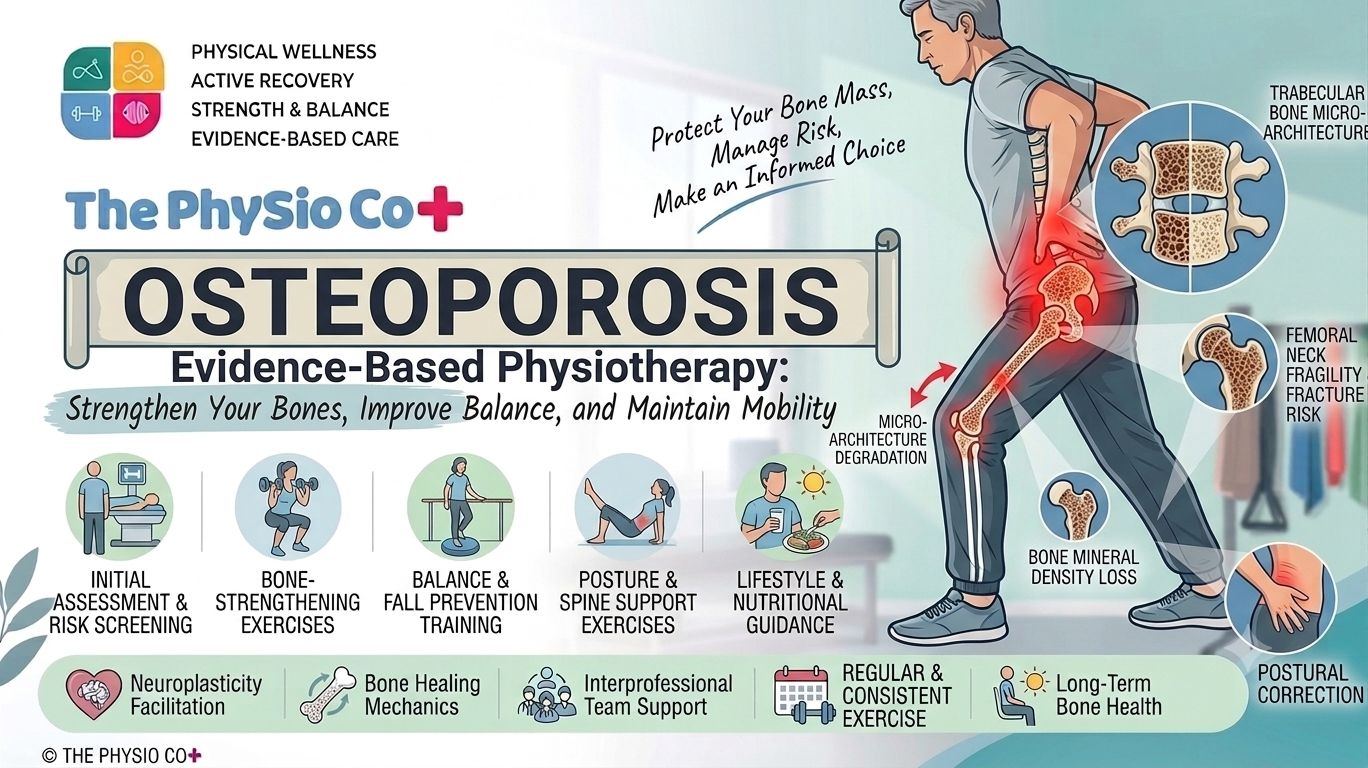

Osteoporosis
Osteoporosis is a condition in which bones become weaker and more likely to fracture.
Unlike many musculoskeletal conditions, osteoporosis may not cause pain or noticeable symptoms in its early stages. A person may only discover that they have osteoporosis after a fracture, particularly after a relatively minor fall or injury.
The good news is that exercise, strength training, balance training and lifestyle management can play an important role in maintaining physical function and reducing the risk of falls.
Physiotherapy can help people with osteoporosis develop a safe and progressive exercise program based on their bone health, age, strength, balance and fracture history.
If you are searching for osteoporosis physiotherapy in Delhi, this guide explains the condition, exercises, fracture prevention and the role of physiotherapy.
What Is Osteoporosis?
Osteoporosis means “porous bone.”
Healthy bone is living tissue that is continuously broken down and rebuilt.
With osteoporosis, bone density and/or bone quality are reduced, making the bones more fragile.
This can increase the risk of fractures, particularly in areas such as the:
- Hip
- Spine
- Wrist
- Upper arm
Osteoporosis is sometimes called a silent disease because bone loss may occur without obvious symptoms.
What Causes Osteoporosis?
Bone strength is influenced by several factors.
Risk factors for osteoporosis include:
- Increasing age
- Postmenopausal estrogen reduction
- Family history of osteoporosis
- Low body weight
- Previous fragility fracture
- Physical inactivity
- Smoking
- Excessive alcohol consumption
- Long-term use of certain medications, including corticosteroids
- Some hormonal or medical conditions
- Inadequate calcium or vitamin D intake
Having a risk factor does not necessarily mean that a person has osteoporosis.
Medical assessment is required for diagnosis.
Who Is at Risk of Osteoporosis?
Osteoporosis can affect both women and men.
Risk generally increases with age, particularly after menopause in women.
People may have increased risk if they have:
- A previous low-trauma fracture
- A family history of hip fracture
- Long-term steroid medication use
- Low physical activity
- Certain endocrine disorders
- Low body weight
- Conditions affecting nutrient absorption
If you have risk factors, discuss bone-health assessment with your doctor.
What Are the Symptoms of Osteoporosis?
Osteoporosis itself often has no obvious symptoms.
People may not know they have reduced bone strength until a fracture occurs.
Possible signs associated with advanced osteoporosis or vertebral fractures can include:
- Sudden back pain
- Loss of height
- Increasing spinal curvature
- Reduced physical function
- Recurrent fractures
A new or severe back pain should not automatically be assumed to be osteoporosis and should be medically assessed.
What Is an Osteoporotic Fracture?
A fragility fracture is generally a fracture that occurs from a force that would not normally be expected to break healthy bone.
Common sites include:
- Hip
- Spine
- Wrist
- Upper arm
A previous fragility fracture can be an important indicator of future fracture risk.
How Is Osteoporosis Diagnosed?
A commonly used test is dual-energy X-ray absorptiometry (DXA or DEXA).
A DXA scan can measure bone mineral density at sites such as the:
- Hip
- Lumbar spine
The results are usually interpreted using a T-score in appropriate populations.
Doctors may also consider:
- Age
- Sex
- Fracture history
- Family history
- Medication use
- Other health conditions
- Overall fracture risk
A diagnosis should therefore not be based on a bone-density number alone.
What Is the Role of Physiotherapy in Osteoporosis?
Physiotherapy does not replace medical treatment for osteoporosis.
However, physiotherapy can play an important role in helping a person remain physically active and reduce fall risk.
A physiotherapist may work on:
- Strength
- Balance
- Mobility
- Postural control
- Walking
- Functional movements
- Confidence with movement
- Safe exercise technique
The exercise program should be individualized according to fracture risk and existing health conditions.
Can Exercise Help Osteoporosis?
Yes.
Appropriately prescribed exercise can help maintain or improve:
- Muscle strength
- Physical function
- Balance
- Mobility
- Exercise capacity
Weight-bearing and resistance exercise are particularly important components of bone-health programs.
However, exercise should be appropriately selected for the individual’s fracture risk.
Best Exercises for Osteoporosis
Exercise selection depends on the person’s age, fitness, bone density, fracture history and other medical conditions.
Common components include:
1. Resistance Training
Progressive resistance training can help improve muscle strength and physical function.
Examples may include:
- Sit-to-stand exercises
- Resistance-band exercises
- Leg strengthening
- Hip strengthening
- Calf strengthening
- Upper-limb strengthening
Resistance should be increased gradually.
2. Weight-Bearing Exercise
Weight-bearing activities place appropriate loading through the skeleton.
Depending on the person’s health and fracture risk, this may include:
- Walking
- Stair climbing
- Low-impact aerobic activity
- Dancing
- Other weight-bearing activities
People with significant osteoporosis or previous fractures may require individualized advice before starting higher-impact activities.
3. Balance Training
Falls are an important concern for people at increased fracture risk.
Balance exercises may include:
- Supported single-leg standing
- Heel-to-toe walking
- Weight shifting
- Step exercises
- Functional balance activities
The exercises should be performed in a safe environment.
4. Functional Strengthening
Exercises such as sit-to-stand can improve lower-limb strength and functional independence.
How to perform:
- Sit on a stable chair.
- Place your feet comfortably on the floor.
- Lean forward slightly.
- Stand up using controlled movement.
- Slowly sit down.
The exercise can be progressed as strength improves.
Osteoporosis Exercises at Home
A home program may include:
- Sit-to-stand
- Heel raises
- Supported balance exercises
- Resistance-band exercises
- Walking
- Hip strengthening
- Postural exercises
The specific exercises should depend on your fracture risk and physical condition.
If you have osteoporosis with a history of vertebral fracture, exercises involving significant spinal loading or bending should be individually assessed.
Exercises to Avoid With Osteoporosis
There is no universal list of exercises that every person with osteoporosis must avoid.
However, people with significant osteoporosis, particularly those with vertebral fractures, may need to modify or avoid activities involving:
- Forceful spinal flexion
- Repeated loaded forward bending
- High-impact activity when not appropriately conditioned
- Forceful twisting
- Heavy lifting with poor technique
- Movements that significantly increase fracture risk
This does not mean that people with osteoporosis should avoid movement.
In fact, appropriate physical activity is an important part of maintaining health and independence.
The key is safe, progressive loading.
Can People With Osteoporosis Do Strength Training?
Yes.
Strength training can be an important part of osteoporosis management.
It can improve:
- Muscle strength
- Functional capacity
- Balance
- Confidence
- Ability to perform daily activities
A physiotherapist can help determine:
- Appropriate resistance
- Exercise selection
- Repetitions
- Technique
- Progression
People with previous fractures or very high fracture risk may require additional precautions.
Can You Walk With Osteoporosis?
Yes.
Walking is generally a useful weight-bearing activity for many people.
It can contribute to:
- Physical activity
- Lower-limb conditioning
- Cardiovascular health
- Functional independence
However, walking alone may not provide sufficient stimulus for all aspects of bone health.
A well-rounded program may also include resistance and balance training.
Can Pilates Help Osteoporosis?
Pilates can be useful for improving:
- Core control
- Muscle strength
- Balance
- Mobility
- Body awareness
However, people with osteoporosis should not assume that every Pilates exercise is appropriate.
Some traditional Pilates movements involve significant spinal flexion or loaded positions that may not be appropriate for people with vertebral fractures or high fracture risk.
A modified Clinical Pilates program can be designed around the person’s medical history and movement needs.
Osteoporosis and Posture
Osteoporosis can be associated with vertebral compression fractures.
Repeated vertebral fractures can contribute to:
- Loss of height
- Increased thoracic curvature
- Changes in posture
- Back pain
Physiotherapy may address:
- Back extensor strength
- Postural awareness
- Balance
- Functional movement
- Safe lifting techniques
The goal is to improve physical capacity rather than force the spine into an artificial position.
Osteoporosis and Fall Prevention
Preventing falls is an important part of fracture prevention.
A physiotherapist may assess:
- Balance
- Walking pattern
- Lower-limb strength
- Foot clearance
- Mobility
- Confidence
- Environmental risk factors
Fall-prevention strategies may include:
- Balance exercises
- Strength training
- Walking practice
- Appropriate footwear
- Home safety modifications
- Vision assessment where appropriate
Osteoporosis After Menopause
Bone loss can accelerate after menopause because of changes in estrogen levels.
For postmenopausal women, maintaining:
- Strength
- Physical activity
- Balance
- Adequate nutrition
- Bone-health monitoring
can be particularly important.
Women with risk factors should discuss osteoporosis screening and medical management with their healthcare provider.
Osteoporosis in Men
Osteoporosis is not only a women’s health condition.
Men can also develop osteoporosis, particularly with:
- Increasing age
- Low testosterone
- Long-term steroid use
- Certain medical conditions
- Low physical activity
- Previous fractures
Men with risk factors should also discuss bone health with their doctor.
Can Physiotherapy Cure Osteoporosis?
No.
Physiotherapy does not cure osteoporosis.
Instead, physiotherapy can support the management of osteoporosis by helping improve:
- Strength
- Balance
- Mobility
- Physical function
- Confidence
- Fall-risk factors
Medical management may also include medication, nutrition and treatment of underlying conditions when appropriate.
Can Osteoporosis Be Reversed?
Bone density can sometimes improve with appropriate medical treatment and lifestyle changes.
However, the goal of osteoporosis management is broader than simply increasing bone density.
It also includes:
- Preventing fractures
- Maintaining strength
- Preventing falls
- Preserving independence
- Maintaining physical activity
Your doctor can determine whether medication or further investigations are appropriate.
Calcium and Vitamin D
Calcium and vitamin D are important for bone health.
However, supplements should not automatically be taken at high doses.
Your nutritional requirements depend on factors such as:
- Age
- Diet
- Vitamin D status
- Medical conditions
- Medication
- Overall fracture risk
Discuss supplementation with a doctor or qualified healthcare professional when necessary.
Physiotherapy After an Osteoporotic Fracture
If a person with osteoporosis sustains a fracture, rehabilitation becomes particularly important.
Depending on the fracture, physiotherapy may focus on:
- Pain management
- Safe mobility
- Strength
- Balance
- Walking
- Transfers
- Functional independence
- Gradual return to activities
The rehabilitation plan must account for both the fracture and underlying bone health.
Osteoporosis Physiotherapy in Delhi
If you are searching for osteoporosis physiotherapy in Delhi, rehabilitation should be individualized rather than based on a generic exercise list.
At The Physio Co+, physiotherapy can focus on progressive strengthening, balance training, mobility, functional exercise and fall-risk reduction.
For people with osteoporosis, previous fractures or age-related weakness, exercise selection and progression can be modified according to individual needs.
Clinical Pilates may also be considered for selected individuals, with exercises modified according to bone health and movement restrictions.
For patients in and around Vasant Kunj, rehabilitation can be tailored according to your activity level, medical history and functional goals.
Related services: Physiotherapy in Delhi | Clinical Pilates | Fracture Rehabilitation | Post-Surgery Rehabilitation
Frequently Asked Questions
What is osteoporosis?
Osteoporosis is a condition characterized by reduced bone strength, which increases the risk of fractures.
What are the symptoms of osteoporosis?
Osteoporosis often has no obvious symptoms until a fracture occurs. Vertebral fractures may cause back pain, height loss or changes in spinal shape.
Can physiotherapy help osteoporosis?
Physiotherapy can help improve strength, balance, mobility and physical function and can contribute to fall and fracture-risk management.
What are the best exercises for osteoporosis?
Appropriately prescribed resistance training, weight-bearing exercise, balance training and functional exercises are commonly recommended components of an osteoporosis exercise program.
Can I do Pilates if I have osteoporosis?
Some people with osteoporosis can participate in modified Pilates. Exercises involving forceful spinal flexion or other high-risk movements may need to be modified, particularly after vertebral fractures.
Can walking improve osteoporosis?
Walking is a useful weight-bearing activity for many people, but it is generally best combined with resistance and balance exercises for a more complete exercise program.
Can people with osteoporosis lift weights?
Yes, progressive resistance training can be beneficial. The amount and type of resistance should be appropriate for the individual’s fracture risk and physical capacity.
Can osteoporosis be cured by exercise?
Exercise cannot be described as a cure for osteoporosis. It can help maintain strength, physical function and balance and may contribute to bone health.
Can osteoporosis cause back pain?
Osteoporosis itself often does not cause pain. Back pain can occur when osteoporosis contributes to a vertebral compression fracture.
How can I prevent fractures if I have osteoporosis?
A comprehensive approach may include appropriate exercise, strength and balance training, fall prevention, medical management, adequate nutrition and treatment of other risk factors.
Key Takeaway
Osteoporosis can weaken bones and increase fracture risk, but having osteoporosis does not mean that you should stop exercising.
The right exercise program can help maintain strength, balance, mobility and independence, while reducing factors associated with falls.
The most important principle is safe and progressive exercise based on individual fracture risk.
If you are looking for osteoporosis physiotherapy in Delhi, osteoporosis exercises in Delhi or physiotherapy for fracture prevention in Vasant Kunj, an individualized assessment can help determine an appropriate rehabilitation program.
References
- National Osteoporosis Foundation / Bone Health and Osteoporosis Foundation. Information and clinical resources on osteoporosis and fracture prevention.
- International Osteoporosis Foundation. Resources on osteoporosis, exercise and fracture prevention.
- National Institute for Health and Care Excellence (NICE). Guidance relating to osteoporosis and fracture risk assessment.
- Royal Osteoporosis Society. Exercise and physical activity guidance for people living with osteoporosis.
- World Health Organization. Physical activity and sedentary behaviour guidelines.