

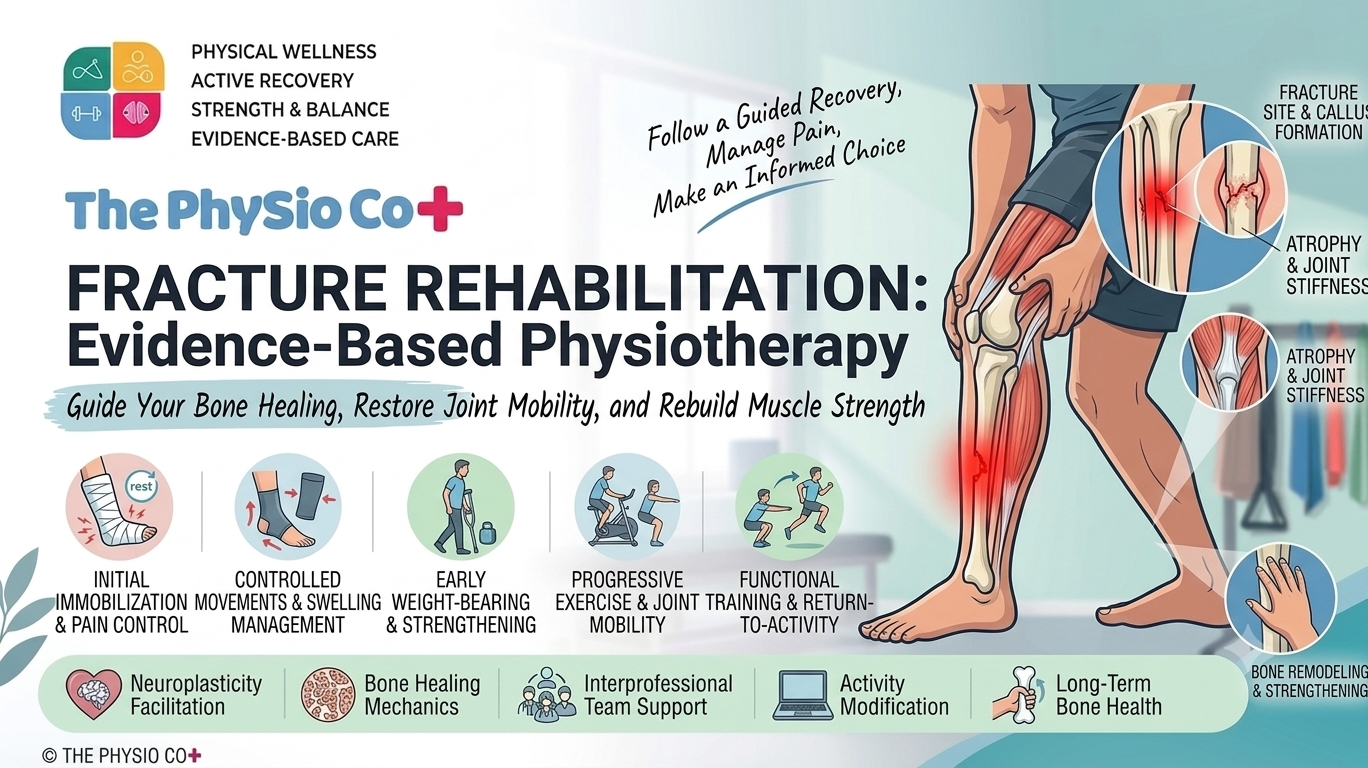

Fracture Rehabilitation
A fracture can affect much more than the bone itself.
After a fracture, pain, swelling, stiffness, muscle weakness and reduced movement can make everyday activities difficult. If the fracture required immobilization, casting or surgery, the surrounding muscles and joints may also lose strength and mobility during the healing period.
Fracture rehabilitation helps restore movement, strength, balance and function while respecting the stage of bone healing.
Physiotherapy can be an important part of recovery after a fracture, but rehabilitation should always be based on the type of fracture, treatment received and medical advice regarding weight-bearing and movement restrictions.
If you are looking for fracture rehabilitation in Delhi or fracture physiotherapy in Delhi, this guide explains what to expect during recovery.
What Is Fracture Rehabilitation?
Fracture rehabilitation is the process of gradually restoring function after a broken bone.
Depending on the injury, rehabilitation may address:
- Joint stiffness
- Muscle weakness
- Swelling
- Reduced range of motion
- Balance problems
- Difficulty walking
- Reduced grip strength
- Loss of coordination
- Difficulty performing daily activities
- Return to work or sports
The rehabilitation program changes as the fracture heals.
The goal is not simply to make the bone heal.
The goal is to help the person safely return to their normal level of function.
What Happens After a Fracture?
Treatment for a fracture may involve:
- Casting
- Splinting
- Bracing
- Reduction of the fracture
- Internal fixation with plates, screws or other implants
- External fixation
- Surgery
The treatment depends on the location and type of fracture.
Once the fracture has been appropriately stabilized, rehabilitation can begin according to the medical team’s instructions.
Why Is Physiotherapy Important After a Fracture?
Immobilization is often necessary for bone healing, but prolonged immobilization can also result in:
- Muscle weakness
- Joint stiffness
- Reduced flexibility
- Swelling
- Reduced balance
- Changes in walking pattern
- Reduced confidence with movement
Physiotherapy helps address these problems progressively.
Depending on the fracture, rehabilitation may include:
- Range-of-motion exercises
- Strengthening
- Mobility training
- Balance exercises
- Gait training
- Functional exercises
- Scar management after surgery
- Swelling management
- Return-to-work rehabilitation
- Return-to-sport rehabilitation
Stages of Fracture Rehabilitation
There is no single rehabilitation timeline that applies to every fracture.
However, rehabilitation can broadly be considered in stages.
Stage 1: Protection and Early Recovery
Immediately after a fracture, the priority is protecting the injured area and allowing the bone to heal.
During this stage, your doctor may prescribe:
- Immobilization
- Limited movement
- Non-weight-bearing
- Partial weight-bearing
- Protected weight-bearing
The exact restrictions depend on the fracture.
Physiotherapy during this stage may focus on areas that can safely be exercised without interfering with fracture healing.
This may include:
- Movement of unaffected joints
- Gentle exercises
- Circulation exercises
- Swelling management
- Breathing exercises when appropriate
- Education about safe mobility
Do not begin weight-bearing or resistance exercises against medical restrictions.
Stage 2: Restoring Range of Motion
Once sufficient healing has occurred and movement is permitted, rehabilitation can focus more on restoring joint mobility.
After immobilization, it is common to experience stiffness.
Exercises may target:
- Joint range of motion
- Muscle flexibility
- Controlled movement
- Functional mobility
The intensity should be gradually increased.
For example, after a wrist fracture, rehabilitation may focus on wrist, forearm and finger mobility.
After an ankle fracture, the program may focus on ankle movement and progressive loading once weight-bearing is permitted.
Stage 3: Strengthening
Muscle weakness is common after a period of immobilization.
Once the fracture is sufficiently healed and loading is medically permitted, strengthening exercises can be progressively introduced.
Depending on the injury, exercises may target:
- Major muscles around the injured joint
- Grip strength
- Core strength
- Lower-limb strength
- Upper-limb strength
- Functional strength
Resistance may progress from:
Body weight → resistance bands → light weights → heavier resistance
The progression depends on the individual and the fracture.
Stage 4: Balance and Coordination
Fractures involving the lower limb can affect balance and walking.
Balance training may include:
- Weight-shifting exercises
- Supported standing
- Single-leg balance when appropriate
- Step exercises
- Proprioception exercises
- Dynamic balance training
Balance rehabilitation is particularly important before returning to activities that require rapid changes in direction.
Stage 5: Functional Rehabilitation
The final stages of rehabilitation focus on activities that matter to the individual.
For example:
For an office worker
The focus may be:
- Desk activities
- Typing
- Lifting light objects
- Comfortable sitting and movement
For a manual worker
The program may include:
- Lifting
- Carrying
- Repetitive movements
- Work-specific strength
For an athlete
Rehabilitation may progress toward:
- Running
- Jumping
- Agility
- Strength
- Sport-specific drills
The aim is to gradually restore the capacity required for the person’s normal activities.
Common Fractures That Require Physiotherapy
Physiotherapy can be used after many different types of fractures.
These include:
Wrist Fracture
A distal radius fracture can cause:
- Wrist stiffness
- Reduced grip strength
- Difficulty rotating the forearm
- Difficulty using the hand
Rehabilitation may include wrist and finger mobility, forearm rotation, grip strengthening and functional hand exercises.
Ankle Fracture
An ankle fracture may result in:
- Reduced ankle movement
- Weakness
- Swelling
- Altered walking
- Balance problems
Rehabilitation commonly progresses from mobility to strengthening, balance and walking activities.
Hip Fracture
Hip fractures can significantly affect mobility, particularly in older adults.
Rehabilitation may focus on:
- Safe transfers
- Walking
- Lower-limb strength
- Balance
- Functional independence
Hip fracture rehabilitation should be closely coordinated with the medical team.
Shoulder Fracture
A fracture around the shoulder can cause substantial stiffness and weakness.
Once movement is medically permitted, rehabilitation may address:
- Shoulder mobility
- Scapular control
- Rotator cuff and shoulder strength
- Functional reaching
Elbow Fracture
Elbow fractures can lead to significant stiffness.
Rehabilitation may focus on restoring:
- Elbow flexion
- Elbow extension
- Forearm rotation
- Strength
- Functional arm use
Leg Fracture
Fractures of the tibia, fibula or other lower-limb bones may require a prolonged period of protected weight-bearing.
Rehabilitation can eventually progress toward:
- Weight-bearing
- Walking
- Strengthening
- Balance
- Functional activities
Fracture Rehabilitation After Surgery
Some fractures require surgical fixation using:
- Plates
- Screws
- Nails
- Wires
- Other fixation devices
Physiotherapy may begin relatively early, depending on the surgical procedure and medical instructions.
Early rehabilitation may involve:
- Swelling management
- Safe movement
- Adjacent-joint mobility
- Muscle activation
- Functional mobility
Later stages may involve progressive strengthening and loading.
The physiotherapist must follow the surgeon’s restrictions regarding movement and weight-bearing.
Can You Exercise After a Fracture?
Yes, but the type and timing of exercise matter.
Exercise should be introduced according to the stage of healing.
Early exercises may focus on unaffected areas and gentle movements that are specifically permitted.
Later exercises can progress to:
- Resistance training
- Weight-bearing
- Balance exercises
- Functional movements
- Sport-specific training
The key is progressive loading rather than rushing the rehabilitation process.
Can Physiotherapy Start While You Have a Cast?
Sometimes, yes.
Even when the fractured area is immobilized, physiotherapy may be used to maintain function in areas that can safely move.
For example, depending on medical instructions, exercises may target:
- Fingers
- Toes
- Shoulder
- Elbow
- Hip
- Knee
- Core
- General mobility
The physiotherapist must avoid movements that could compromise fracture healing or fixation.
How Long Does Fracture Rehabilitation Take?
There is no universal recovery timeline.
It depends on:
- Type of fracture
- Location of fracture
- Severity
- Whether surgery was required
- Age
- Bone health
- General health
- Smoking
- Nutrition
- Weight-bearing restrictions
- Complications
- Rehabilitation consistency
Bone healing and functional recovery are also not always the same thing.
The bone may be sufficiently healed while the person still has weakness, stiffness or reduced confidence.
This is why rehabilitation may continue after the initial bone-healing period.
Can Physiotherapy Speed Up Fracture Healing?
Physiotherapy should not be described as a way to make every fracture heal faster.
The primary process of bone healing depends on biological factors and appropriate medical management.
Physiotherapy’s role is mainly to help maintain and restore:
- Movement
- Strength
- Function
- Balance
- Mobility
- Independence
The timing and loading of exercises should respect the healing process.
What Exercises Are Used After a Fracture?
The exercises depend entirely on the fracture.
Common rehabilitation exercises may include:
Range-of-Motion Exercises
Used to gradually restore movement after immobilization.
Muscle Activation
Gentle contractions may help maintain or restore muscle activity.
Progressive Strengthening
Resistance is gradually increased once loading is permitted.
Balance Exercises
Particularly important after lower-limb fractures.
Gait Training
Used when a fracture has affected walking.
Functional Exercises
Exercises are progressed toward everyday tasks.
There is no single “best fracture exercise.” The exercise must match the injured bone, stage of healing and medical restrictions.
What Should You Avoid After a Fracture?
Avoid activities that have not yet been cleared by your doctor or physiotherapist.
Depending on the fracture, this may include:
- Premature weight-bearing
- Heavy lifting
- High-impact exercise
- Jumping
- Running
- Contact sports
- Forceful stretching
- Aggressive joint mobilization
Do not use pain alone as a guide for deciding whether an activity is safe.
Some injuries can be aggravated without producing immediate severe pain.
Fracture Rehabilitation After Cast Removal
Cast removal does not necessarily mean that the rehabilitation is finished.
After immobilization, you may notice:
- Stiffness
- Muscle weakness
- Dry or sensitive skin
- Swelling
- Reduced range of motion
- Reduced confidence
Physiotherapy can gradually restore mobility and strength.
The program should progress according to the healing status of the fracture.
Returning to Sports After a Fracture
Athletes should not return to sport simply because the cast has been removed or pain has decreased.
A progressive return may involve:
Basic movement → Strength → Balance → Running → Agility → Sport-specific drills → Full participation
Depending on the sport, rehabilitation may also include:
- Jumping
- Landing
- Sprinting
- Cutting
- Throwing
- Contact preparation
The return-to-sport decision should consider the type of fracture, healing status, strength and sport-specific demands.
Fracture Rehabilitation for Older Adults
Older adults may require additional attention after fractures because a period of reduced mobility can lead to rapid loss of strength and independence.
Rehabilitation may focus on:
- Walking
- Transfers
- Balance
- Lower-limb strength
- Fall prevention
- Confidence
- Functional independence
After certain fractures, particularly hip fractures, a coordinated rehabilitation program can be particularly important.
How Can Physiotherapy Help Prevent Another Fracture?
Physiotherapy cannot eliminate fracture risk, but rehabilitation can address factors that may contribute to falls or reduced physical capacity.
This may include:
- Balance training
- Strength training
- Gait training
- Mobility exercises
- Fall-prevention strategies
- Functional training
For people at increased risk of osteoporosis-related fractures, medical assessment of bone health is also important.
When Should You Start Physiotherapy After a Fracture?
There is no single start date for every fracture.
Physiotherapy may begin while the fracture is still healing, but the type of treatment changes according to the stage of recovery.
Your physiotherapist should work within the restrictions provided by your orthopaedic surgeon or treating doctor.
For example:
Early stage: protection, safe mobility and exercises that do not interfere with healing.
Middle stage: mobility restoration and gradual strengthening.
Later stage: progressive loading, balance, functional and sport-specific rehabilitation.
When Should You Contact Your Doctor?
After a fracture, seek medical advice if you experience:
- Increasing rather than improving pain
- Significant swelling
- New numbness or weakness
- Changes in skin colour or temperature
- Fever or signs of infection
- Wound discharge after surgery
- Sudden loss of function
- New severe pain after an exercise or injury
These symptoms should not simply be managed through physiotherapy without appropriate medical assessment.
Fracture Physiotherapy in Delhi
If you are searching for fracture rehabilitation in Delhi or fracture physiotherapy in Delhi, rehabilitation should be individualized according to the type of fracture, treatment received and stage of bone healing.
At The Physio Co+, fracture rehabilitation can focus on restoring joint mobility, muscle strength, balance, walking ability and functional movement.
Depending on the injury, treatment may include therapeutic exercise, mobility training, progressive strengthening, gait rehabilitation, balance training and return-to-activity programs.
For patients in and around Vasant Kunj, rehabilitation can be tailored according to your doctor’s restrictions, daily activities, occupation and recovery goals.
Related services: Post-Surgery Rehabilitation | Sports Injury Physiotherapy | Physiotherapy in Delhi | Clinical Pilates
Frequently Asked Questions
What is fracture rehabilitation?
Fracture rehabilitation is a structured process designed to restore movement, strength, balance and functional ability after a broken bone.
When should physiotherapy start after a fracture?
The timing depends on the type of fracture, treatment and medical restrictions. Physiotherapy can sometimes begin during the healing phase with safe exercises and mobility training.
Can physiotherapy help after fracture surgery?
Yes. Physiotherapy is commonly used after fracture surgery to restore mobility, strength and function while following the surgeon’s restrictions.
How long does fracture rehabilitation take?
Recovery varies considerably depending on the fracture, healing process, surgery, age, health and rehabilitation requirements.
Can I exercise after a fracture?
Yes, but exercise should be appropriate for the stage of healing. Weight-bearing and resistance exercises should only be progressed when medically appropriate.
Why is my joint stiff after the cast is removed?
Immobilization can reduce joint movement and muscle activity. Stiffness after cast removal is common and can often be addressed through gradual rehabilitation.
Can physiotherapy speed up bone healing?
Physiotherapy primarily helps restore movement, strength and function. It should not be considered a guaranteed method for speeding up the biological healing of a fracture.
Can I walk normally after a leg fracture?
Most people work progressively toward normal walking, but the timeline depends on the fracture, healing status and weight-bearing restrictions.
When can I return to sports after a fracture?
Return to sport depends on bone healing, strength, mobility, balance and the physical demands of the sport. A gradual return is generally safer than returning immediately to full activity.
Key Takeaway
A fracture is only one part of the recovery process.
Once the bone has been appropriately stabilized and healing progresses, rehabilitation helps restore the movement, strength, balance and confidence needed for everyday activities.
The most important principle is progressive rehabilitation within the limits of bone healing.
Do not rush weight-bearing, heavy resistance or high-impact activities before they are medically appropriate.
If you are looking for fracture rehabilitation in Delhi, fracture physiotherapy in Delhi or post-fracture physiotherapy in Vasant Kunj, an individualized assessment can help determine the appropriate rehabilitation plan.
References
- American Academy of Orthopaedic Surgeons (AAOS). Fractures (Broken Bones). OrthoInfo.
- National Institute of Arthritis and Musculoskeletal and Skin Diseases (NIAMS). Information on fractures and bone health.
- World Health Organization. Guidance on physical activity, mobility and rehabilitation.
- American Physical Therapy Association. Clinical resources relating to rehabilitation following orthopaedic injuries and surgery.
- British Orthopaedic Association. Guidance and patient information relating to fracture management and rehabilitation.