


Carpal Tunnel Syndrome
Carpal tunnel syndrome is a common condition that causes symptoms such as numbness, tingling, pain and weakness in the hand.
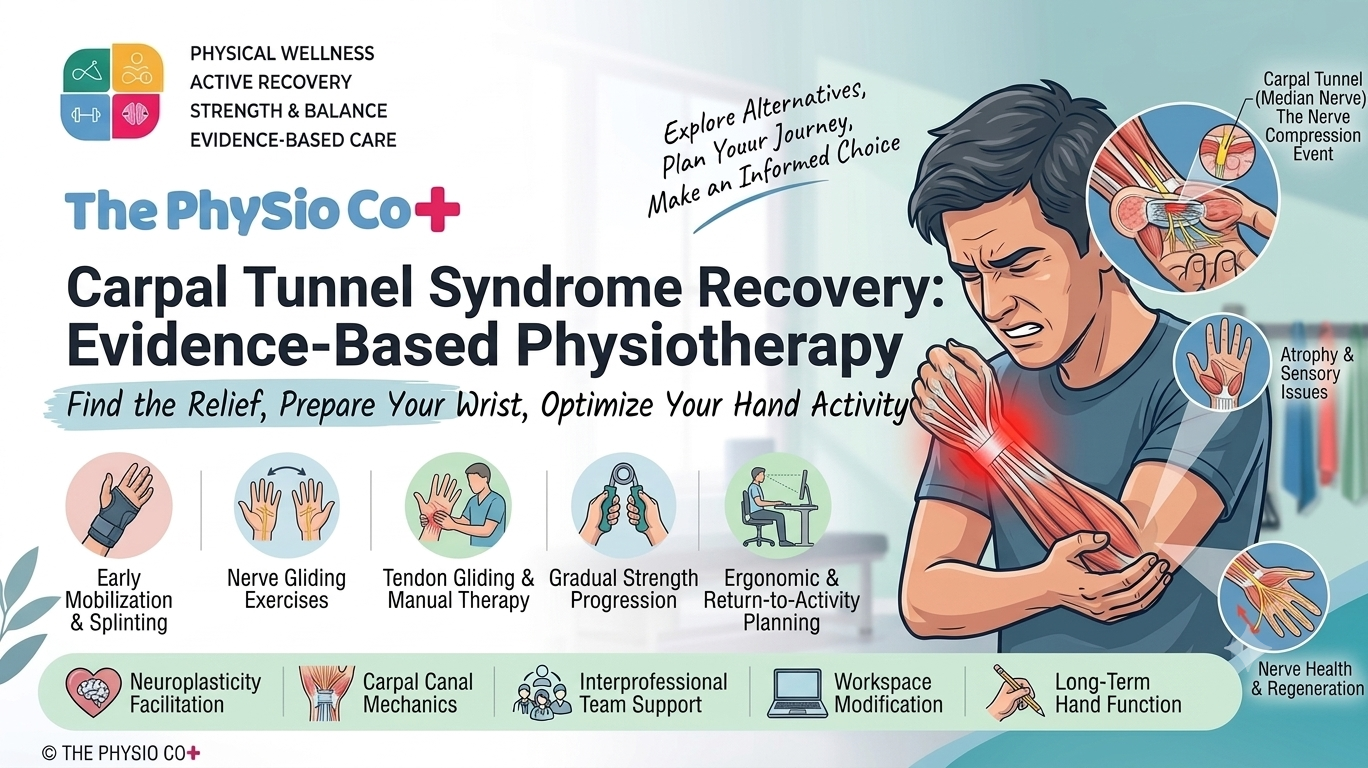
It occurs when the median nerve is compressed as it passes through a narrow space in the wrist called the carpal tunnel.
Symptoms may initially come and go, particularly at night, but persistent nerve compression can eventually affect hand strength and sensation.
If you are searching for carpal tunnel syndrome physiotherapy in Delhi, understanding the symptoms, causes and available treatment options can help you decide when to seek professional assessment.
What Is Carpal Tunnel Syndrome?
The carpal tunnel is a narrow passageway located at the wrist.
It is formed by the wrist bones and a strong band of connective tissue called the transverse carpal ligament.
The median nerve passes through this tunnel along with several tendons that move the fingers.
When pressure increases within the carpal tunnel, the median nerve can become irritated or compressed.
This may lead to symptoms in the:
- Thumb
- Index finger
- Middle finger
- Part of the ring finger
The little finger is generally not supplied by the median nerve, so symptoms isolated to the little finger may suggest another cause.
What Causes Carpal Tunnel Syndrome?
There is not always one specific cause.
Factors associated with carpal tunnel syndrome can include:
- Wrist anatomy
- Repetitive hand activities
- Previous wrist injury
- Certain medical conditions
- Pregnancy
- Diabetes
- Thyroid disorders
- Inflammatory conditions
- Fluid retention
- Increased pressure within the carpal tunnel
Some people develop carpal tunnel syndrome without an obvious cause.
Who Is More Likely to Develop Carpal Tunnel Syndrome?
Carpal tunnel syndrome can affect people in different occupations and age groups.
It may occur in people who:
- Perform repetitive hand movements
- Work with vibrating tools
- Perform prolonged gripping
- Have previous wrist injuries
- Are pregnant
- Have diabetes
- Have certain thyroid or inflammatory conditions
However, repetitive computer use alone should not automatically be considered the cause of carpal tunnel syndrome.
What Are the Symptoms of Carpal Tunnel Syndrome?
The most common symptoms include:
- Numbness in the hand
- Tingling or pins and needles
- Burning sensations
- Wrist or hand pain
- Symptoms that are worse at night
- Weak grip
- Difficulty holding objects
- Feeling that the hand is swollen even when there is no visible swelling
Symptoms commonly affect the thumb, index and middle fingers and part of the ring finger.
Why Is Carpal Tunnel Worse at Night?
Many people notice carpal tunnel symptoms during sleep.
The wrist may remain in a bent position for prolonged periods, which can increase pressure within the carpal tunnel.
Some people also sleep with their wrists flexed without realizing it.
Night-time symptoms can therefore be an important feature of carpal tunnel syndrome.
Can Carpal Tunnel Syndrome Cause Weakness?
Yes.
Persistent median nerve compression can affect the muscles supplied by the nerve.
This may result in difficulty with:
- Opening jars
- Buttoning clothes
- Holding a phone
- Picking up small objects
- Pinching
- Gripping
In more advanced cases, the muscles at the base of the thumb may become visibly smaller.
Persistent weakness should be assessed by a healthcare professional.
Can Carpal Tunnel Cause Pain in the Arm?
Although symptoms are usually most noticeable around the hand and wrist, some people experience discomfort that extends toward the forearm or, less commonly, higher up the arm.
However, symptoms extending from the neck into the arm may have a different cause, such as cervical nerve irritation.
A proper assessment is therefore important.
Carpal Tunnel Syndrome vs Cervical Radiculopathy
Both conditions can cause numbness and tingling in the arm or hand.
| Feature | Carpal Tunnel Syndrome | Cervical Radiculopathy |
|---|---|---|
| Main nerve involved | Median nerve | Cervical nerve root |
| Common symptom area | Thumb, index, middle & part of ring finger | Distribution depends on nerve root |
| Common location | Wrist/hand | Neck, shoulder, arm and/or hand |
| Night symptoms | Common | Variable |
| Neck pain | Usually not the main symptom | May be present |
| Cause | Compression at wrist | Irritation/compression near cervical spine |
Because symptoms can overlap, clinical assessment is important.
How Is Carpal Tunnel Syndrome Diagnosed?
Diagnosis generally begins with a detailed history and physical examination.
A healthcare professional may assess:
- Sensation
- Grip strength
- Thumb strength
- Wrist movement
- Hand function
- Symptoms during specific wrist positions
- Possible nerve involvement elsewhere
Clinical tests may be used to reproduce symptoms.
In some cases, nerve conduction studies or electromyography (EMG) may be recommended to assess nerve function and severity.
Ultrasound may also be used in selected cases.
Do You Need an MRI for Carpal Tunnel Syndrome?
Usually, MRI is not the first-line test for typical carpal tunnel syndrome.
The diagnosis is generally based on symptoms and clinical assessment, with electrodiagnostic testing or ultrasound used when appropriate.
The choice of investigation depends on the individual presentation.
Can Physiotherapy Help Carpal Tunnel Syndrome?
Physiotherapy may be useful for selected people with mild to moderate carpal tunnel symptoms.
Treatment may focus on:
- Activity modification
- Wrist positioning
- Nerve mobility
- Tendon mobility
- Hand and forearm exercises
- Ergonomic advice
- Strengthening
- Education about symptom management
The treatment plan should depend on symptom severity and whether there is evidence of significant nerve dysfunction.
Physiotherapy Treatment for Carpal Tunnel Syndrome
1. Activity Modification
Activities that repeatedly aggravate symptoms may need to be modified.
This may involve changing:
- Wrist position
- Grip force
- Repetition
- Duration of activity
- Work technique
- Recovery periods
The goal is not necessarily to stop using the hand completely.
Instead, the aim is to reduce unnecessary irritation while maintaining useful activity.
2. Wrist Positioning
Keeping the wrist in a relatively neutral position may reduce pressure within the carpal tunnel for some people.
This is particularly relevant during:
- Sleeping
- Typing
- Repetitive work
- Prolonged gripping
3. Wrist Splinting
A wrist splint that keeps the wrist relatively neutral is commonly used, particularly at night.
Splinting may help reduce symptoms in some people with mild to moderate carpal tunnel syndrome.
It should not be excessively tight.
A physiotherapist or healthcare professional can help determine whether a splint is appropriate.
4. Median Nerve Gliding Exercises
Nerve-gliding exercises aim to encourage movement of the median nerve relative to surrounding tissues.
They are usually performed gently.
General approach:
- Position the arm comfortably.
- Gradually move the wrist, elbow and fingers through the prescribed sequence.
- Avoid forcing the movement.
- Perform smooth, controlled repetitions.
Nerve-gliding exercises are not appropriate to perform aggressively.
If symptoms significantly increase, the exercise should be stopped and reassessed.
5. Tendon Gliding Exercises
The tendons that pass through the carpal tunnel can be moved through different finger positions.
Common positions include:
- Straight hand
- Hook fist
- Full fist
- Flat fist
- Straight fist
These exercises may help maintain tendon mobility.
The exact exercise selection should depend on the individual’s symptoms.
6. Forearm and Hand Strengthening
Once symptoms are appropriately controlled, strengthening may be introduced.
Exercises can target:
- Grip
- Thumb muscles
- Wrist muscles
- Forearm muscles
Strengthening should be gradual and should not repeatedly aggravate nerve symptoms.
Carpal Tunnel Exercises at Home
Some commonly used exercises include:
Wrist Stretch
- Extend your arm comfortably.
- Gently move the wrist into extension.
- Use the opposite hand only to provide a light stretch.
- Avoid forcing the wrist.
- Hold briefly and relax.
Tendon Glides
Move the fingers slowly through the prescribed tendon-gliding positions.
Perform the movements smoothly rather than repeatedly squeezing the hand forcefully.
Median Nerve Glides
Median nerve glides should ideally be taught by a physiotherapist because the sequence needs to be performed correctly.
The aim is gentle nerve movement rather than stretching the nerve aggressively.
Should You Massage Carpal Tunnel Syndrome?
Massage may provide temporary comfort for some people, particularly when surrounding muscles are tight.
However, massage does not remove the underlying cause of median nerve compression.
If used, it should be considered an adjunct to a broader management plan rather than the main treatment.
Does Dry Needling Help Carpal Tunnel Syndrome?
Dry needling may sometimes be used to address associated muscular symptoms.
However, it should not be presented as a treatment that directly eliminates compression of the median nerve.
For carpal tunnel syndrome, treatment should focus on appropriate assessment, symptom modification and management of the underlying nerve compression.
Can Carpal Tunnel Syndrome Be Treated Without Surgery?
Many people with mild or moderate symptoms can initially be managed without surgery.
Conservative management may include:
- Night-time wrist splinting
- Activity modification
- Physiotherapy
- Exercise
- Management of contributing medical conditions
- Medical treatment when appropriate
However, treatment depends on severity and duration.
People with significant or progressive nerve dysfunction may require specialist assessment.
When Is Surgery Considered?
Carpal tunnel release surgery may be considered when:
- Symptoms are severe
- Symptoms persist despite appropriate conservative management
- There is significant nerve dysfunction
- There is progressive weakness
- There is muscle wasting
- Testing demonstrates significant nerve compression
Surgery involves releasing the ligament forming the roof of the carpal tunnel to reduce pressure on the median nerve.
The decision should be made with an appropriate medical specialist.
Can Carpal Tunnel Syndrome Go Away on Its Own?
Some cases may improve, particularly when associated with a temporary condition such as pregnancy.
However, persistent symptoms should not simply be ignored.
Long-standing nerve compression can potentially lead to more persistent sensory or motor problems.
Early assessment can help determine the appropriate management strategy.
How Long Does Carpal Tunnel Physiotherapy Take?
There is no fixed recovery time.
Progress depends on:
- Severity of nerve compression
- Duration of symptoms
- Underlying causes
- Work demands
- Treatment consistency
- Presence of weakness
- Overall health
Mild symptoms may improve with conservative management, while more advanced cases may require specialist treatment.
Can You Work With Carpal Tunnel Syndrome?
Many people can continue working while managing carpal tunnel syndrome.
However, modifications may be helpful.
Depending on your job, this could include:
- Keeping the wrist relatively neutral
- Reducing excessive gripping
- Taking regular breaks
- Alternating tasks
- Adjusting workstation setup
- Reducing exposure to vibration
- Modifying repetitive movements
The right modification depends on the individual’s symptoms and occupation.
Carpal Tunnel Syndrome and Computer Use
Computer use is often blamed for carpal tunnel syndrome.
However, the relationship is more complicated.
Long periods of keyboard or mouse use can contribute to hand and wrist discomfort, but computer use alone does not necessarily mean that someone has carpal tunnel syndrome.
If symptoms include characteristic numbness or tingling in the median nerve distribution, an appropriate assessment is important.
When Should You See a Physiotherapist?
Consider getting assessed if you experience:
- Recurrent hand numbness
- Night-time tingling
- Wrist pain
- Reduced grip strength
- Difficulty with fine hand movements
- Symptoms that interfere with work or sleep
- Persistent symptoms despite changing activities
A physiotherapist can assess your wrist, hand, nerve function and movement patterns and determine whether physiotherapy is appropriate.
When Should You See a Doctor?
Medical assessment is particularly important if you develop:
- Progressive hand weakness
- Persistent numbness
- Muscle wasting around the thumb
- Loss of hand function
- Severe or worsening symptoms
- Symptoms following significant trauma
These may indicate more significant nerve involvement.
Carpal Tunnel Physiotherapy in Delhi
If you are searching for carpal tunnel syndrome physiotherapy in Delhi, treatment should begin with an appropriate assessment rather than assuming that every case of wrist pain is carpal tunnel syndrome.
At The Physio Co+, physiotherapy assessment can include evaluation of wrist movement, grip strength, nerve-related symptoms, hand function and contributing activities.
Depending on the presentation, rehabilitation may include activity modification, ergonomic advice, wrist and hand exercises, nerve and tendon mobility exercises, progressive strengthening and guidance regarding splinting.
For patients in and around Vasant Kunj, the program can be tailored according to symptoms, occupation and daily activities.
Related services: Physiotherapy in Delhi | Sports Injury Physiotherapy | Pain Management Physiotherapy | Clinical Pilates
Frequently Asked Questions
What is carpal tunnel syndrome?
Carpal tunnel syndrome occurs when the median nerve is compressed as it passes through the carpal tunnel at the wrist.
What are the first symptoms of carpal tunnel syndrome?
Early symptoms commonly include intermittent numbness, tingling or burning in the thumb, index finger, middle finger and part of the ring finger, particularly at night.
Can physiotherapy help carpal tunnel syndrome?
Physiotherapy may help selected cases through activity modification, splinting advice, exercises and nerve or tendon mobility techniques. More severe cases may require specialist medical assessment.
What exercises are good for carpal tunnel syndrome?
Depending on the individual, exercises may include tendon glides, gentle median nerve glides, wrist mobility and progressive hand or forearm strengthening.
Should I wear a wrist brace at night?
A neutral wrist splint may help reduce night-time symptoms for some people with carpal tunnel syndrome. The fit and suitability should be assessed if symptoms are persistent.
Can carpal tunnel syndrome be cured without surgery?
Mild and moderate cases can often initially be managed conservatively. Severe or progressive nerve dysfunction may require specialist assessment and, in some cases, surgery.
Can carpal tunnel syndrome cause shoulder pain?
Carpal tunnel syndrome primarily affects the hand and wrist. Pain extending into the arm or shoulder may require assessment for other possible causes, including cervical nerve involvement.
Is carpal tunnel syndrome caused by using a laptop?
Computer use can contribute to hand and wrist discomfort, but it does not automatically mean that a person has carpal tunnel syndrome.
How long does carpal tunnel syndrome take to improve?
Recovery varies depending on severity, duration, underlying causes and treatment. Mild symptoms may respond to conservative management, while persistent nerve compression can require longer-term or specialist treatment.
Can carpal tunnel syndrome come back?
Yes. Symptoms can recur if contributing factors remain or if the underlying nerve compression persists. Appropriate management and activity modification may help reduce symptom recurrence.
Key Takeaway
Carpal tunnel syndrome is a condition involving compression of the median nerve at the wrist.
Typical symptoms include night-time numbness or tingling, hand pain and, in more advanced cases, weakness or muscle wasting.
Early assessment can help determine the severity of the condition and whether conservative treatment is appropriate.
Physiotherapy may be useful for selected cases, particularly when combined with appropriate wrist positioning, activity modification, splinting and progressive rehabilitation.
If you are searching for carpal tunnel syndrome physiotherapy in Delhi, carpal tunnel treatment in Delhi or wrist pain physiotherapy in Vasant Kunj, a professional assessment can help identify the appropriate treatment approach.
References
- American Academy of Orthopaedic Surgeons. Carpal Tunnel Syndrome. OrthoInfo.
- American Academy of Orthopaedic Surgeons. Management of Carpal Tunnel Syndrome: Evidence-Based Clinical Practice Guideline.
- Page MJ, et al. Surgery for carpal tunnel syndrome. Cochrane Database of Systematic Reviews.
- Padua L, et al. Carpal tunnel syndrome: clinical features, diagnosis and management. The Lancet Neurology.
- National Institute of Neurological Disorders and Stroke. Carpal Tunnel Syndrome.