
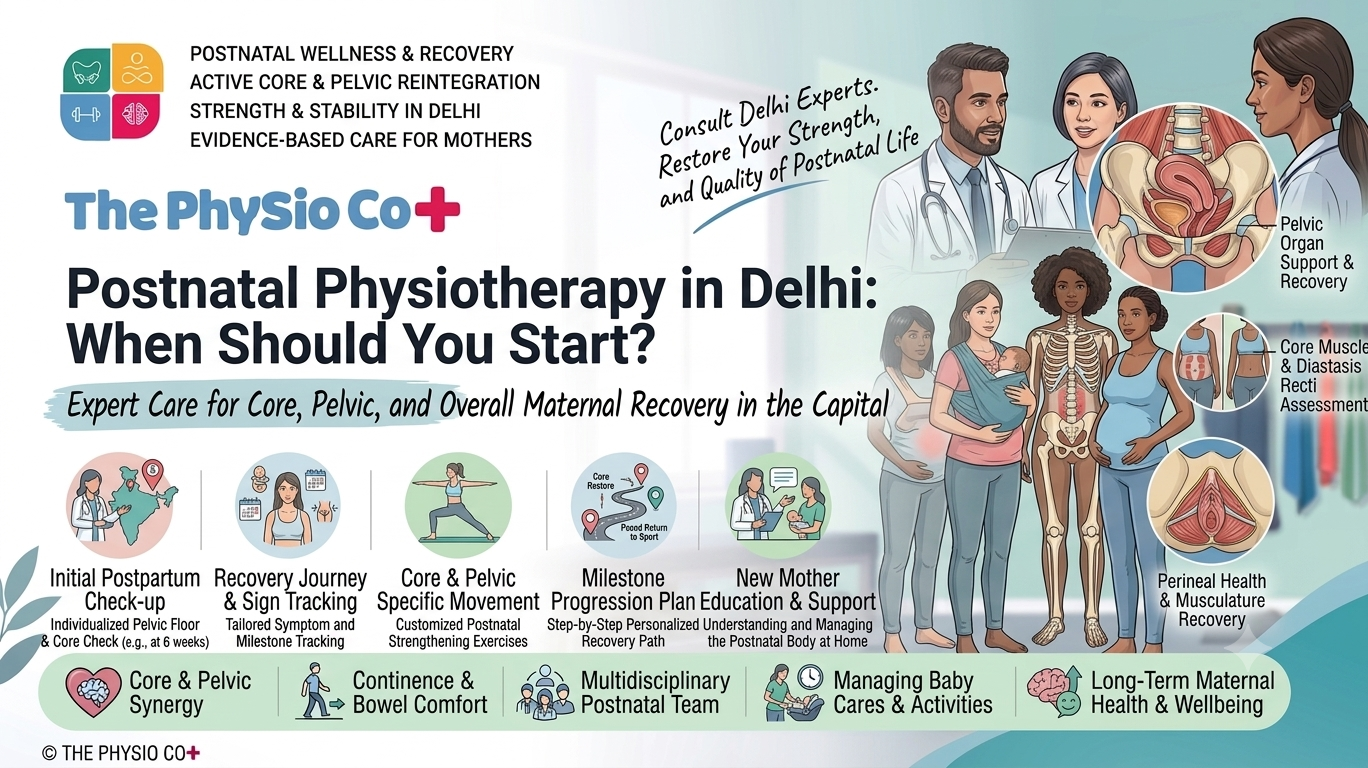

Postnatal Physiotherapy in Delhi
Pregnancy and childbirth bring major physical changes to the body.
After delivery, many women focus almost entirely on the baby and postpone their own recovery. But symptoms such as back pain, pelvic discomfort, urine leakage, abdominal weakness, difficulty lifting the baby or difficulty returning to exercise can affect everyday life.
This is where postnatal physiotherapy can help.
One of the most common questions is:
“When should I start postnatal physiotherapy?”
The answer is not one fixed number of days or weeks for everyone.
For women with an uncomplicated vaginal delivery, gentle physical activity can often begin soon after childbirth when they feel ready. ACOG notes that exercise may be resumed within days after an uncomplicated vaginal delivery, while women who have had a cesarean birth or complications should discuss the appropriate timing with their obstetric clinician.
Postnatal physiotherapy should therefore be individualized according to the delivery, healing, symptoms and medical circumstances.
What Is Postnatal Physiotherapy?
Postnatal physiotherapy is rehabilitation designed to help a woman safely recover after pregnancy and childbirth.
It may address:
- Pelvic floor function
- Abdominal and core strength
- Back and pelvic pain
- Postural changes
- Pelvic girdle symptoms
- Urinary leakage
- Scar-related issues
- General strength and mobility
- Return to exercise
- Functional activities such as lifting and carrying the baby
The goal is not simply to “get the body back.”
It is to help the woman regain comfortable movement, strength, confidence and physical capacity.
When Should You Start Postnatal Physiotherapy?
There is no universal postpartum day when every woman should begin physiotherapy.
After an Uncomplicated Vaginal Delivery
Gentle movement and physical activity can generally begin early, as tolerated.
ACOG states that after a healthy pregnancy and normal vaginal delivery, exercise can usually begin within a few days after birth or as soon as the woman feels ready.
However, this does not mean starting intense workouts immediately.
Early activity may simply involve:
- Short walks
- Gentle mobility
- Breathing exercises
- Comfortable pelvic floor exercises when appropriate
- Basic functional movement
Progression should be gradual.
After a Cesarean Birth
A cesarean birth involves abdominal surgery, so recovery needs to be considered differently.
Gentle movement and walking are often part of early recovery, but the timing and progression of exercise should take the surgical recovery into account.
ACOG recommends discussing exercise timing with the obstetric clinician after cesarean delivery or complications.
A physiotherapist can then help progress rehabilitation according to healing and functional ability.
If There Were Complications
If there were complications during pregnancy, delivery or the postpartum period, exercise should be individualized with appropriate medical guidance.
Examples include:
- Significant perineal injury
- Postpartum hemorrhage
- Infection
- Significant pelvic pain
- Persistent wound problems
- Severe pain
- Other medical or obstetric complications
The appropriate timing should be determined in coordination with the relevant healthcare professionals.
Do You Need to Wait Six Weeks?
Not necessarily.
The traditional idea that every woman must wait exactly six weeks before doing any physical activity is too simplistic.
There is a difference between:
Early gentle movement
and
returning to demanding exercise.
A woman may be encouraged to move gently soon after delivery while still requiring several weeks or longer before returning to running, heavy lifting, intense abdominal training or high-impact exercise.
ACOG recommends gradual progression of physical activity postpartum, taking delivery method and complications into account.
Why Is Postnatal Physiotherapy Important?
Pregnancy and childbirth can affect several areas of physical function.
1. Pelvic Floor Recovery
The pelvic floor may experience stretching and loading during pregnancy and childbirth.
Some women experience:
- Urine leakage
- Pelvic heaviness
- Difficulty controlling gas or stool
- Reduced pelvic floor strength
- Difficulty relaxing the pelvic floor
Pelvic floor muscle training is an important part of postnatal care when clinically appropriate.
NICE recommends encouraging pelvic floor muscle training during postnatal care and recommends supervised training for women with stress or mixed urinary incontinence.
2. Abdominal and Core Recovery
Pregnancy changes the abdominal wall and trunk.
Postnatal rehabilitation may gradually address:
- Deep abdominal muscle activation
- Trunk control
- Breathing
- Functional core strength
- Progressive resistance exercise
The focus should be on restoring function rather than simply trying to flatten the abdomen as quickly as possible.
3. Back Pain
Back pain can continue after pregnancy due to multiple factors, including:
- Reduced trunk strength
- Changes in movement
- Feeding positions
- Prolonged sitting
- Repeated lifting
- Poorly tolerated workloads
- Sleep disruption
Physiotherapy can help identify contributing factors and develop an appropriate strengthening and movement program.
4. Pelvic or Hip Pain
Some women experience pelvic girdle or hip discomfort during pregnancy or after delivery.
Rehabilitation may include:
- Hip strengthening
- Mobility exercises
- Trunk control
- Functional movement training
- Activity modification
5. Returning to Exercise
Returning to exercise should be progressive.
The initial goal may be simply to walk comfortably.
Later, rehabilitation can progress toward:
- Strength training
- Pilates
- Squats
- Lunges
- Carrying exercises
- Running
- Jumping
- Sports
The appropriate progression depends on symptoms and physical capacity.
What Does a Postnatal Physiotherapy Assessment Include?
A postnatal physiotherapy assessment may look at:
History
Your physiotherapist may ask about:
- Pregnancy
- Delivery
- Cesarean or vaginal birth
- Perineal injury
- Pain
- Bladder symptoms
- Bowel symptoms
- Exercise history
- Current activity
- Your goals
Physical Assessment
Depending on your symptoms and consent, assessment may include:
- Posture
- Breathing
- Abdominal function
- Pelvic and hip movement
- Lower-limb strength
- Functional movement
- Pelvic floor function when appropriate
The assessment should be respectful, individualized and explained to you before any examination.
What Exercises Can You Do After Pregnancy?
The appropriate exercises depend on your stage of recovery.
Early Stage
Examples may include:
- Gentle walking
- Breathing exercises
- Ankle movements
- Gentle mobility
- Comfortable pelvic floor exercises
- Basic functional movements
Intermediate Stage
Once appropriate, exercises may progress toward:
- Squats
- Glute bridges
- Step-ups
- Resistance exercises
- Core exercises
- Hip strengthening
- Pelvic floor strengthening or relaxation work
Advanced Stage
For women returning to higher-level activity:
- Progressive strength training
- Running
- Jumping
- Hopping
- Sport-specific drills
- Higher-load resistance training
Progression should be based on symptoms and functional capacity rather than simply the number of weeks postpartum.
When Can You Start Walking After Delivery?
Walking is generally one of the easiest ways to gradually reintroduce activity.
After an uncomplicated delivery, short comfortable walks can often be introduced early, increasing gradually as tolerated.
ACOG describes walking as a useful way to begin returning to activity postpartum.
If walking increases pain, bleeding, dizziness or other concerning symptoms, stop and seek appropriate medical advice.
When Can You Start Core Exercises After Pregnancy?
There is no single exercise that every woman should start with.
Early postpartum rehabilitation generally emphasizes gentle movement and gradual restoration of abdominal and trunk function.
As healing progresses, strengthening can become more challenging.
The important principle is progression rather than rushing.
ACOG notes that abdominal strengthening exercises can form part of postpartum exercise and that activity can be gradually increased as medically appropriate.
When Can You Start Running After Pregnancy?
Running is a higher-impact activity and should not be treated the same way as walking.
Before returning to running, it is useful to consider:
- Pain
- Bleeding
- Pelvic floor symptoms
- Urinary leakage
- Pelvic heaviness
- Abdominal function
- Leg strength
- Balance
- Walking tolerance
- Overall conditioning
A physiotherapist can help assess readiness and build a gradual return-to-running plan.
Postnatal Physiotherapy After C-Section
After a C-section, rehabilitation should account for the abdominal surgical wound and recovery.
Physiotherapy may eventually include:
- Walking progression
- Breathing exercises
- Gentle abdominal activation
- Postural education
- Scar-related rehabilitation when appropriate
- Progressive strengthening
- Functional lifting
- Return-to-exercise planning
Do not use exercise to push through significant wound pain or other concerning symptoms.
If there are concerns about wound healing, infection, severe pain or other complications, medical review is appropriate.
Postnatal Physiotherapy After Vaginal Delivery
After vaginal delivery, rehabilitation may focus particularly on:
- Pelvic floor function
- Perineal recovery
- Urinary symptoms
- Pelvic heaviness
- Core function
- Back and pelvic pain
- Gradual return to exercise
Women who experienced assisted vaginal delivery or significant perineal injury may benefit from individualized pelvic floor assessment.
NICE specifically identifies assisted vaginal birth and anal sphincter injury among factors relevant to postnatal pelvic floor care.
How Long Does Postnatal Physiotherapy Take?
There is no fixed duration.
Some women may need only education and a gradual exercise plan.
Others may require longer rehabilitation for:
- Persistent pelvic floor symptoms
- Urinary incontinence
- Pelvic pain
- Significant weakness
- Cesarean recovery
- Pelvic girdle pain
- Difficulty returning to running or sport
The program should change as your body recovers.
When Should You See a Postnatal Physiotherapist?
You can consider an assessment if you have:
- Urine leakage
- Pelvic heaviness
- Pelvic pain
- Persistent back pain
- Difficulty lifting or carrying your baby
- Abdominal weakness
- Difficulty returning to exercise
- Pain with movement
- Pelvic floor concerns
- Difficulty returning to running or sport
- Concerns after C-section
- Ongoing symptoms after childbirth
You do not necessarily need to wait until symptoms become severe.
Red Flags After Childbirth
Physiotherapy is not a substitute for medical assessment when there are signs of a possible postpartum complication.
Seek appropriate medical care for symptoms such as:
- Heavy or rapidly increasing bleeding
- Fever
- Foul-smelling vaginal discharge
- Severe or worsening abdominal or pelvic pain
- Chest pain
- Difficulty breathing
- Severe headache or visual changes
- Significant leg swelling or pain
- Problems with a C-section wound
- Other sudden or concerning symptoms
WHO emphasizes ongoing postnatal care and assessment of mothers during the postpartum period, particularly during the first six weeks after birth.
Postnatal Physiotherapy in Delhi
If you are looking for postnatal physiotherapy in Delhi, the focus should be on your recovery rather than following a generic postpartum workout.
At The Physio Co+, women’s health physiotherapy can include individualized postnatal rehabilitation addressing pelvic floor function, core strength, posture, pain and gradual return to exercise.
For women in and around Vasant Kunj, a physiotherapy assessment can help determine what exercises are appropriate for your current stage of recovery.
Related services: Women’s Health Physiotherapy | Pelvic Floor Physiotherapy | Clinical Pilates | Physiotherapy in Delhi
Frequently Asked Questions
When should I start postnatal physiotherapy?
There is no universal starting date. Gentle activity can often begin soon after an uncomplicated vaginal delivery when you feel ready, while recovery after C-section or complications requires individualized medical guidance.
Can I start physiotherapy immediately after delivery?
Some gentle rehabilitation activities may begin early, depending on the delivery and your medical condition. More demanding exercises should be introduced gradually.
Do I need physiotherapy after a C-section?
Not every woman requires formal physiotherapy, but assessment can be useful if you have pain, abdominal weakness, difficulty returning to activity, scar-related concerns or other functional problems.
Can physiotherapy help urinary leakage after childbirth?
Yes. Pelvic floor muscle training is an established treatment for stress and mixed urinary incontinence. NICE recommends supervised pelvic floor muscle training for these conditions.
When can I start exercising after pregnancy?
After an uncomplicated vaginal delivery, ACOG states that exercise can generally begin within a few days or when you feel ready. After cesarean birth or complications, timing should be discussed with your obstetric clinician.
When can I start Pilates after pregnancy?
Pilates can be reintroduced gradually when medically appropriate. The exercises should be modified according to delivery, healing, symptoms, pelvic floor function and current strength.
Can postnatal physiotherapy help with back pain?
Yes. Physiotherapy can address contributing factors such as reduced strength, movement patterns, posture, lifting demands and physical deconditioning.
Is postnatal physiotherapy only for women with problems?
No. Physiotherapy can also provide education and a structured return-to-exercise plan for women who want guidance during postpartum recovery.
Key Takeaway
There is no single “correct” day to start postnatal physiotherapy.
For some women, gentle movement can begin within days after an uncomplicated vaginal delivery. After a C-section or complications, rehabilitation needs to be individualized with appropriate medical guidance.
The important distinction is between starting gentle movement early and returning to demanding exercise too quickly.
A structured postnatal physiotherapy program can help restore pelvic floor function, strength, mobility and confidence while supporting a gradual return to everyday activities and exercise.
If you are looking for postnatal physiotherapy in Delhi or Vasant Kunj, an individualized assessment can help determine the appropriate next step for your recovery.
References
- American College of Obstetricians and Gynecologists. Exercise After Pregnancy. Reviewed 2024.
- American College of Obstetricians and Gynecologists. Physical Activity and Exercise During Pregnancy and the Postpartum Period. Committee Opinion No. 804.
- World Health Organization. WHO recommendations on maternal and newborn care for a positive postnatal experience. 2022.
- NICE. Pelvic floor dysfunction: prevention and non-surgical management (NG210).
- NICE. Urinary incontinence and pelvic organ prolapse in women: management (NG123).
SEO Setup
Primary Keyword:
Postnatal Physiotherapy in Delhi
Secondary Keywords:
- Postnatal Physiotherapist in Delhi
- Postnatal Physiotherapy Vasant Kunj
- Postpartum Physiotherapy Delhi
- Postpartum Physiotherapist Vasant Kunj
- Women’s Health Physiotherapy Delhi
- Post Pregnancy Physiotherapy Delhi
- Post Pregnancy Physiotherapy Vasant Kunj
- Physiotherapy After C Section
- Physiotherapy After Normal Delivery
- Postpartum Pelvic Floor Physiotherapy
- Postnatal Exercise Physiotherapy
- Pelvic Floor Physiotherapy Delhi
Suggested URL Slug:/blog/postnatal-physiotherapy-in-delhi/
SEO Title:
Postnatal Physiotherapy in Delhi: When Should You Start?
Meta Description:
When should you start postnatal physiotherapy? Learn about postpartum exercise, pelvic floor recovery, C-section rehabilitation, core strengthening and safe return to activity.
Suggested Internal Links:
- Postnatal Physiotherapy → https://thephysiocoplus.com/
- Pelvic Floor Physiotherapy → https://thephysiocoplus.com/
- Women’s Health Physiotherapy → https://thephysiocoplus.com/
- Clinical Pilates → https://thephysiocoplus.com/
- Physiotherapy in Delhi → https://thephysiocoplus.com/
Suggested Image/Blog Banner Text:
Postnatal Physiotherapy in Delhi
When Should You Start?