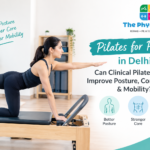


Clinical Pilates in Delhi
Pilates has become increasingly popular for improving strength, mobility, posture and body control. But Clinical Pilates is different from simply attending a regular Pilates class.
Clinical Pilates uses Pilates-based exercises in a more individualized and rehabilitation-focused way. A physiotherapist can assess your movement, strength, flexibility, pain and functional goals and then modify exercises according to your needs.
It may be useful for people recovering from an injury, managing persistent back pain, improving strength after a period of inactivity, or simply working toward better movement and physical conditioning.
Research has particularly studied Pilates for chronic low back pain. Systematic reviews and meta-analyses suggest that Pilates can improve pain and disability compared with minimal or no exercise, although current evidence does not consistently show that Pilates is superior to other forms of exercise.
What Is Clinical Pilates?
Clinical Pilates is a physiotherapy-guided exercise approach based on Pilates principles, adapted to an individual’s physical condition and goals.
A session may incorporate:
- Core and trunk exercises
- Hip and lower-limb strengthening
- Shoulder and upper-body exercises
- Mobility exercises
- Balance and coordination work
- Postural and movement control exercises
- Breathing and body-awareness exercises
- Progressive resistance exercises
- Reformer-based exercises where appropriate
The important difference is individualisation.
A standard Pilates class may follow a general programme for a group, whereas Clinical Pilates can be modified according to a person’s symptoms, movement limitations, strength and rehabilitation goals.
Clinical Pilates vs Regular Pilates
The two approaches can use similar exercises, but the purpose and delivery may differ.
| Clinical Pilates | Regular Pilates |
|---|---|
| Usually assessment-led | Usually follows a general class programme |
| Exercises can be individually modified | Exercises are generally designed for the group |
| Can be incorporated into rehabilitation | Usually focused on general fitness and movement |
| Progression is based on individual goals | Progression often follows the class structure |
| Can be adapted for certain pain or movement limitations | May not be suitable for everyone without modification |
| Often supervised by a physiotherapist or rehabilitation professional | Usually led by a Pilates instructor |
Neither approach is automatically better for everyone.
The appropriate choice depends on your goals, experience, physical condition and whether you have an injury or medical condition requiring rehabilitation.
What Are the Benefits of Clinical Pilates?
Clinical Pilates can be used to develop several components of physical fitness and movement.
1. Improved Core and Trunk Strength
Many Pilates exercises challenge the muscles around the trunk while the person controls their movement.
Progressive trunk strengthening can be useful for people who need to improve their capacity for everyday activities, exercise or sport.
However, it is important not to think of the “core” as a single muscle or assume that core exercises alone will solve every type of back pain.
2. Better Movement Control
Clinical Pilates places emphasis on controlled movement.
Exercises can challenge:
- Coordination
- Balance
- Body awareness
- Trunk control
- Hip control
- Shoulder control
This can be useful when returning to exercise after injury or inactivity.
3. Improved Mobility
Pilates sessions can include controlled mobility exercises for areas such as:
- Spine
- Hips
- Shoulders
- Thoracic region
Mobility exercises can be combined with strengthening rather than treating flexibility as the only goal.
4. Strength and Muscular Endurance
Pilates can be progressed using body weight, springs, resistance and reformer equipment.
This allows exercises to become more challenging as strength and tolerance improve.
5. Posture and Movement Awareness
Clinical Pilates can help people become more aware of how they move and maintain positions during exercises and everyday activities.
However, posture should not be viewed as a simple cause of all pain.
A physiotherapist can help identify whether movement habits, strength, mobility or activity levels are relevant to your particular problem.
6. Rehabilitation After Injury
Clinical Pilates can be incorporated into rehabilitation when appropriate.
For example, a physiotherapist may gradually introduce Pilates-based exercises after:
- Back pain
- Sports injuries
- Musculoskeletal injuries
- Periods of inactivity
- Some post-operative rehabilitation programmes
The exact exercises depend on the diagnosis and stage of recovery.
What Does the Evidence Say About Pilates for Back Pain?
This is one of the most researched clinical applications of Pilates.
A 2023 systematic review and meta-analysis included 19 randomized controlled trials involving 1,108 people with chronic low back pain. The researchers found that Pilates was associated with improvements in pain and functional disability compared with control interventions.
Another 2023 systematic review and meta-analysis found that Pilates improved pain and disability in people with chronic low back pain, with some benefits maintained at six months after the intervention.
A 2024 systematic review with model-based network meta-analysis also found Pilates among the exercise approaches associated with meaningful improvements in pain, although the certainty of evidence varied from very low to moderate.
But there is an important qualification.
Research does not consistently demonstrate that Pilates is better than every other form of exercise.
A 2023 systematic review comparing Pilates with other forms of exercise concluded that there was no strong evidence that one exercise approach was superior overall. The authors recommended choosing exercise based on the individual’s goals and preferences.
Therefore, a more accurate statement is:
Pilates can be an effective form of exercise for many people with chronic low back pain, but it is one option within exercise-based rehabilitation rather than a universally superior treatment.
Can Clinical Pilates Help With Back Pain?
It may help some people with persistent or recurrent back pain, particularly when it forms part of a progressive exercise programme.
A Clinical Pilates programme may include:
- Trunk strengthening
- Hip strengthening
- Mobility exercises
- Movement-control exercises
- Functional strengthening
- Gradual exposure to activities that have become difficult
The programme should be adjusted according to the individual’s symptoms and functional goals.
If your back pain is severe, persistent or associated with neurological symptoms, an assessment is important before beginning an exercise programme.
Who Can Benefit From Clinical Pilates?
Clinical Pilates may be appropriate for people who want to improve:
- Strength
- Mobility
- Movement control
- Balance
- Physical conditioning
- Exercise tolerance
- Functional capacity
It may also be considered as part of rehabilitation for selected musculoskeletal conditions.
People With Back Pain
Pilates has been extensively studied in people with chronic non-specific low back pain.
Evidence suggests it can improve pain and disability compared with minimal or no exercise.
People Returning to Exercise
If you have been inactive because of pain, injury or lifestyle factors, Clinical Pilates can provide a structured way to gradually rebuild exercise capacity.
People Looking to Improve Strength and Mobility
Clinical Pilates does not have to be used only for people with pain.
It can also be used as a structured exercise programme for individuals who want to improve strength, mobility, coordination and body control.
People With Movement Limitations
Exercises can be modified according to the person’s available range of motion, strength and tolerance.
This can make Clinical Pilates more adaptable than following a fixed exercise routine.
Older Adults
Appropriately modified Pilates-based exercise can be incorporated into programmes aimed at maintaining strength, mobility and balance.
The exercises should be selected according to the individual’s physical abilities and medical considerations.
What Exercises Are Included in Clinical Pilates?
There is no single list of exercises that every person should perform.
A physiotherapist may select exercises based on your assessment.
Examples can include:
1. Pelvic Tilt
Performed lying on your back, this exercise involves controlled movement of the pelvis and trunk.
It can be used to introduce awareness of trunk movement and control.
2. Bridge
The bridge involves lifting the pelvis while maintaining controlled movement through the trunk and hips.
It can be progressed to challenge the gluteal muscles and posterior chain.
3. Dead Bug Variations
These exercises challenge trunk control while the arms and/or legs move.
The difficulty can be adjusted according to the individual’s ability.
4. Side-Lying Leg Exercises
These can target the hip muscles and challenge pelvic control.
5. Bird Dog
Performed on hands and knees, the exercise involves moving the opposite arm and leg while maintaining trunk control.
It can be modified to suit different ability levels.
6. Reformer Footwork
When using a Pilates reformer, footwork can be used to develop lower-limb strength and movement control.
Resistance can be adjusted according to the individual’s ability.
7. Reformer-Based Core and Upper-Body Exercises
The reformer allows resistance and body position to be modified for different exercises.
This can make it useful for progressive rehabilitation and conditioning.
These exercises should not be treated as a universal prescription. The right exercise, resistance, repetitions and progression depend on the person’s condition and goals.
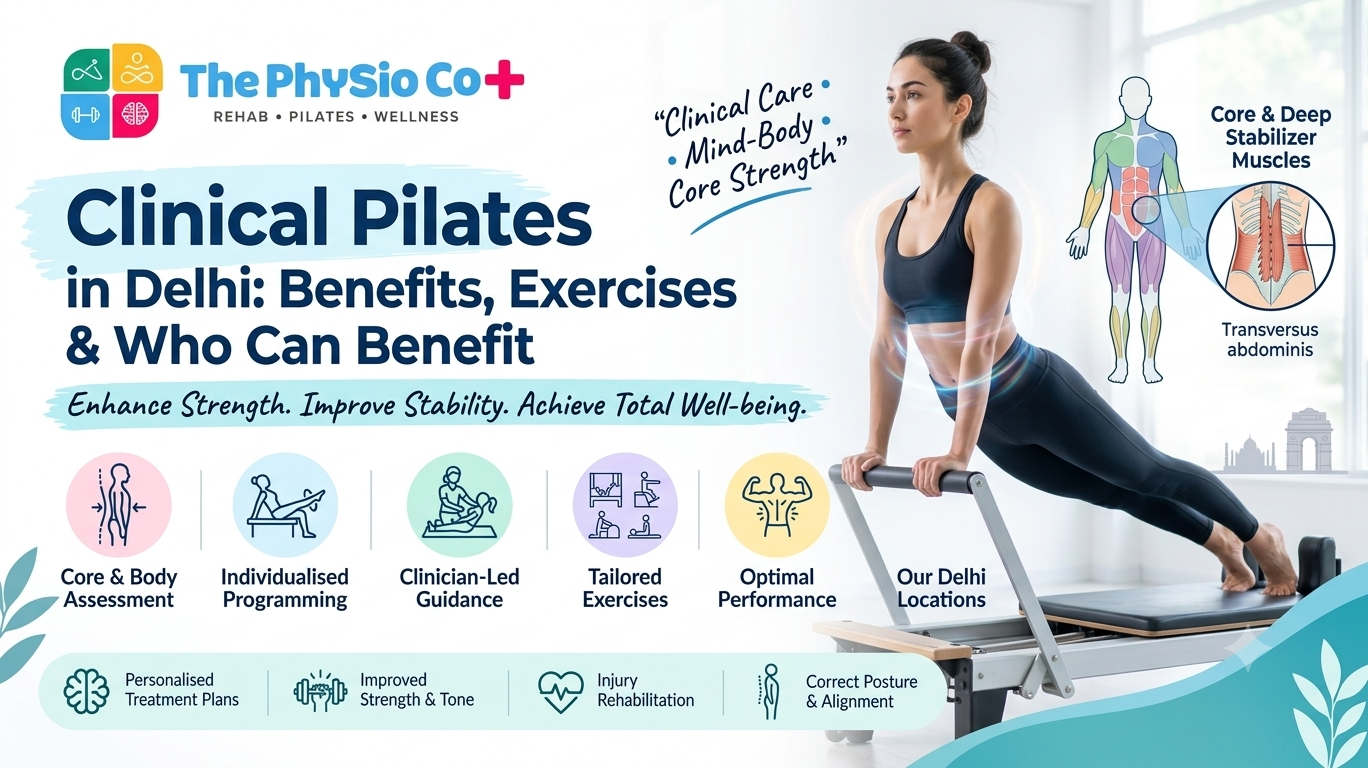
What Is a Pilates Reformer?
A Pilates reformer is a piece of exercise equipment that uses a moving carriage, springs and other components to provide adjustable resistance.
It can be used for:
- Lower-limb strengthening
- Core exercises
- Mobility
- Balance and coordination
- Upper-body strengthening
- Movement-control exercises
- Progressive conditioning
Because resistance can be adjusted, reformer exercises can be made easier or more challenging depending on the individual’s ability.
Clinical Pilates for Weight Loss: Does It Work?
Pilates can contribute to physical activity and muscular conditioning, but it should not be promoted as a standalone weight-loss treatment.
Changes in body weight and body composition depend on multiple factors, including:
- Overall physical activity
- Nutrition
- Energy intake
- Sleep
- Genetics
- Medical factors
If your primary goal is weight management, Clinical Pilates can be one component of a broader exercise and lifestyle programme.
Clinical Pilates for Posture
Clinical Pilates can include exercises that improve strength, movement control and awareness.
These may be useful for people who feel uncomfortable during prolonged sitting or who want to improve their ability to maintain different positions during daily activities.
However, there is no single “perfect posture.”
Good rehabilitation focuses on helping you develop the strength, mobility and capacity to change positions and tolerate activities, rather than trying to hold one rigid posture throughout the day.
Clinical Pilates for Pregnancy and Postnatal Rehabilitation
Pregnancy and the postnatal period involve significant physical changes.
Exercise programmes during this period should be appropriately modified according to the individual’s pregnancy stage, symptoms, fitness level and medical considerations.
Clinical Pilates may be incorporated into an appropriate exercise or rehabilitation programme for some women.
However, pregnancy-specific exercise should be individualised, particularly when there are complications or symptoms requiring medical assessment.
Can Clinical Pilates Replace Physiotherapy?
Not necessarily.
Clinical Pilates is an exercise-based component of physiotherapy and rehabilitation, not a replacement for assessment when assessment is required.
A physiotherapy appointment may include:
- Assessment
- Identification of contributing factors
- Education
- Hands-on treatment when appropriate
- Exercise therapy
- Clinical Pilates
- Home exercises
- Progression and reassessment
For someone with an injury or persistent pain, the most appropriate approach may involve several of these components.
How Is a Clinical Pilates Session Different?
A typical session may begin with an assessment or discussion of your current symptoms and goals.
Your physiotherapist may then select exercises based on:
- Current strength
- Mobility
- Pain
- Movement control
- Exercise experience
- Functional goals
Exercises are then progressed gradually.
For example:
Beginner → controlled movement → increased resistance → more complex movement → functional strengthening
The goal is to improve your physical capacity rather than simply complete a fixed list of Pilates exercises.
How Often Should You Do Clinical Pilates?
There is no universal frequency that applies to everyone.
Research on Pilates for low back pain has used different programmes, durations and frequencies. Some evidence suggests that programmes involving regular sessions over several weeks can be beneficial, but the appropriate frequency depends on the person’s goals and overall exercise programme.
For some people, supervised sessions may be combined with home exercise.
Your programme should be based on:
- Your goals
- Current fitness
- Symptoms
- Recovery
- Other physical activity
- Available time
Consistency is generally more important than simply doing more sessions.
Is Clinical Pilates Suitable for Everyone?
No exercise programme is suitable for absolutely everyone.
A physiotherapy assessment may be particularly useful if you have:
- Persistent pain
- Recent injury
- Significant weakness
- Dizziness or balance problems
- Recent surgery
- Pregnancy-related concerns
- Neurological symptoms
- Significant movement restrictions
- A medical condition affecting exercise tolerance
If you have unexplained severe pain, rapidly worsening neurological symptoms, chest pain, severe breathlessness or other urgent symptoms, you should seek appropriate medical evaluation rather than starting an exercise programme independently.
Clinical Pilates in Delhi: What Should You Look For?
If you are searching for Clinical Pilates in Delhi, consider whether the programme is actually individualised.
Useful questions to ask include:
- Is there an initial assessment?
- Are exercises modified according to my condition?
- Can the programme be progressed over time?
- Is the practitioner qualified to manage my specific condition?
- Can the programme incorporate rehabilitation if I have pain or an injury?
- Is the exercise programme based on my goals rather than a fixed routine?
The equipment itself is only one part of the programme.
The quality of assessment, exercise selection, supervision and progression matters.
Final Takeaway
Clinical Pilates can be a useful way to combine strength, mobility, movement control and progressive exercise in an individualized rehabilitation or fitness programme.
Research supports Pilates as an effective exercise option for improving pain and disability in many people with chronic low back pain. However, evidence does not show that Pilates is universally better than other forms of exercise.
The biggest benefit of Clinical Pilates is therefore not simply the exercises themselves.
It is the ability to adapt and progressively load exercises according to the person’s needs, capacity and goals.
Whether your goal is managing back pain, returning to exercise, improving strength, developing better movement control or building overall physical fitness, a physiotherapist can help determine whether Clinical Pilates is appropriate for you.
Frequently Asked Questions
What is Clinical Pilates?
Clinical Pilates is a physiotherapy-guided exercise approach that uses Pilates-based movements adapted to an individual’s symptoms, physical abilities and rehabilitation or fitness goals.
Is Clinical Pilates good for back pain?
Research suggests Pilates can improve pain and disability in people with chronic low back pain. However, it has not consistently been shown to be superior to other forms of exercise.
What is the difference between Pilates and Clinical Pilates?
Clinical Pilates is generally more individualized and may be incorporated into rehabilitation following an assessment. Regular Pilates classes are usually designed around general exercise and movement.
Can Clinical Pilates help with posture?
It can help improve strength, movement control and awareness, which may help with functional movement. However, there is no single “perfect posture” that everyone needs to maintain.
Can I do Clinical Pilates if I have back pain?
Many people with back pain can exercise safely, but the appropriate exercises depend on the cause and severity of the pain. An assessment may be appropriate if symptoms are persistent or significant.
Is Reformer Pilates the same as Clinical Pilates?
No. A reformer is a piece of Pilates equipment. Clinical Pilates refers more to the individualized, rehabilitation-focused approach. Clinical Pilates may or may not use a reformer.
How many Clinical Pilates sessions do I need?
There is no fixed number. The required duration and frequency depend on your goals, starting level, symptoms and progress.
Can Clinical Pilates help with weight loss?
Pilates can contribute to physical activity and muscular conditioning, but weight management generally requires a broader approach involving overall physical activity, nutrition and other lifestyle factors.
Is Clinical Pilates suitable for beginners?
Yes, exercises can be modified for beginners. The starting level should be based on the person’s strength, mobility, experience and goals.
References
- Yu Z, et al. Efficacy of Pilates on Pain, Functional Disorders and Quality of Life in Patients with Chronic Low Back Pain: A Systematic Review and Meta-Analysis. International Journal of Environmental Research and Public Health. 2023.
- Huang J, Park HY. Effect of Pilates training on pain and disability in patients with chronic low back pain: a systematic review and meta-analysis based on randomized controlled trials. Physical Activity and Nutrition. 2023.
- Wong CM, Rugg B, Geere JA. The effects of Pilates exercise in comparison to other forms of exercise on pain and disability in individuals with chronic non-specific low back pain: A systematic review with meta-analysis. Musculoskeletal Care. 2023.
- The Best Exercise Modality and Dose for Reducing Pain in Adults With Low Back Pain: A Systematic Review With Model-Based Bayesian Network Meta-analysis. Journal of Orthopaedic & Sports Physical Therapy. 2024.
- Effectiveness of Pilates exercise on low back pain: a systematic review with meta-analysis.
- Lim ECW, et al. Effects of Pilates-based exercises on pain and disability in individuals with persistent nonspecific low back pain: a systematic review with meta-analysis. JOSPT.
Medical note: This article is for general educational purposes and does not replace an individual assessment by a physiotherapist or other qualified healthcare professional.