

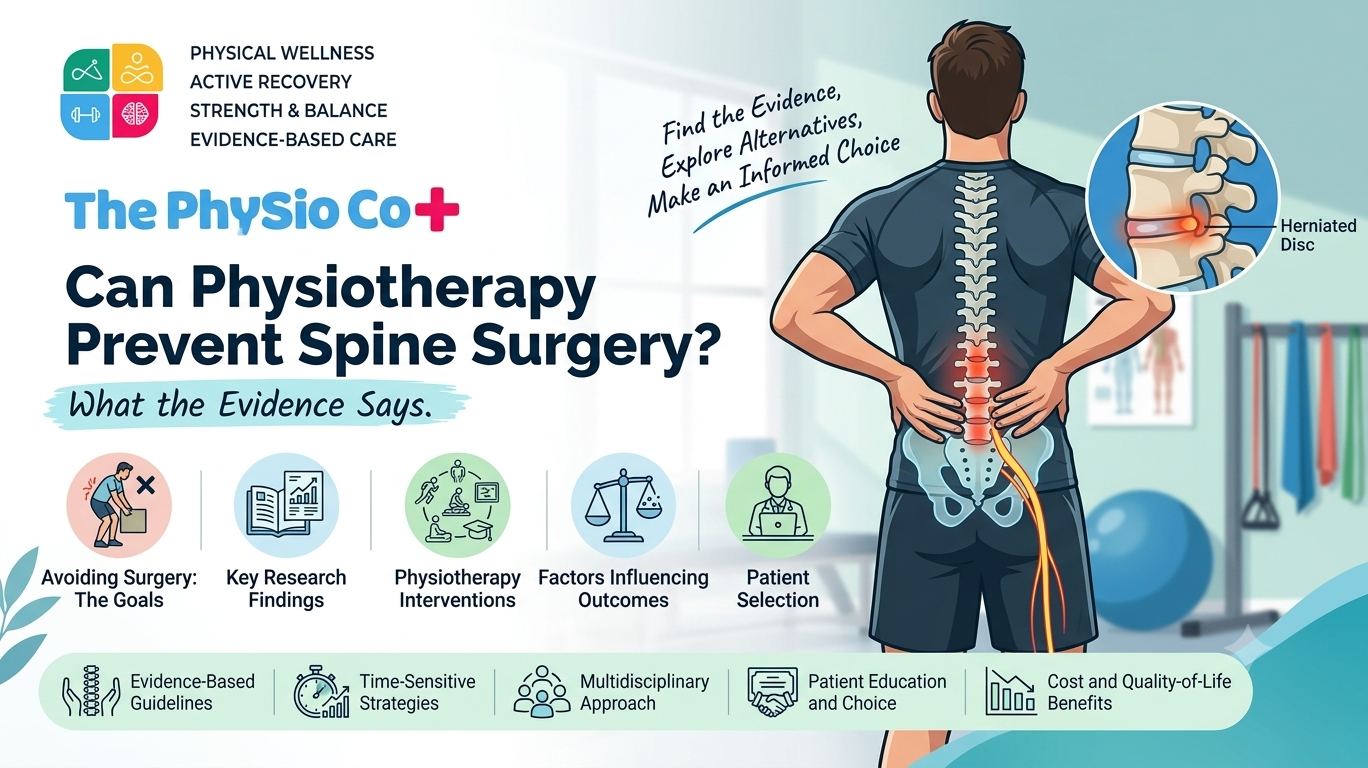

Can Physiotherapy Prevent Spine Surgery?
Back pain, sciatica, slipped discs and other spinal conditions can be frustrating—especially when surgery is mentioned as a possible treatment.
But does needing a spine operation always mean surgery is the only option?
Not necessarily. For many people with low back pain or certain lumbar disc problems, a structured non-surgical treatment plan that includes physiotherapy, exercise, education and gradual return to activity may improve pain and function and, in some cases, help avoid or delay surgery.
However, physiotherapy cannot guarantee that surgery will never be required. The right treatment depends on the diagnosis, severity of symptoms, neurological findings, duration of symptoms and response to conservative treatment.
What Does the Evidence Say About Physiotherapy and Spine Surgery?
Current evidence supports non-surgical management as an important part of care for many people with low back pain and some lumbar disc conditions.
The World Health Organization recommends non-surgical approaches for chronic primary low back pain, including education, exercise and selected physical therapies.
For lumbar disc herniation with nerve-related leg pain, a 2025 systematic review found that physiotherapy interventions showed beneficial effects on radicular leg pain in several studies, although the authors also highlighted that higher-quality research is still needed.
This means physiotherapy should not be viewed as a promise to “cure every disc problem without surgery.” Instead, it can be an important part of an evidence-based conservative treatment approach.
Can a Herniated Disc Improve Without Surgery?
Yes, in many cases.
One reason is that some lumbar disc herniations can naturally decrease in size over time. A 2023 meta-analysis involving 31 studies and 2,233 patients receiving conservative treatment reported an overall disc-resorption rate of approximately 70%. The rate was higher for extruded and sequestered discs than for protrusions and bulges.
Importantly, a disc looking better on an MRI is not the same thing as a person becoming pain-free. Symptoms and function need to be assessed alongside imaging.
Physiotherapy can help during this period by addressing pain, movement limitations, strength, physical activity and confidence with movement.
What Can Physiotherapy Actually Do?
A physiotherapist does not “push a slipped disc back into place.”
Instead, treatment may focus on improving how you move and function while allowing the irritated tissues and nervous system time to recover.
Depending on the diagnosis and assessment, a physiotherapy programme may include:
1. Exercise Therapy
Specific exercises can help improve:
- Spinal and hip mobility
- Core and trunk endurance
- General strength
- Functional capacity
- Tolerance to everyday activities
- Confidence with movement
A 2025 systematic review of exercise interventions for lumbar disc herniation found evidence supporting exercise as part of conservative management, although the researchers noted variation between studies and the need for more high-quality research.
2. Gradual Return to Activity
Avoiding all movement for long periods is generally not the goal.
Physiotherapy can help you gradually return to activities such as:
- Walking
- Sitting
- Bending
- Lifting
- Working
- Exercise and sports
The exact progression should depend on the individual’s symptoms and clinical findings.
3. Pain and Symptom Management
Treatment may include education and selected hands-on techniques alongside exercise when appropriate.
The goal is not simply to reduce pain temporarily but to help the person become more capable and independent.
4. Strength and Conditioning
Weakness or reduced physical capacity can make normal activities more difficult.
A progressive strengthening programme can target the trunk, hips and other areas relevant to the individual’s movement and functional goals.
5. Education
Understanding your condition can be an important part of recovery.
A physiotherapist can explain:
- What your diagnosis means
- What movements are appropriate
- How to modify activities temporarily
- How to progressively return to normal activity
- Which symptoms require medical review
This can help prevent fear-driven avoidance of normal movement.
Does Physiotherapy Actually Reduce the Need for Surgery?
This is where the evidence needs to be interpreted carefully.
There is evidence that some patients improve with conservative care and do not ultimately require surgery.
For example, a randomized controlled trial of people with sciatica caused by lumbar disc herniation compared early surgery with an intended six months of conservative treatment. In the conservative-treatment group, 44% eventually underwent surgery, meaning more than half did not undergo surgery during the two-year study period. Disability outcomes were not significantly different overall, although early surgery resulted in faster improvement in leg pain.
This is an important distinction:
Conservative treatment can allow some patients to recover without surgery, but it does not mean physiotherapy prevents surgery in every patient.
Another large SPORT study followed people with imaging-confirmed lumbar disc herniation. Both surgical and non-operative groups experienced substantial improvement, although patients who underwent surgery had greater improvement in some outcomes in longer-term analyses.
Therefore, surgery and physiotherapy should not always be viewed as competing treatments.
The appropriate approach depends on the individual patient.
When Might Surgery Still Be Necessary?
Physiotherapy is not appropriate as a substitute for urgent medical or surgical assessment when serious neurological problems are present.
For example, urgent medical evaluation is particularly important when someone develops symptoms such as:
- New or worsening significant muscle weakness
- Loss of bladder or bowel control
- Numbness around the genital or saddle region
- Severe or rapidly worsening neurological symptoms
These symptoms can indicate serious nerve compression and require urgent medical assessment.
For less urgent cases, surgery may be considered when symptoms remain significantly disabling despite an appropriate period of non-surgical management.
The NICE guideline recommends considering spinal decompression for people with sciatica when non-surgical treatment has not improved pain or function and the radiological findings are consistent with the sciatic symptoms.
This highlights an important point:
An MRI abnormality alone does not automatically mean that surgery is required.
The scan needs to be interpreted alongside symptoms, clinical examination and functional limitations.
Physiotherapy vs Spine Surgery: Are They Opposites?
Not necessarily.
Think of them as different parts of a clinical decision-making process.
| Physiotherapy / Conservative Care | Surgery |
|---|---|
| Usually focuses on non-surgical management | Addresses selected structural problems surgically |
| Exercise and rehabilitation are central | Procedure depends on the diagnosis |
| Can improve strength and function | May provide faster symptom relief in selected cases |
| May allow some patients to avoid surgery | May be appropriate when conservative care fails |
| Requires active participation | Requires medical/surgical assessment |
| Not suitable for every spinal condition | Not necessary for every spinal condition |
The aim should not be “never have surgery.”
The aim should be:
Use the least invasive appropriate treatment while recognising when surgery or specialist assessment is necessary.
What About Slip Disc or Sciatica?
This is one of the situations where patients commonly ask whether physiotherapy can prevent surgery.
For lumbar disc herniation with sciatica, conservative treatment can include:
- Education
- Activity modification
- Exercise therapy
- Progressive strengthening
- Mobility exercises
- Functional rehabilitation
- Selected manual therapy
- Neural mobilisation when clinically appropriate
A 2025 systematic review and meta-analysis found that exercise, manipulation and traction-based physiotherapy approaches may reduce pain and disability in people with lumbar disc herniation, but the studies were highly heterogeneous, meaning the results should not be interpreted as evidence that one specific physiotherapy technique works for everyone.
Does Physiotherapy Help After Spine Surgery Too?
Yes.
Physiotherapy isn’t only relevant when trying to avoid surgery.
It can also be an important part of rehabilitation after procedures such as lumbar disc surgery.
A 2025 evidence synthesis of 55 randomized controlled trials involving 4,311 patients found that physical therapy after lumbar disc herniation surgery was associated with improvements in pain, function and quality of life.
Another 2025 systematic review and meta-analysis found that exercise following lumbar disc herniation surgery reduced pain and short-term disability and improved several quality-of-life outcomes.
So physiotherapy can have a role before and after surgery.
So, Can Physiotherapy Prevent Spine Surgery?
The evidence-based answer is: sometimes, but not always.
Physiotherapy may help some people improve enough that surgery is no longer necessary. This is particularly relevant for many cases of non-specific low back pain and selected cases of lumbar disc-related symptoms.
However, there is no physiotherapy treatment that can guarantee prevention of spine surgery.
Some patients have persistent or progressive neurological symptoms, severe functional limitations or structural problems where surgical treatment may be appropriate.
The decision should therefore be based on:
Diagnosis + symptoms + neurological examination + imaging when appropriate + response to conservative treatment + individual goals.
When Should You See a Physiotherapist?
Consider an assessment if you have:
- Persistent low back pain
- Recurrent back pain
- Sciatica
- Pain travelling into the leg
- Difficulty sitting or standing
- Pain while bending or lifting
- Reduced activity because of back pain
- Recovery problems after spine surgery
- A diagnosis of lumbar disc herniation and have been advised to try conservative treatment
A physiotherapist can assess your movement, strength, function and symptoms and determine whether physiotherapy is appropriate—or whether you should first be referred for further medical assessment.
Final Takeaway
Physiotherapy cannot promise to prevent spine surgery, but evidence supports conservative rehabilitation as an important treatment option for many people with low back pain and selected lumbar disc conditions.
For some patients, symptoms improve with time, exercise, education and progressive rehabilitation, allowing them to continue without surgery. For others, particularly those with persistent disabling symptoms or significant neurological problems, surgery may become appropriate.
The goal isn’t simply to avoid surgery at all costs.
The goal is to choose the safest and most appropriate treatment based on the individual’s condition.
If you are experiencing persistent back pain, sciatica or a diagnosed disc problem, an individual assessment can help determine whether physiotherapy is appropriate for you.
Frequently Asked Questions
Can physiotherapy cure a slipped disc?
Physiotherapy can help manage symptoms and improve function in people with lumbar disc herniation, but it cannot guarantee that the disc itself will completely return to normal.
Can physiotherapy prevent spine surgery?
In some patients, symptoms improve with conservative treatment and surgery may not be required. However, physiotherapy cannot guarantee prevention of surgery.
How long should I try physiotherapy before considering surgery?
There is no single timeframe that applies to everyone. It depends on the diagnosis, severity of symptoms, neurological findings and response to treatment. Some people require earlier specialist assessment.
Is surgery always necessary for a slipped disc?
No. Many people with lumbar disc herniation improve with non-surgical care. However, surgery can be appropriate for selected patients.
Can physiotherapy help sciatica?
Yes. Physiotherapy can be part of conservative management for sciatica, particularly when treatment is tailored to the individual’s symptoms and functional limitations.
Can physiotherapy help after spine surgery?
Yes. Rehabilitation after lumbar disc surgery can help improve pain, function and quality of life.
References
- World Health Organization. WHO guideline for non-surgical management of chronic primary low back pain in adults in primary and community care settings. 2023.
- National Institute for Health and Care Excellence (NICE). Low back pain and sciatica in over 16s: assessment and management (NG59).
- Thavarajasingam SG, et al. Exercise, manipulation and traction physiotherapy in the conservative management of lumbar disc herniation: A systematic review and meta-analysis. Brain Spine. 2025.
- Prognostic factors for treatment success of conservative management and role for physiotherapy in radicular pain caused by a lumbar disc herniation: a systematic review. Brain Spine. 2025.
- Peul WC, et al. Prolonged conservative care versus early surgery in patients with sciatica caused by lumbar disc herniation. BMJ.
- Weinstein JN, et al. Surgical versus nonoperative treatment for lumbar disc herniation: eight-year results for the Spine Patient Outcomes Research Trial. Spine.
- Incidence of Spontaneous Resorption of Lumbar Disk Herniation: A Meta-analysis. Spine. 2023.
Medical note: This article is for general education and does not replace an individual assessment by a physiotherapist, orthopaedic specialist or neurosurgeon.